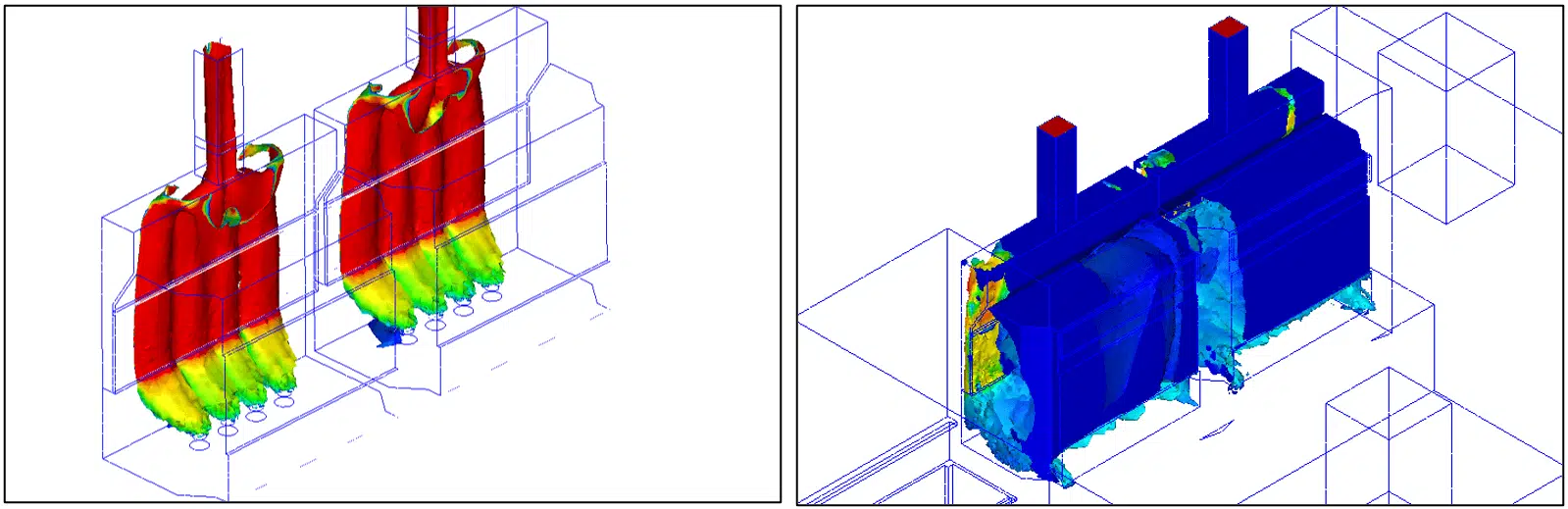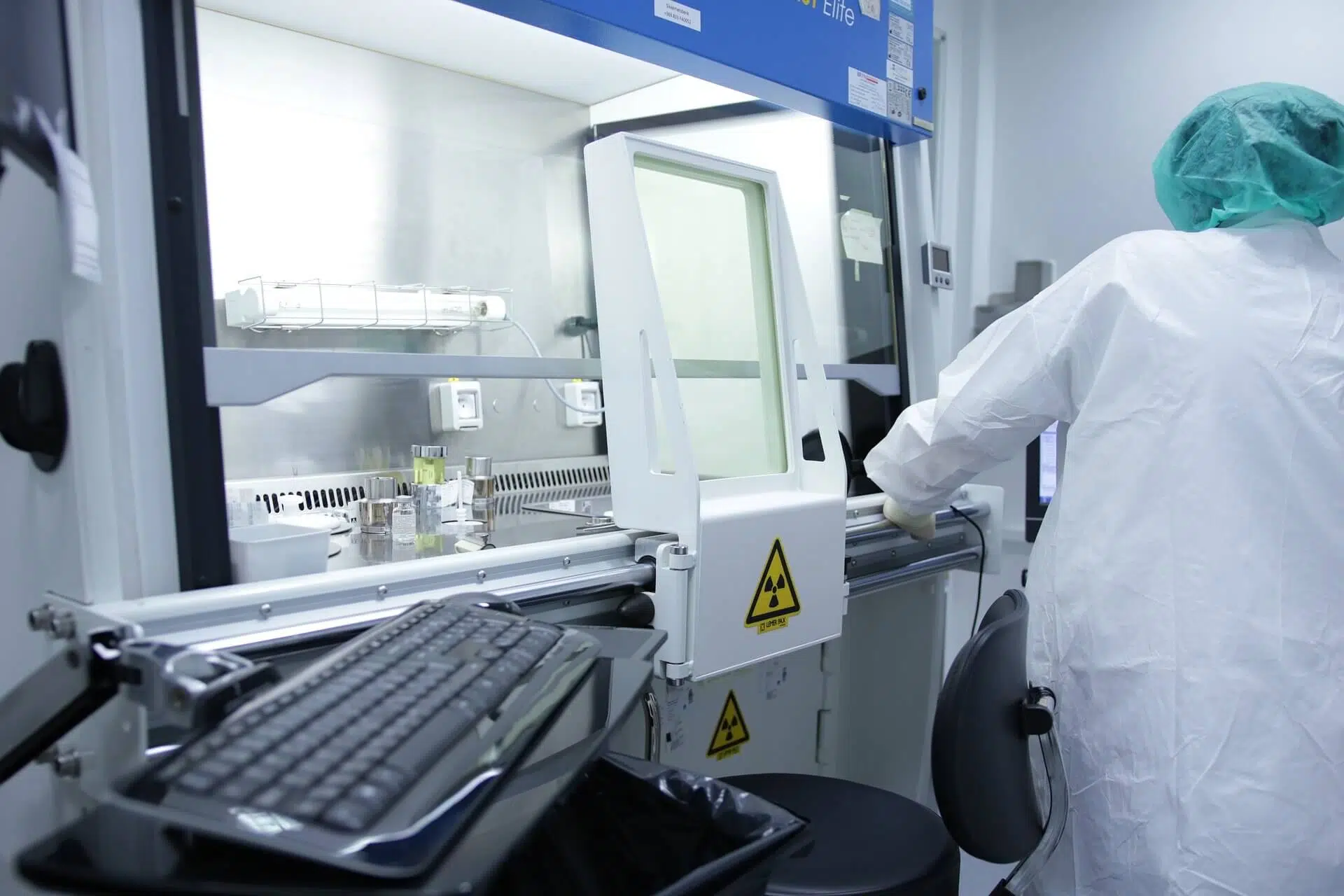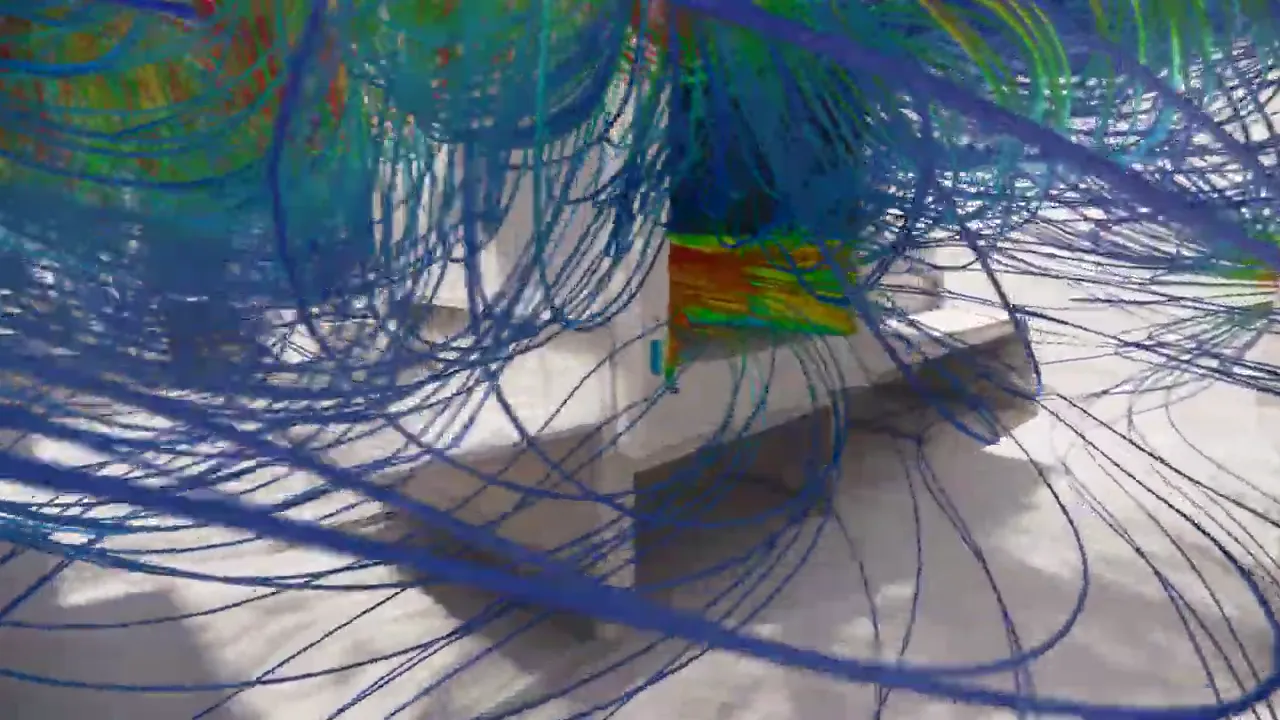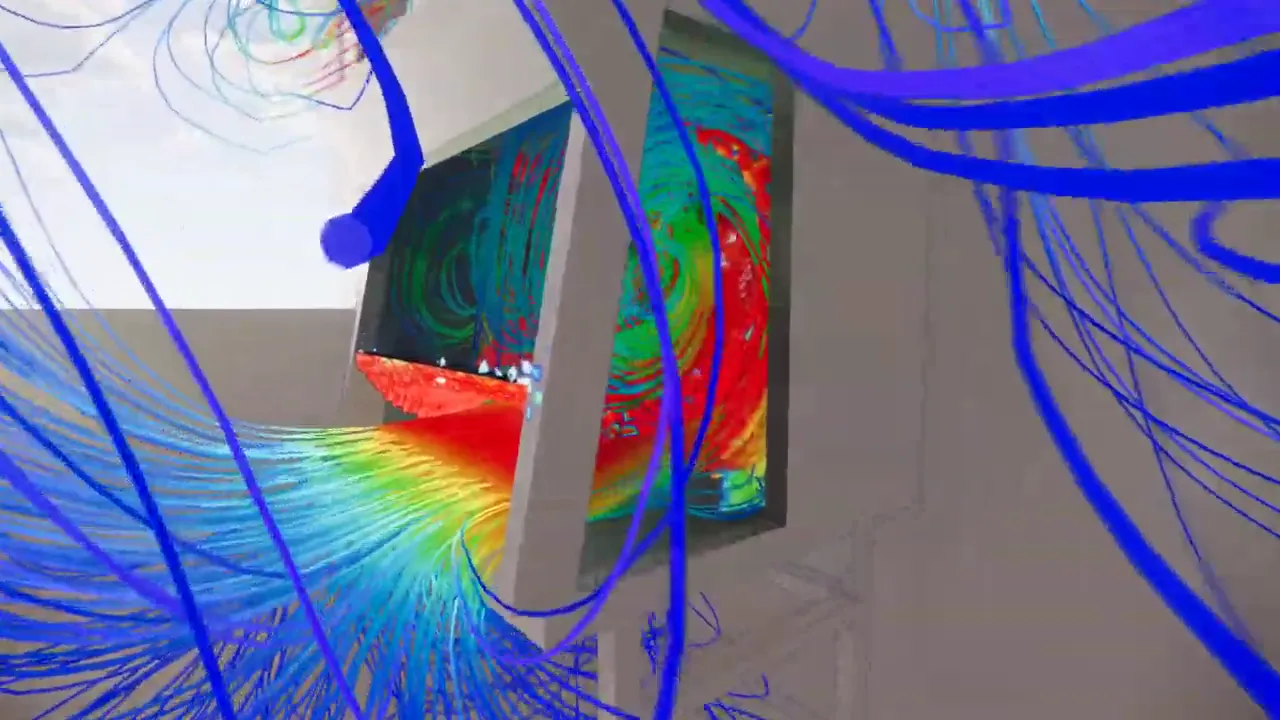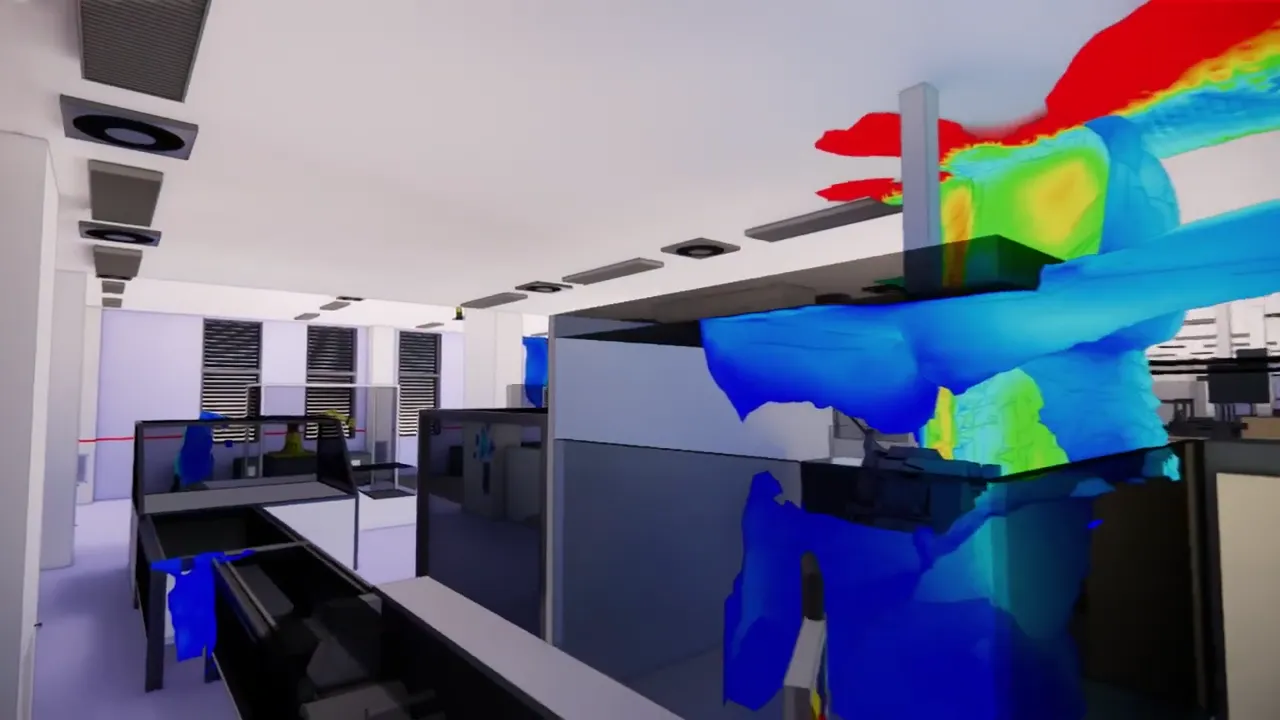
Simulation of two laboratory fume cupboards with operators present: we follow the room airflows reaching the fume cupboards, the velocities at the openings and the distribution of air around the workstations.
Updated on 25 November 2026
Two minutes forty to see what an on-site test only partly shows: the room airflows reaching the fume cupboards, the air velocities in their openings and the effect of the operators' presence. Numerical qualification secures compliance with standards and the design.
Click a passage to play it in the player.
This video is taken from a numerical qualification of laboratory fume cupboards. A fume cupboard protects the operator by capturing the vapours and dust produced inside its enclosure, thanks to an extraction flow. The simulation reproduces the laboratory, two fume cupboards and their operators.
In the first part, coloured volumes cross the room towards the fume cupboards: they represent the airflows reaching the openings, which can disturb containment. Next come the air velocities at the openings, with the operator in position, then an overall view of the airflows in the laboratory.
Laboratory fume cupboards undergo standardised tests under the European standard EN 14175: face velocity, tracer gas containment, smoke flow visualisation. EOLIOS carries out pre-qualifications from the design stage, as well as containment tests.
The velocity of the air drawn in through the fume cupboard opening. It must be sufficient to keep pollutants inside the enclosure, without creating turbulence that would push them back out towards the operator.
Numerical qualification reproduces these tests by CFD simulation: it calculates air velocities and the dispersion of a tracer at every point in the volume, whereas an on-site test only provides a few measurement points.
View the full study: CFD qualification of laboratory fume cupboardsThe video shows the airflows on which qualification relies: room airflow, velocities in the openings, effect of the operators. Together with the tracer containment analysis, they make it possible to check compliance with standards and to act on the design before handover, as detailed in the full study.
View the study results: CFD qualification of laboratory fume cupboardsThe video, the airflows around the fume cupboards and the link with the qualification.
A CFD simulation of two laboratory fume cupboards with operators present. It shows the room airflows reaching the fume cupboards, the air velocities in front of and within the openings, then the distribution of airflows around the workstations.
A draught reaching the opening from the front or the side can disturb extraction and push pollutants back out towards the operator. The simulation shows where these airflows come from and how they interact with the fume cupboard.
The operator's body, in front of the opening, changes the flow of air entering the fume cupboard. Representing it makes it possible to assess protection under real conditions of use.
On the planes, they represent air velocity: from blue for calm areas to red for the highest velocities, particularly in the fume cupboard openings.
The numerical qualification method, tracer containment and validation are detailed in the full fume cupboard qualification study.
Explore our expertise, projects and technical papers to go further than the FAQ.
CFD expertise, delivered projects and technical dossiers: the whole Laboratories field in one place.
The simplest thing is to talk it through together. Our engineers reply with an initial technical read.