The importance of the airflow audit in laboratories and controlled environments
Guaranteeing the performance of a cleanroom is not just about installing ventilation: you have to understand how the air really circulates and how it affects particle cleanliness and process safety.
An on-site airflow audit measures the airflows, the pressures and the air quality, in order to detect contamination risks, anticipate malfunctions and optimise the installations.
Visualise
- Airflows with neutral smoke
- Anemometric & thermal measurements
Check
- Contamination tests & particle tracking
- Air quality & filter effectiveness
Optimise
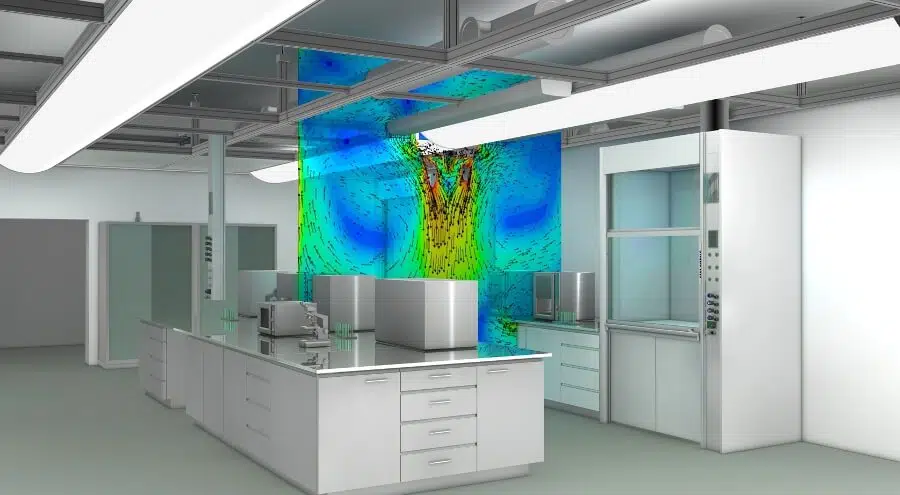
- Consistency of measurements / CFD simulation
- Concrete optimisation recommendations
EOLIOS helps laboratories and controlled environments master their airflows thanks to its expertise in fluid mechanics and advanced airflow auditing.
Objectives of a cleanroom airflow audit
Studying the airflows and contamination risks
The airflow audit offers a complete, objective view of the performance of a cleanroom, highlighting the stagnation zones, the unwanted recirculations or the inconsistent flows compared to the design. This information makes it possible to detect the sensitive points to reduce contamination risks, but also to check the stability of the pressure gradients between clean and less-clean zones, and to identify the turbulence zones that disturb the laminar flows.

The field measurements also serve as a reference to check the consistency with the CFD simulation models and identify the complex zones requiring particular attention. Finally, the collected data facilitate decision-making and the planning of corrective actions, offering concrete added value for the performance, safety and reliability of the cleanroom.
How a cleanroom audit unfolds
General approach of an airflow audit
The airflow audit combines a rigorous visual inspection, precise on-site measurements and targeted contamination tests to offer a complete, reliable view of the real behaviour of the cleanroom. This approach compares the theoretical design to the operational conditions, identifies the at-risk zones and explains how the air circulates throughout the space. By simultaneously analysing several aspects of operation, the audit provides objective, measurable information on the performance of the installations, the stability of the flows and the control of air cleanliness — a solid basis to guide optimisation decisions and ensure the safety of sensitive processes.
Inspection of the installations and assessment of the airflows
Equipment, supplies, returns, doors, airlocks and containment devices are checked to ensure their proper operation and tightness. Particular attention is paid to the continuity of the laminar flows and to the zones at risk of cross-contamination.
Airflow and thermal measurements
To get an overall view of the air behaviour, smoke machines using non-toxic glycol water are used. The neutral smoke makes it possible to visualise the main flow trajectories, the turbulence zones and the recirculations: an immediate large-scale understanding that highlights the sensitive zones and guides the detailed measurements. To complement this visualisation, precision anemometers record the velocities and air flow rates at various strategic points, quantify the flow behaviour, detect the stagnation or recirculation zones and assess the effectiveness of the supplies and returns — providing a precise map that complements the macroscopic observation of the smoke.
Finally, the temperature of the air and surfaces is analysed using thermal cameras and probes, in order to spot the thermal gradients likely to influence the flows and cause unexpected air movements. This information is essential to understand how temperature variation impacts particle dispersion and room cleanliness, and serves as a reference to validate or refine the simulation models.
Smoke test and particle tracing
To check that the airflows and containment systems work correctly, contamination-tracing tests are carried out: particles or neutral smoke are generated at a precise point in the room, or even directly inside a machine, to observe their spread. This test highlights the zones where the flows or containment devices are insufficient, confirms the effectiveness of the systems, detects unexpected propagation paths and provides valuable field feedback to validate the flows and the simulation models. The audit thus links the flow dynamics to the dispersion of particles. All these tests and measurements are essential to:
- verify the effectiveness of the containment systems;
- detect the propagation paths;
- prioritise the corrective actions to limit contamination;
- provide essential field feedback to validate the flows and refine any CFD study.
Identifying the critical zones in a cleanroom
In a cleanroom, not all zones present the same risk for air cleanliness and product safety. Identifying and mapping the critical zones is essential to guide the measurements and optimise the effectiveness of the airflow systems. These zones are studied during the audit using both instruments (anemometers, thermal cameras, particle counters) and visualisation tests (neutral smoke, particle tracers).
“Dead” or poorly ventilated spaces
Peripheral zones or those behind obstacles, little swept by the air: points of particle accumulation and silent contamination. The audit proposes flow readjustments or targeted interventions (diffusers, furniture).
Flow-convergence zones
When several flows meet, turbulence and recirculations favour stagnation or uncontrolled dispersion. The audit assesses the consistency of the flows and proposes corrections (repositioning of diffusers, supply nozzles).
Workstations & sensitive surfaces
Production, assembly, packaging, analyses: any turbulent flow or stagnation can deposit particles on the products. The uniformity of the laminar flow above the stations and the air trajectories are checked.
Hoods & isolators
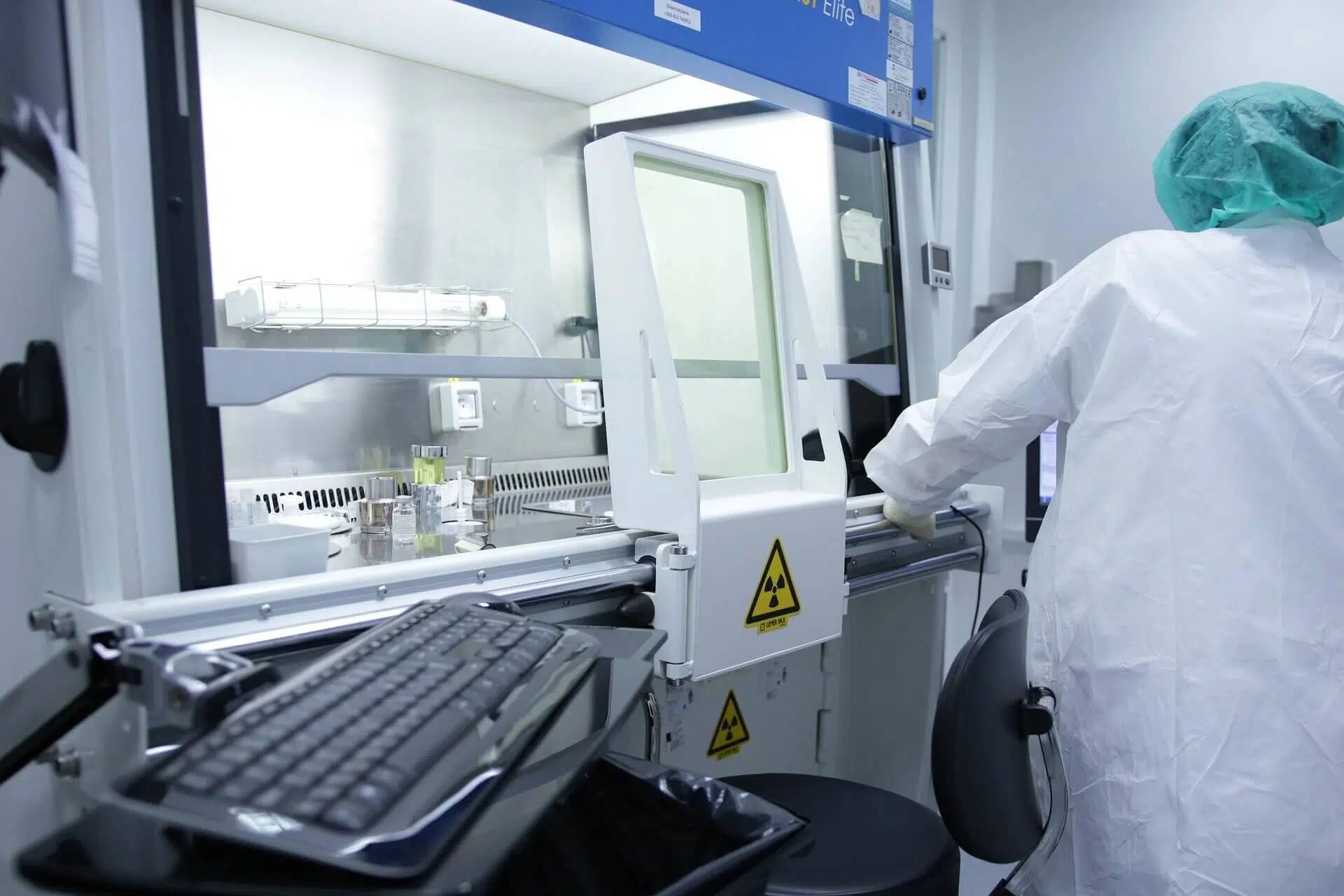
These local containments protect the product and/or the operator. The audit checks that the incoming and outgoing flows follow the intended trajectories, that nothing escapes and that the air is correctly renewed — including the hood/room junctions.
Airlocks & transition zones
Airlocks, fast doors and passages between rooms of differing cleanliness: a major risk of cross-contamination. The openings cause pressure disturbances; the audit ensures that the differentials maintain the desired flow.
Bulky or hot equipment
Fans, ovens, production lines and automated machines create micro-turbulence and disturb the laminar flows. Flow rates and temperatures are measured around these obstacles to detect the undesirable effects.
Intensive traffic points
Aisles, corridors and zones of frequent staff movement: the constant motion generates aerodynamic disturbances and spreads particles. The audit assesses the impact and proposes adjustments (airlocks, barriers, training).
Carrying out your airflow audit with EOLIOS
A cleanroom airflow audit is not limited to noting deviations: it makes it possible to understand in depth the real operation of your installations, identify the critical points and propose concrete corrective actions. This approach directly contributes to the reliability of your processes and the safety of your sensitive environments.
Our experts work on site to carry out precise measurements, analyse your flows and support you in optimising your cleanrooms. Depending on your needs, the audit can be complemented by a CFD study, in order to simulate different scenarios and anticipate the future performance of your installations.