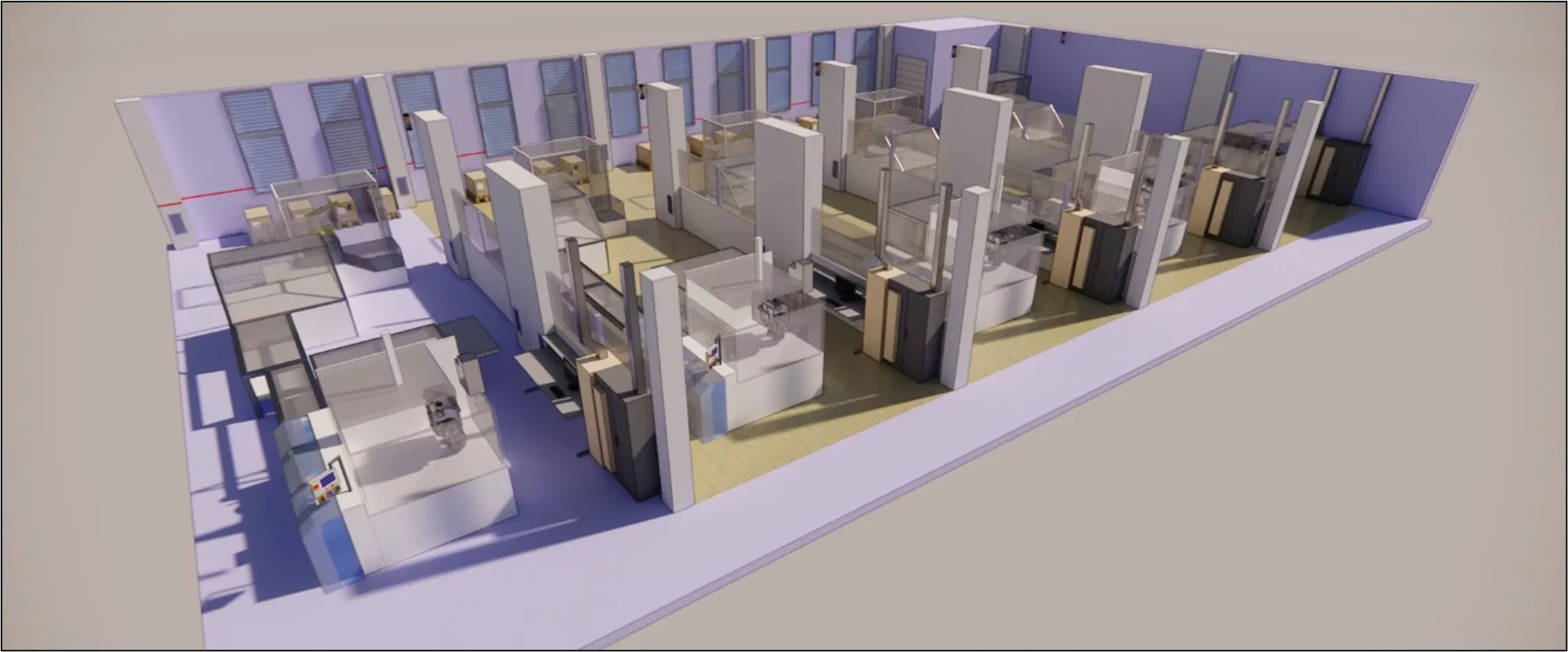
EOLIOS analysed through audit and CFD simulation the airflows and particle dispersion of a multi-line pharmaceutical production building, and compared three configurations to eliminate the cross-contamination risk.
EOLIOS Engineering was called upon to analyse the airflows and the particle dispersion within a production laboratory. Through an on-site audit and several CFD simulations, our engineers characterised the air movements, identified the sensitive zones, understood the cross-contamination mechanisms between lines and proposed concrete solutions.
The essentials. In a pharmaceutical building where five production lines run in parallel without partitioning, EOLIOS characterised through audit (smoke + thermal camera) and CFD the dispersion of the bagging dust. Three configurations were compared; the chosen solution combines compartmentalisation and vertical supply to remove the recirculations and the cross-contamination risk.
In a cleanroom, the air is never neutral: it carries, dilutes or concentrates the fine particles from the processes, the operators or the equipment. The slightest supply defect, an unexpected recirculation or a localised turbulence can lead to a dispersion of dust towards sensitive zones. Understanding how the air actually circulates is therefore essential, particularly in pharmaceuticals where the product quality depends directly on the airflow stability.
Cross-contamination is the involuntary transfer of particles from one zone or production line to another, here through the air. In pharmaceuticals it compromises product quality; controlling it means controlling the airflows and the partitioning.
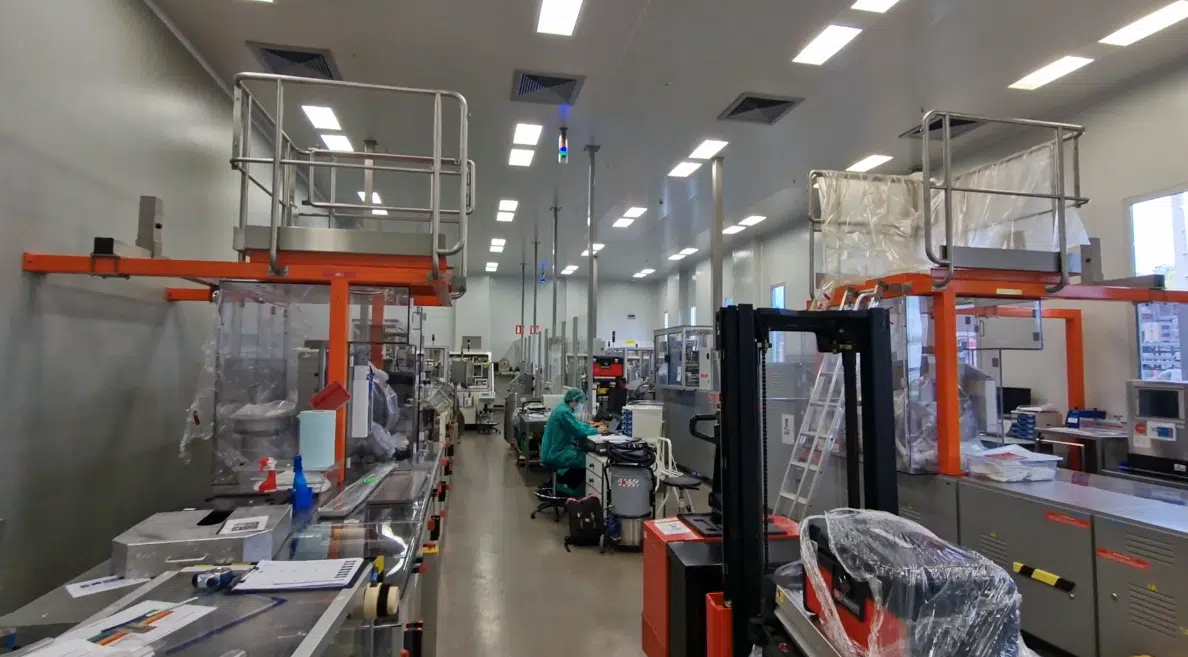
In this laboratory, five production lines operate in parallel. At each cycle, the bagging machines release a small amount of product into the air at the moment of sealing — a normal phenomenon, but problematic when the environment is not compartmentalised. As the lines are not physically isolated, the air circulates freely above the workstations, promoting the dispersion of dust from one line to another and creating a cross-contamination risk.
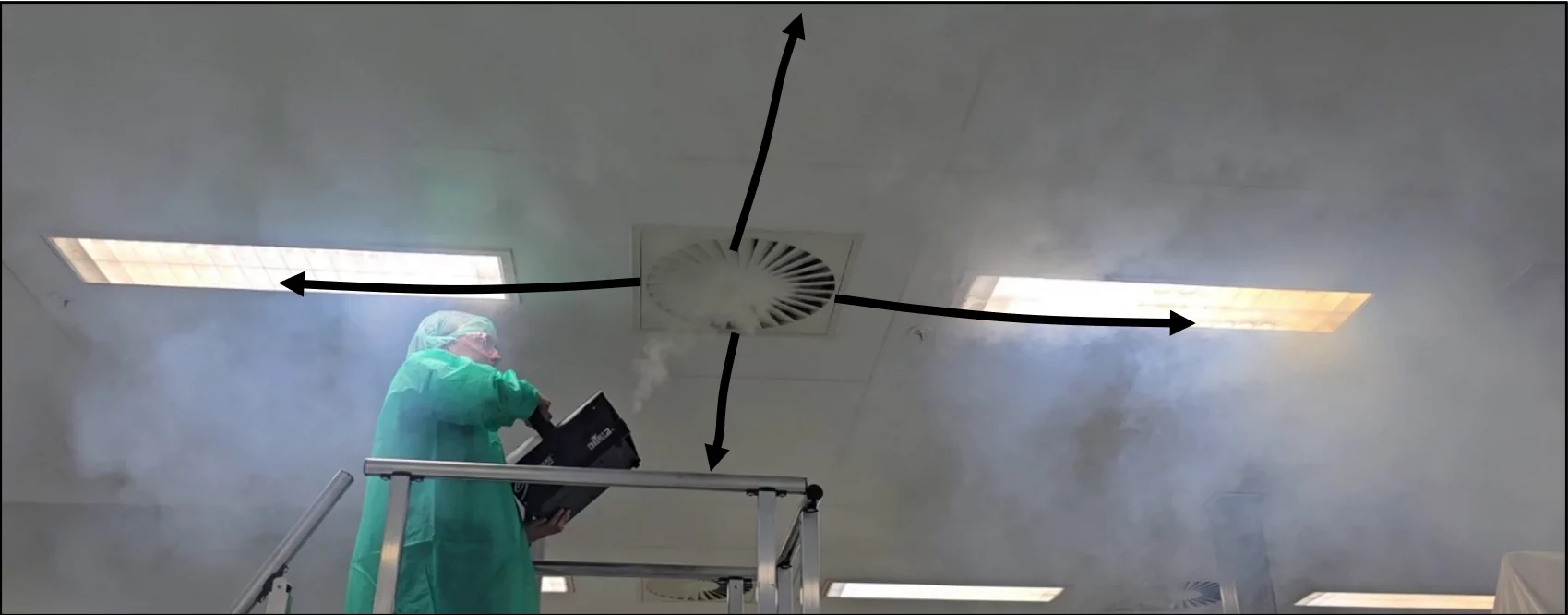
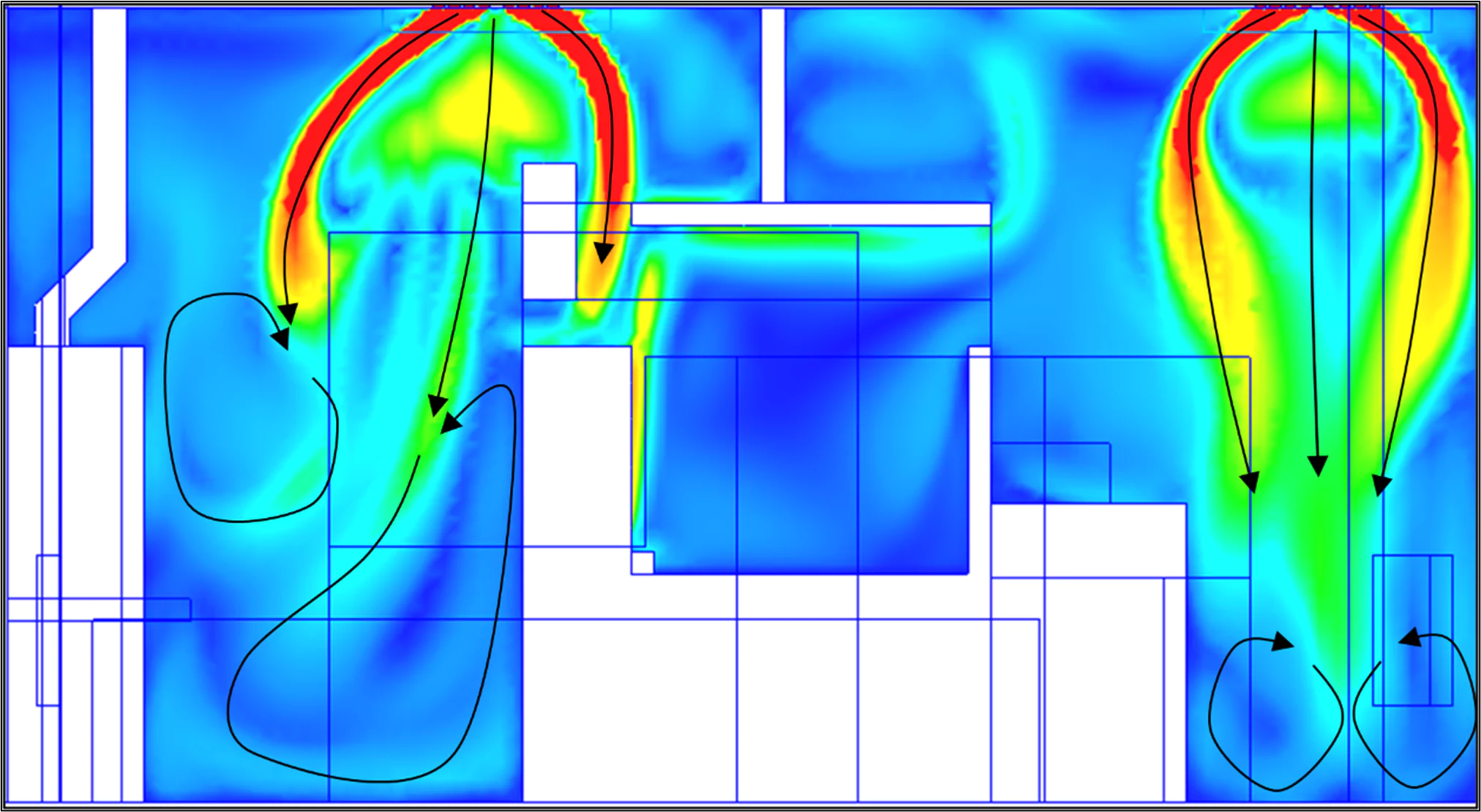
A first audit phase made it possible to identify the behaviour of the air through smoke tests. These tests revealed that the swirl grilles blow the air parallel to the ceiling, and not vertically — creating recirculation zones that allow the low-altitude particles to rise then be diffused. The flow runs along the ceiling, passes above the central partitions (open at the top) and the particles spread into the circulation corridor, a source of potential contamination.
The smoke test injects a neutral smoke to make the real flows visible: supply direction, recirculations, crossing of the partitions. It reveals here that the swirl grilles blow along the ceiling instead of descending towards the extracts.
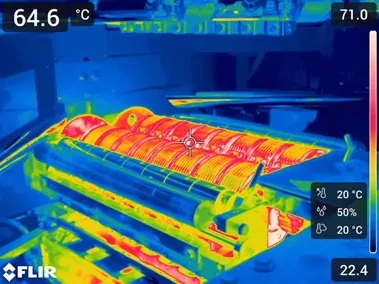
A thermal study is essential, as the hot spots can significantly alter the local airflow. The thermal camera highlights heating elements linked to the sealing of the bags rising up to 65 °C, likely to locally disturb the flows and create ascending zones. These measurements fed the CFD modelling.
A swirl diffuser mixes the air in a sheet along the ceiling, which promotes recirculations; a square vertical-supply diffuser pushes the air straight down towards the floor and the low extracts. The latter limits the re-suspension of particles.
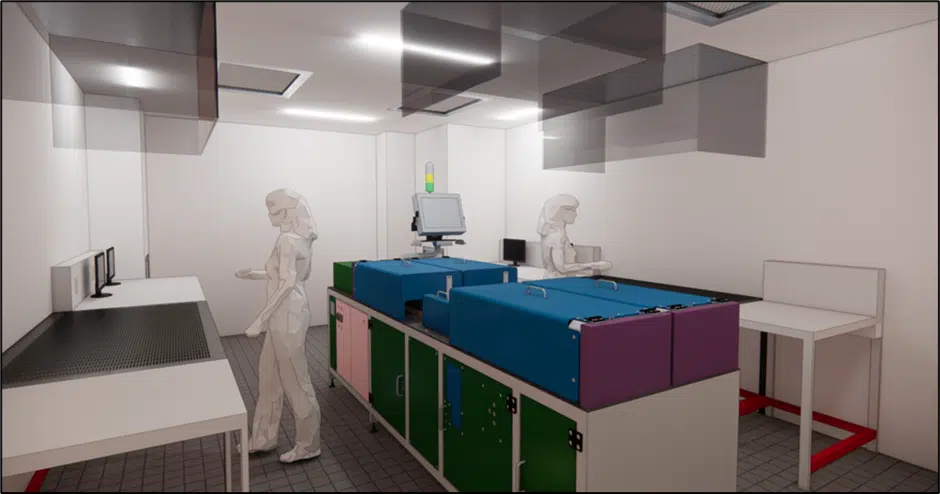
A complete 3D model of the room was produced from the audit measurements, the site plans and the technical documentation of the equipment. Three scenarios were studied: the existing configuration, the addition of partitions, then an optimised configuration with modification of the diffusers.
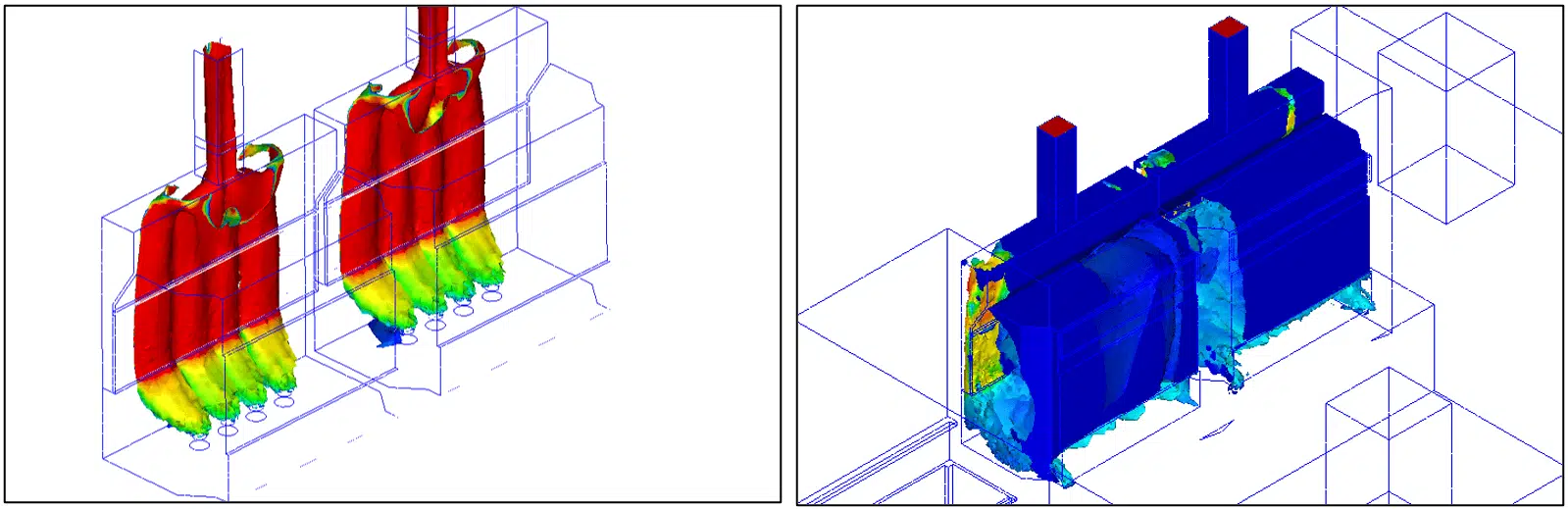
Reference simulation, used to check the consistency of the model with the measurements. It confirms the audit findings: the swirl diffusers generate recirculations that make the particles rise, diffused through the opening above the central partitions; some take the corridor to contaminate the adjacent line.
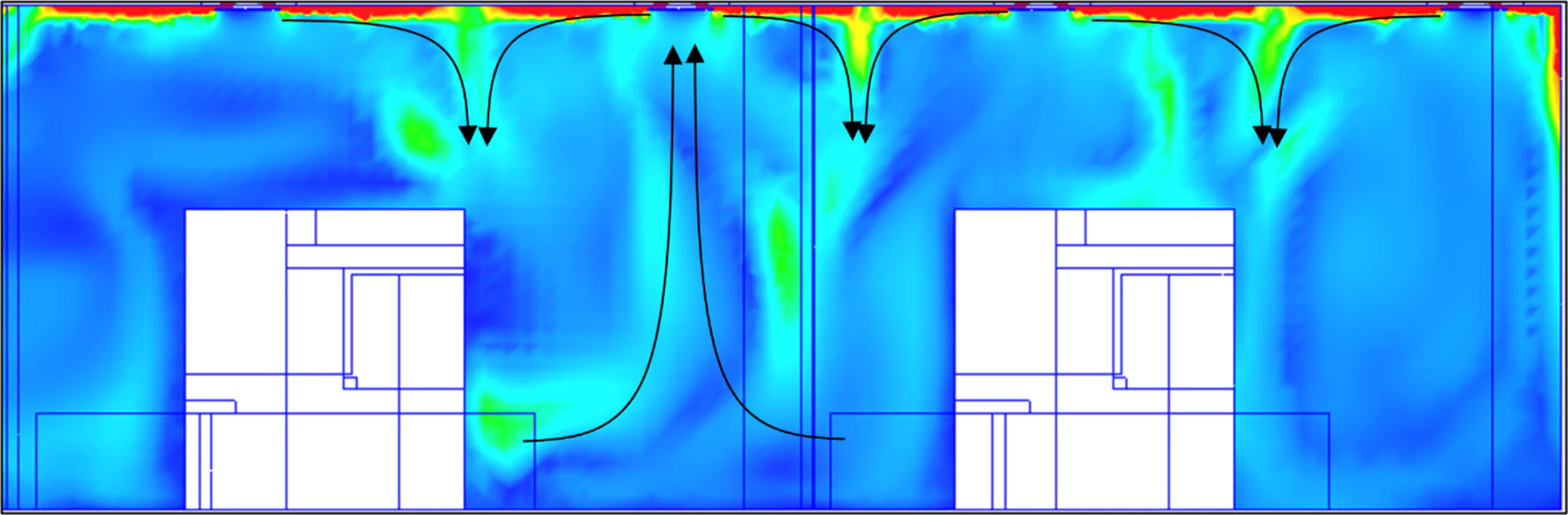
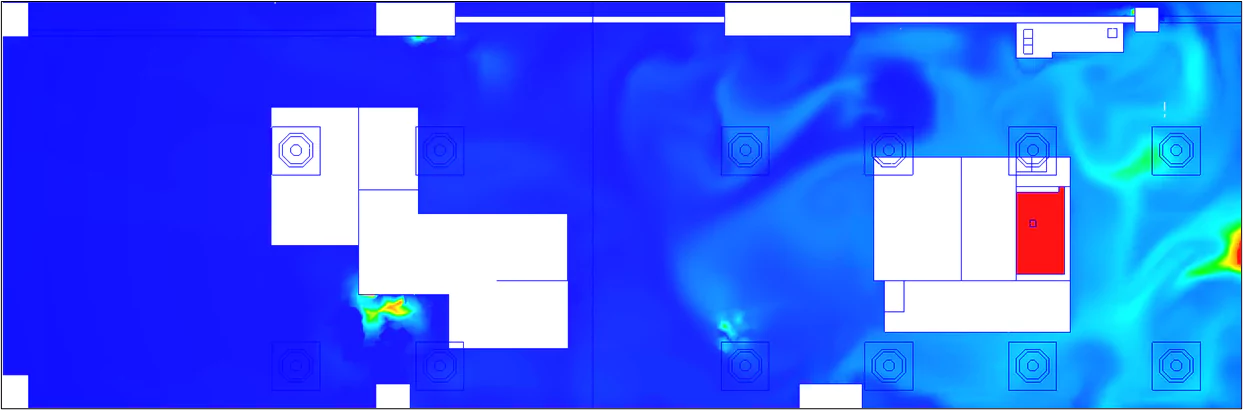
As the transmission mainly occurs above the central partitions and through the corridor, it was proposed to partition these spaces. The closure clearly improves the containment between lines, but the recirculations of the horizontal diffusers persist: the bagging zone becomes highly concentrated in particles — without diffusion towards the neighbouring lines, but with an increased risk for the operators.
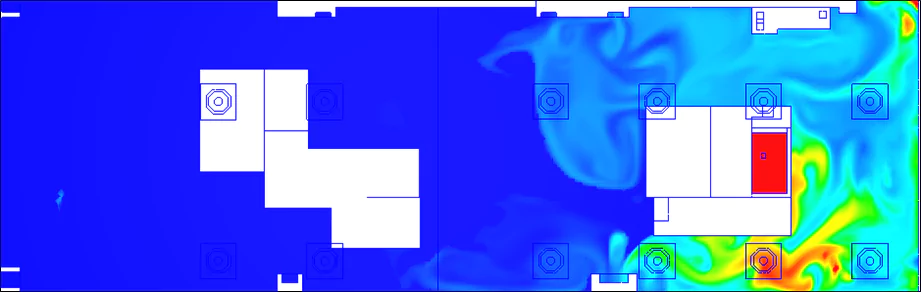
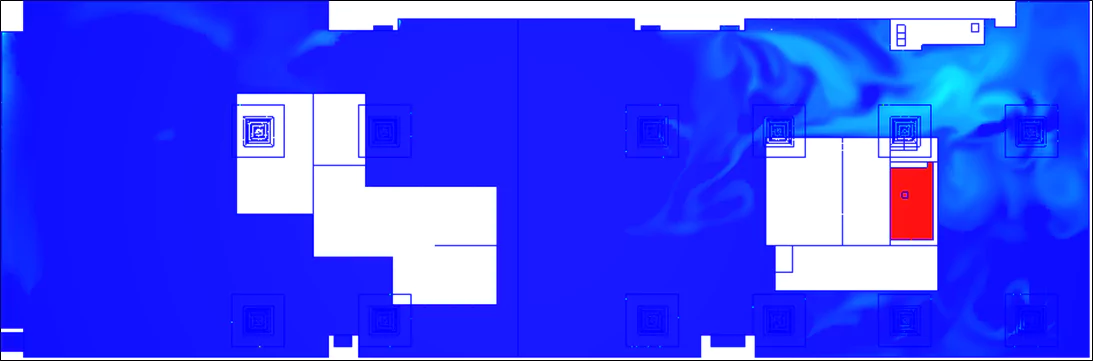
The final configuration combines the closure of the upstream corridor, the closure of the central partitions and the replacement of the swirl grilles by square vertical-supply diffusers. This change strongly reduces the recirculations: the updrafts under the grilles disappear, limiting the rise of the particles; instead they are redirected towards the low extract grilles.
Thanks to a realistic modelling of the laboratory, the equipment, the supplies and the physical barriers, the analysis precisely identifies how the airflows carry the particles from one line to another. It highlights the sensitive zones, validates or invalidates the configurations and proposes concrete adjustments to limit the recirculations and reduce the cross-contamination risk.
CFD makes the invisible visible: complex air movements, recirculations above the partitions, stagnant zones, probable particle trajectories and real supply effectiveness. It establishes itself as a genuine decision-support tool, to objectively assess the existing devices and anticipate the defects linked to the geometry, the layout or the supply mode.
Key takeaway. Partitioning without revising the supply can move the problem rather than solve it: the containment stops the transfer between lines but concentrates the dust on the operator. It is the pairing of partitioning + vertical supply that solves both.
Cross-contamination, diffusers and partitioning of a multi-line pharmaceutical production building.
It is the transfer of particles from one production line to another through the air. Here, the bagging machines release a little product at each sealing; as the lines are not partitioned, the air circulates above the workstations and disperses the dust from one line to another. A related challenge was addressed on our pharmaceutical laboratory, dust project.
They blow the air parallel to the ceiling rather than vertically. This creates recirculations that make the low particles rise, which then pass above the central partitions and reach the circulation corridor.
Closing the partitions and the corridor improves the containment between lines, but the recirculations of the horizontal diffusers persist: the bagging zone then concentrates in particles, without diffusion towards the neighbours but with an increased risk for the operators.
Configuration 3: closure of the upstream corridor, closure of the central partitions and replacement of the swirl grilles by square vertical-supply diffusers. It removes the updrafts and redirects the particles towards the low extracts.
Hot spots alter the local airflow. Here, the sealing elements rise up to 65 °C and create ascending zones; measuring these temperatures makes it possible to integrate them into the CFD model.
Explore our expertise, projects and technical papers to go further than the FAQ.
The study combines field audit and advanced numerical simulation to durably control the cross-contamination risks. By analysing airflows, recirculation zones and particle trajectories generated by the bagging, the engineers understood the real dispersion mechanisms between lines and compared three scenarios. The chosen configuration — compartmentalisation + vertical supply — limits the recirculations, reduces the re-suspension of dust and promotes the extraction towards the extracts, while improving the working conditions of the operators.
CFD expertise, delivered projects and technical dossiers: the whole Laboratories field in one place.
The simplest thing is to talk it through together. Our engineers reply with an initial technical read.