Home » Prototype – Natural ventilation chimney
Prototype – Natural ventilation chimney
Project for a building ventilated by natural ventilation chimneys
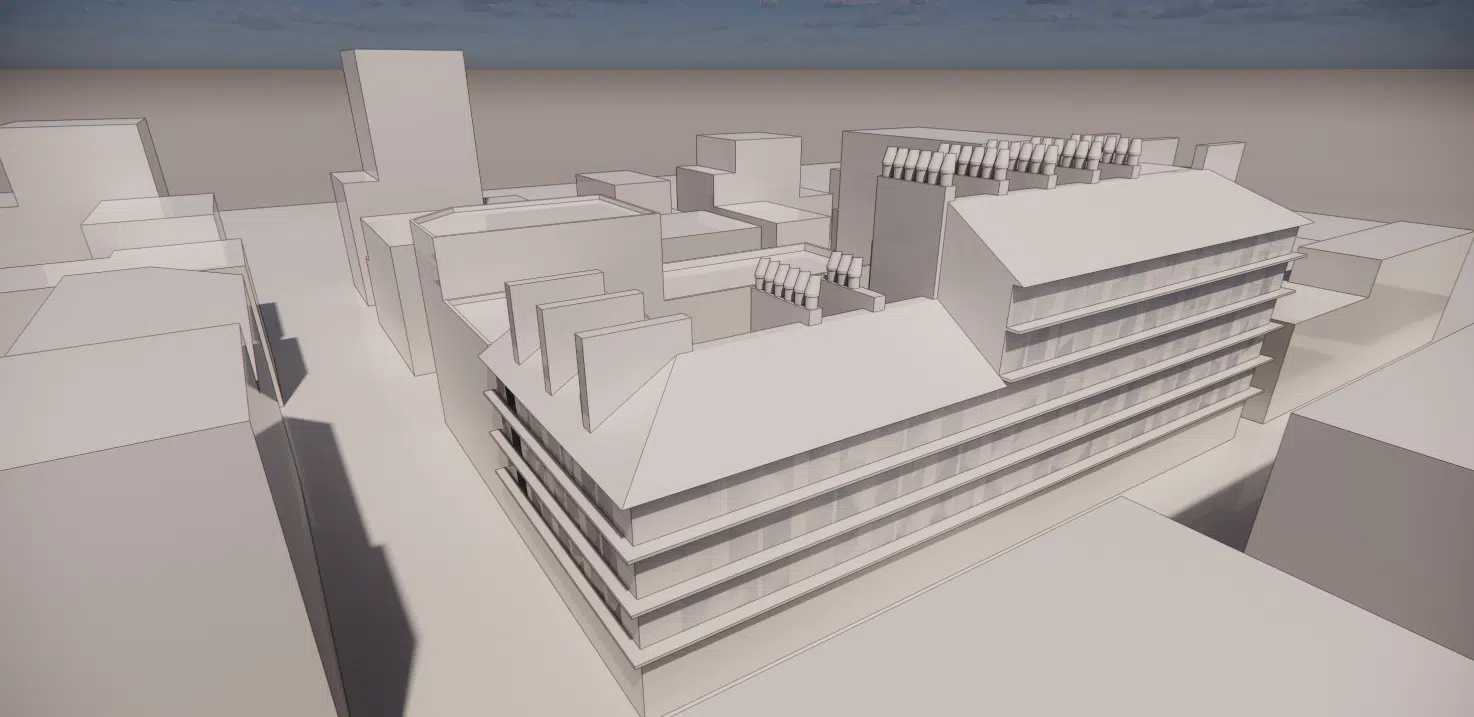
EOLIOS Engineering was contacted by an architectural firm to study the natural ventilation of a future building. The building will consist of office space that will be ventilated using wind chimneys. In this type of natural ventilation, it is not the thermal draft effect that is primary, but the action of the wind.
In this study, EOLIOS studied several types of chimneys and determined which one offers the best airflow.
Prototype - Natural ventilation chimney
Year
2024
Customer
Location
Rennes
Typology
HVAC engineering
Continue navigation :
Our other projects :
Latest news :
Technical file :
Our expertise:
Numerical simulation of natural ventilation via wind chimney
General presentation of the project
Eolios conducted an in-depth study on a future architectural project that incorporates two main components : a section dedicated to housing and another to business premises . Our attention is specifically focused on this second part , as it is the business premises that will benefit from a natural ventilation system .
Climate study
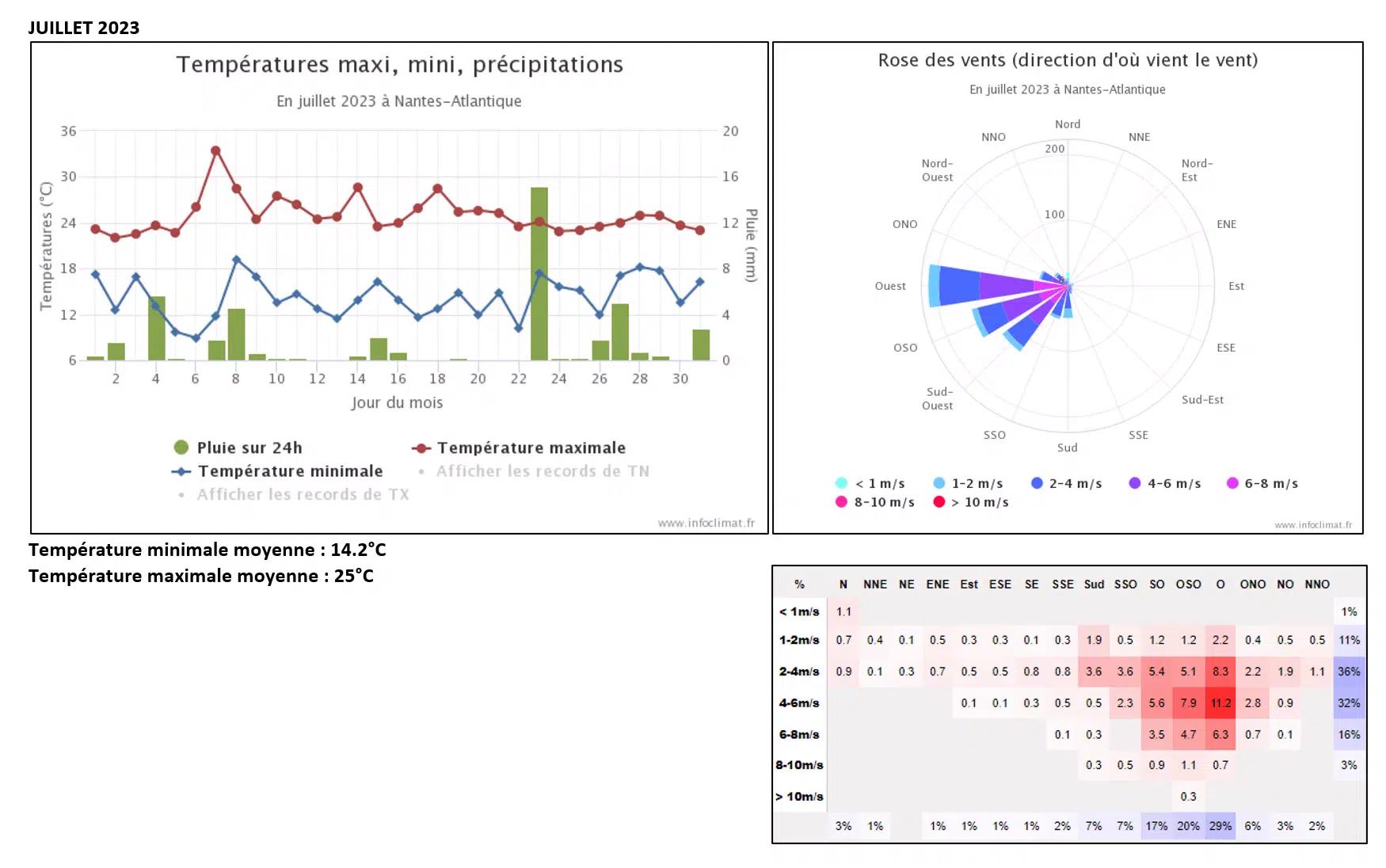
To conduct this natural ventilation study , we first perform a climate analysis of the future site to run simulations that are as realistic as possible . For this project, the climate analysis revealed that the wind blows primarily from the southwest . A second prevailing wind comes from the northeast . After identifying these prevailing winds , we measure their intensity , that is , the average wind speed in these directions , as well as the minimum and maximum speeds to study extreme cases .
A study of temperatures according to the seasons was also carried out but is not presented in this section . In the remainder of this article, we will present results for a southwest wind at a speed of 6 m/s , which, according to this climate study, is the most frequent wind .
3D model
To study the natural ventilation of a building, it is crucial to consider neighboring buildings that act as air barriers . These surrounding structures can significantly impact the airflow around and through the building under study. The presence of neighboring buildings can create areas of varying pressure and turbulence that influence wind direction and speed . Therefore, accurate modeling of these neighboring buildings is essential for a realistic assessment of natural ventilation.
Modeling neighboring buildings allows us to simulate the effects of obstacles on airflow. This includes identifying wind shadows , where airflow is reduced or disrupted, and wind channels , where airflow is accelerated. These phenomena can affect indoor air quality , thermal comfort , and the energy efficiency of the building under study. Effective modeling helps identify the best locations for ventilation openings , such as windows and vents, to optimize fresh air intake and stale air removal .
Sizing
Properly sizing ventilation ducts is essential for effective ventilation . Eolios offers its expertise in sizing and improving natural ventilation systems . Subsequently, CFD simulation allows for verification of this sizing . The advantage of CFD lies in the ability to test multiple systems and configurations . Indeed, it is easier to modify ventilation systems during the simulation phase than once they are already installed.
Testing several chimneys using CFD
Studies have been carried out on several chimneys:
- One with a rectangular duct 4m high and a flat hood
- Two with a cylindrical duct 4m high: one with a fixed hemispherical hood and the other rotating
- And a 4m high facade with two orientations
The aim of the study is to determine the most suitable shape for the project by comparing the airflow extracted by the chimneys under different configurations. The collection areas and the size of the flues are equivalent for each study in order to compare only the efficiency of natural draft .
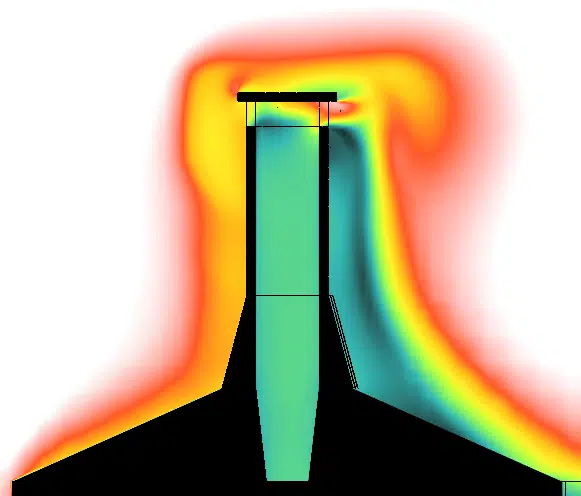
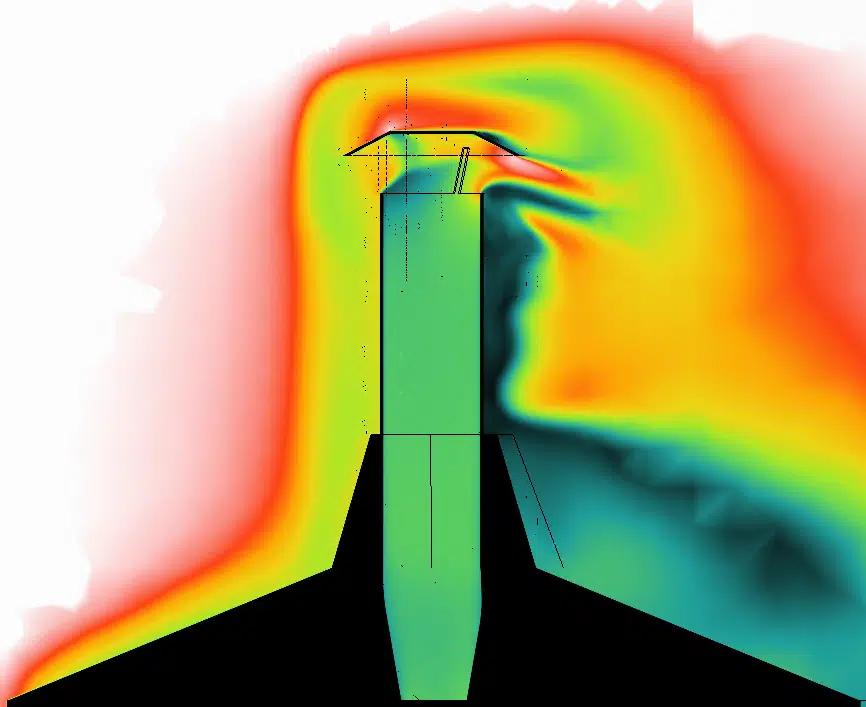
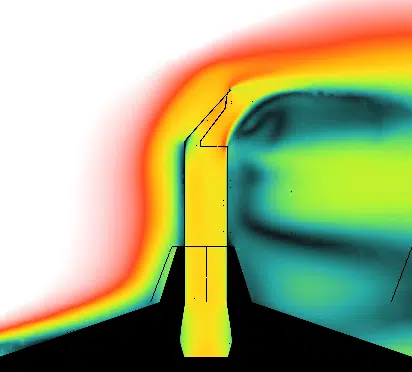
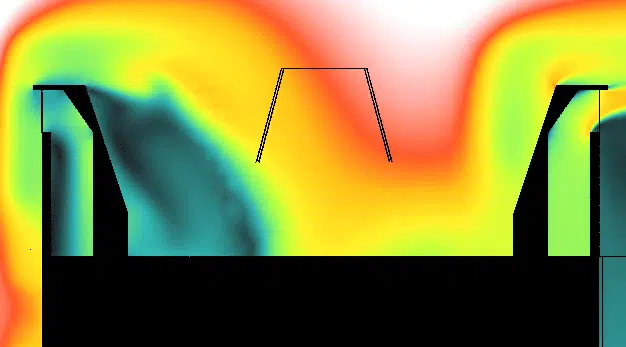
Air velocities across the 4 different chimney configurations
Studies show that chimneys with rotating cowls create the strongest draft . Their exhaust flow is approximately twice that of chimneys with fixed cowls , regardless of wind direction or disturbances from surrounding buildings. Furthermore, the cowl rotates to ensure optimal conditions, resulting in improved draft .
Facade chimneys can be an interesting solution despite some constraints. They are extremely dependent on wind direction ; depending on the wind direction and the chimney’s orientation, it can either function as an air intake or exhaust, which can be both an advantage and a disadvantage .
In the context of this study, in order to obtain the best possible draft, the chimney with a rotating hood is preferred .
Simulations and results
This section presents the results of CFD simulations with individual ducts and mobile cylindrical chimneys . Indeed, as the initial simulations show, this type of chimney is the most efficient .
The simulation results presented below are for a southwest wind of approximately 6 m/s . This is the prevailing wind in the project area . It should be noted that other wind directions and speeds were tested but are not presented in this article.
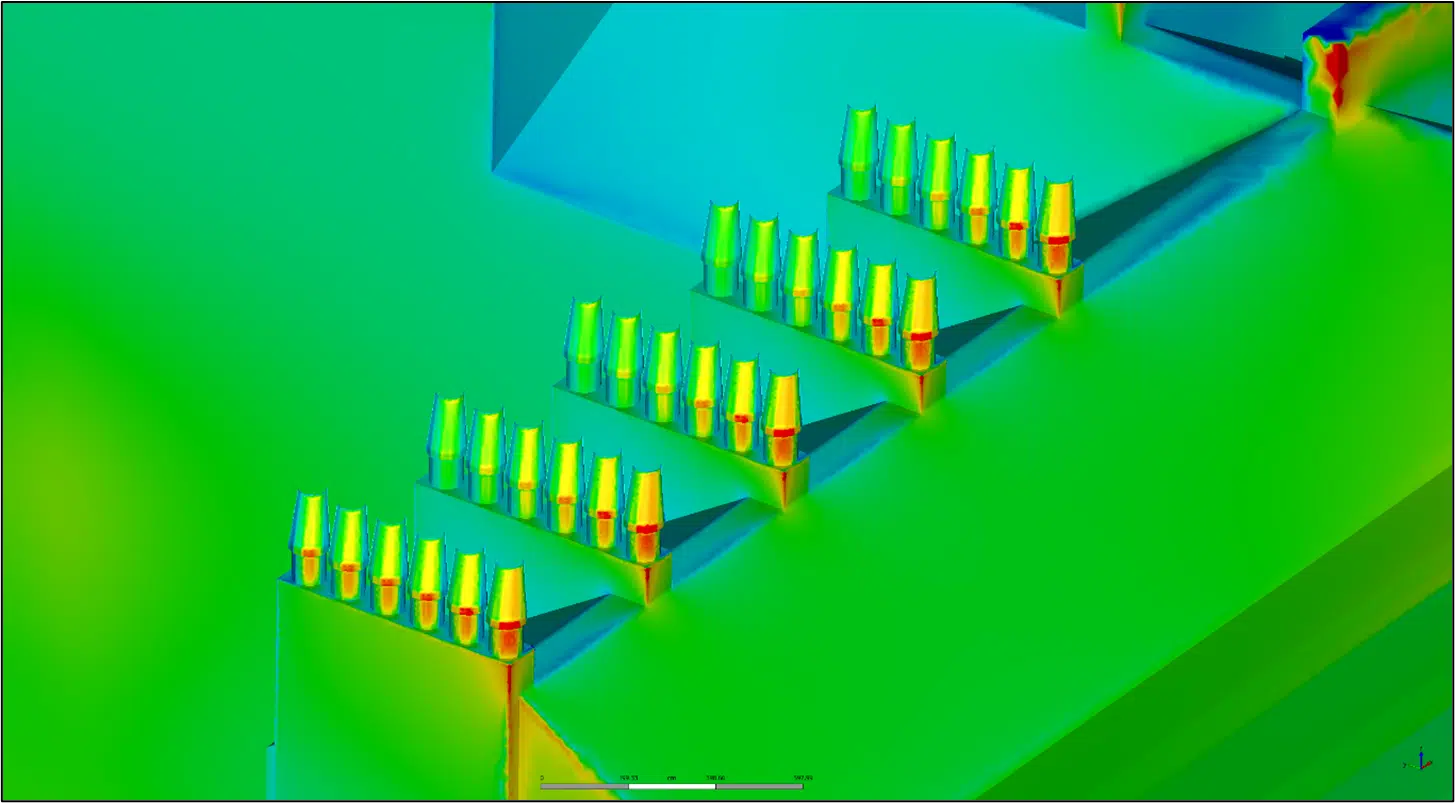
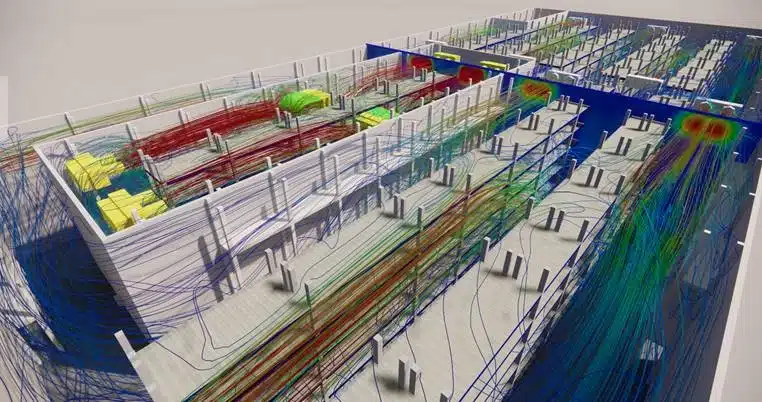
The red areas indicate which chimneys are most affected by the wind coming from the Southwest . Those where these red areas are not observed are less affected by this wind due to the presence of other chimneys upstream .
With the aim of comparing fixed and mobile chimneys, two studies were carried out for each case and are presented below.
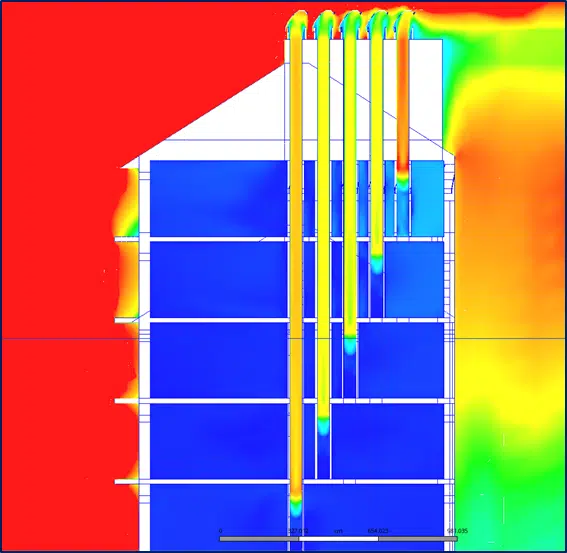
Velocity distribution in individual ducts of mobile chimneys - Preliminary sizing study
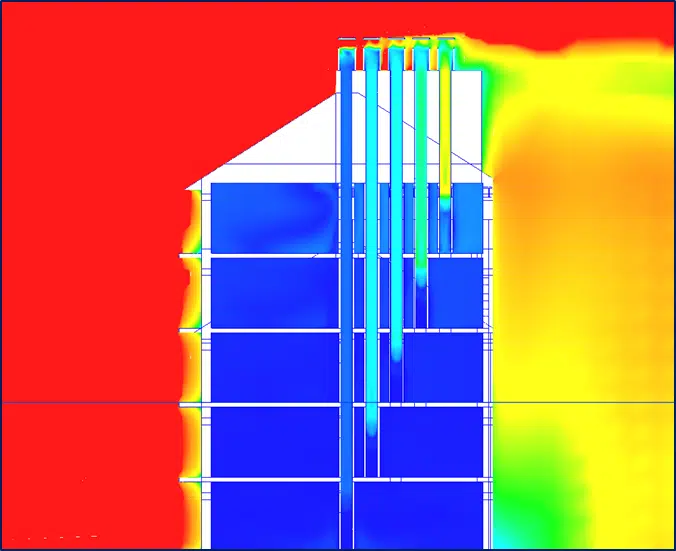
At first glance, the air velocities in the flues of mobile chimneys are higher than in the flues of fixed chimneys . Furthermore, a difference can be observed between the flues of fixed chimneys . Indeed, in the case of fixed chimneys, the chimney with the longest flue (1st floor) has a flow rate of 0.7 air changes per hour (AV/h) , well below the expected 5 AV/h . Only the shortest flue (5th floor) almost reaches this target of 5 AV/h , and this flow rate increases with each floor .
The table below is a summary of flow rates per floor and per type of chimney :
This table shows that ventilation with fixed chimneys is on average half as effective as ventilation with a mobile chimney . It is also important to note and remember that in the case of a fixed chimney, the first floor receives virtually no ventilation .
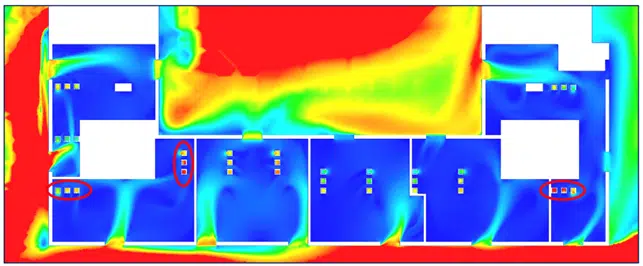
In this study, the facade openings studied are in a high position and open once every two frames , as can be seen in the figure below.
It is noticeable that the series of chimneys directly exposed to the wind (circled in red in the figure above) exhibit flow rates significantly higher than the average of the other chimneys . For these chimneys, the target of 5 vol/h is therefore achieved in the mobile case, but not yet in the fixed case.
These initial results indicate that natural ventilation functions correctly in the case of the chimney with the movable cap . In this instance, the ducts were correctly sized to achieve a ventilation rate of 5 air changes per hour (AV/h) .
Simulation of nocturnal discharge by natural ventilation
Quantifying the gains of natural ventilation via chimney
Following performance studies of different types of chimneys , a study was conducted to evaluate nighttime heat dissipation in this building using natural ventilation and these chimneys . Nighttime heat dissipation refers to the passive cooling process that utilizes the drop in outside temperatures during the night to remove heat accumulated during the day. This phenomenon relies on the natural or forced circulation of air , thus reducing the indoor temperature and improving thermal comfort without resorting to mechanical air conditioning .
This study aims to quantify the effectiveness of this mechanism as a function of climatic conditions , building characteristics and induced airflows .
Conditions for nighttime discharge
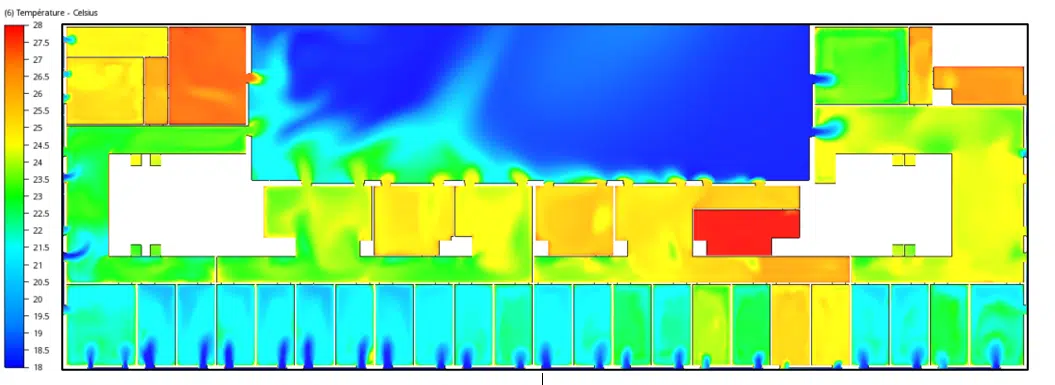
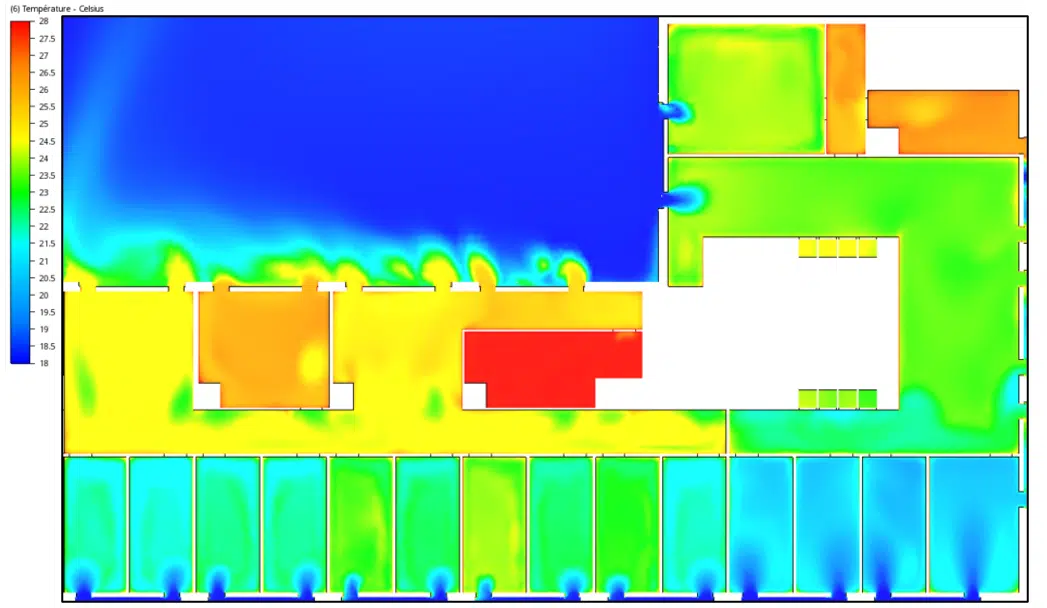
To model a nighttime discharge corresponding to a realistic scenario , we chose to simulate a temperature difference of 10°C between indoor and outdoor air. More specifically, we considered two characteristic situations: an outdoor temperature of 18°C and an indoor temperature of 28°C .
This choice is based on the assumption that, during periods of intense heat, heat accumulation within the building leads to a rise in the indoor temperature, while the drop in outdoor temperatures at night initiates a passive cooling effect. This temperature difference promotes natural ventilation by creating a thermal gradient that encourages air circulation through the building’s chimneys and openings.
Wind conditions were also determined based on a prior climate study. The prevailing wind at the site was selected for this study.
Results of climate discharge studies
The results of the nighttime discharge make it easy to identify properly ventilated areas , where indoor temperatures are relatively close to the outdoor temperature . These areas benefit from efficient air circulation , promoting passive cooling of the building.
Conversely, poorly ventilated areas are also highlighted. In these spaces, air circulation is more limited, resulting in high residual temperatures , close to 28°C . Identifying these areas is essential for optimizing the natural ventilation strategy , by adjusting openings or integrating solutions to improve air renewal and homogenize temperature distribution.
This study identified heat hotspots in the building and analyzed their impact on thermal comfort . Overall, nighttime heat loss proved effective in maintaining comfortable temperatures throughout most of the building , promoting optimal passive cooling .
However, it is observed that areas with low water movement do not benefit from nighttime discharge.
Furthermore, this study played a key role in supporting our client in optimizing natural ventilation . Thanks to the results obtained, we were able to establish a list of best practices to maximize natural ventilation and, consequently, improve nighttime heat loss . These recommendations aim in particular to optimize the management of openings , adjust airflow rates , and fully exploit temperature differences to enhance the effectiveness of passive cooling .
Continue on this topic
Video summary of the study
Discover other projects
Fine particle capture in a metro station
Impact of wind on a solar power plant
Controlling wind erosion on a solar power plant
Impact of wind on a high-rise building
CFD air quality control study – Issy underground RER station construction site
Securing a commercial site – CFD study of wind risk
Study of aeraulic comfort – Middle school
Wind comfort study – Rooftop
Wind impacts on high-rise buildings: Tours Olympiades in Paris
Comfort – Rooftop of a palace – Casablanca
Tour Liberté – La Défense
Cooling towers – ICPE
Pedestrian comfort study – La Défense
Confort au Vent – PSG training center
Wind study – La Défense
Sharaan by Jean Nouvel resort
Air coolers – Critical study – Heat wave
Fine dust measurements
Balenciaga – Wind potential