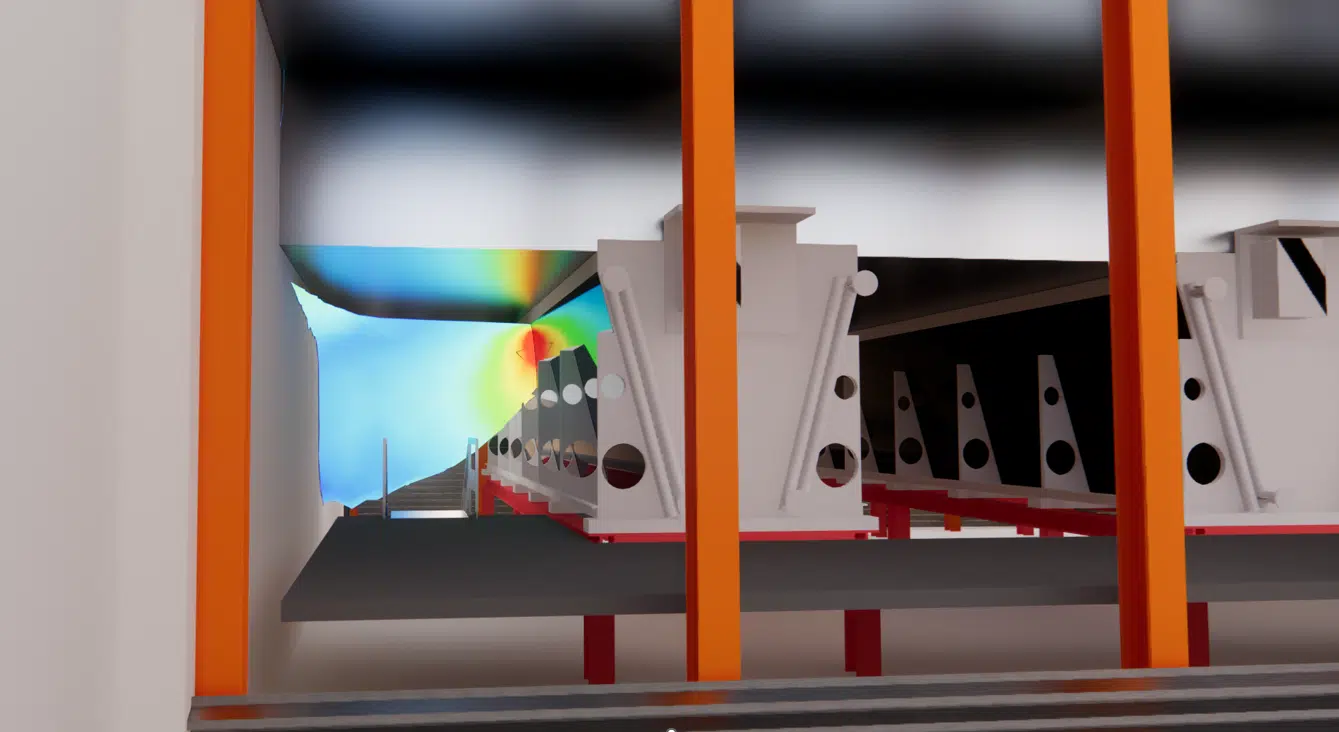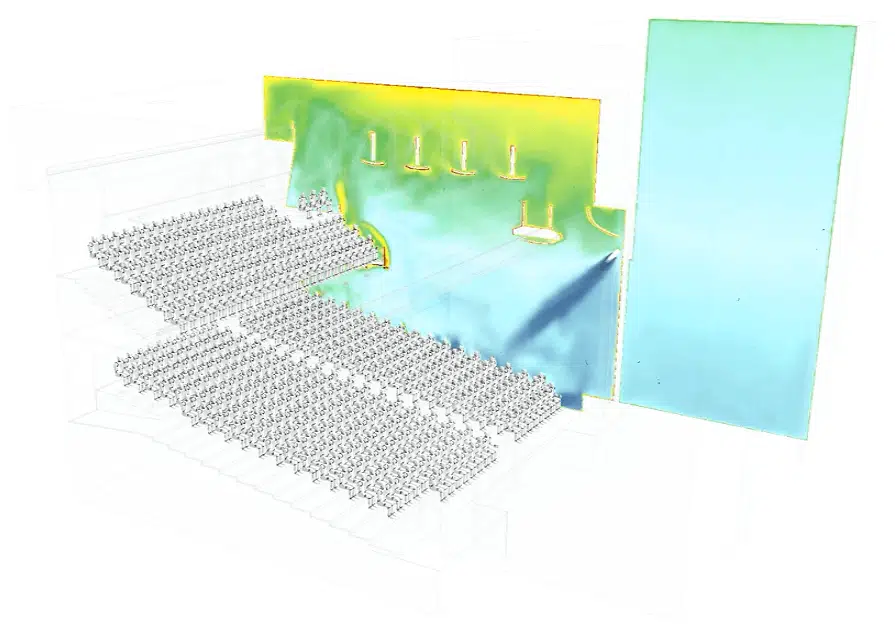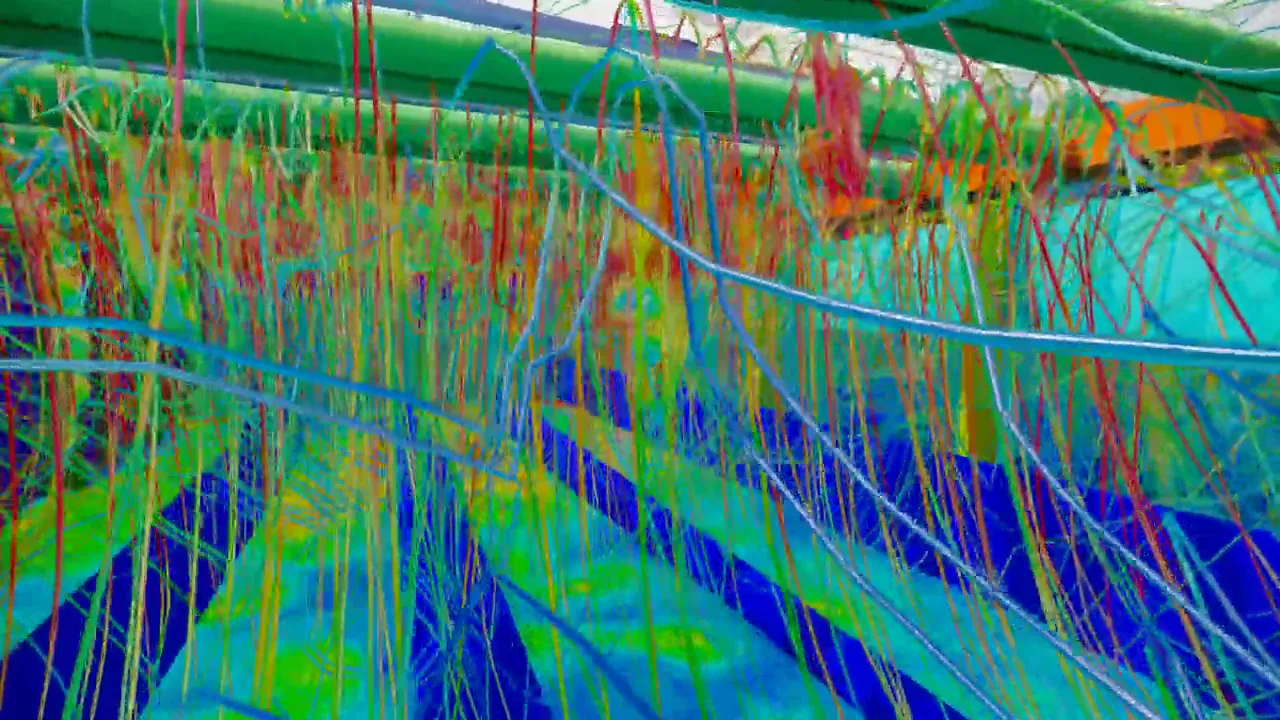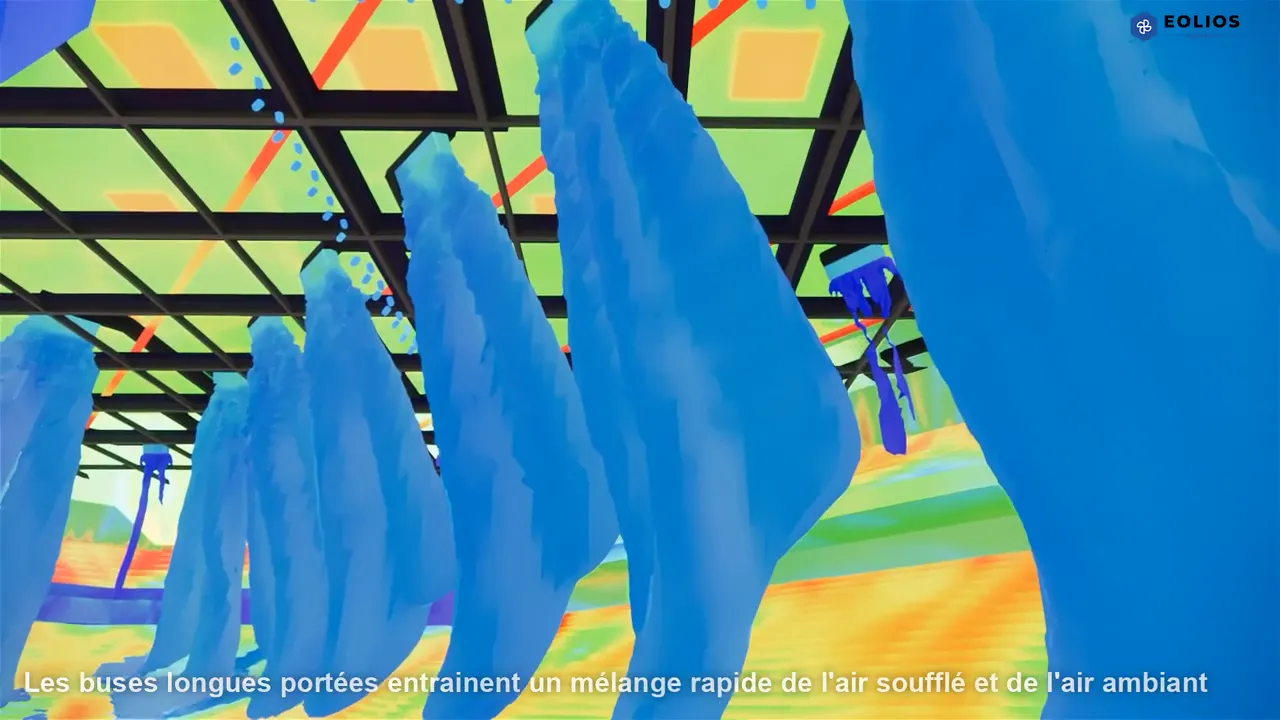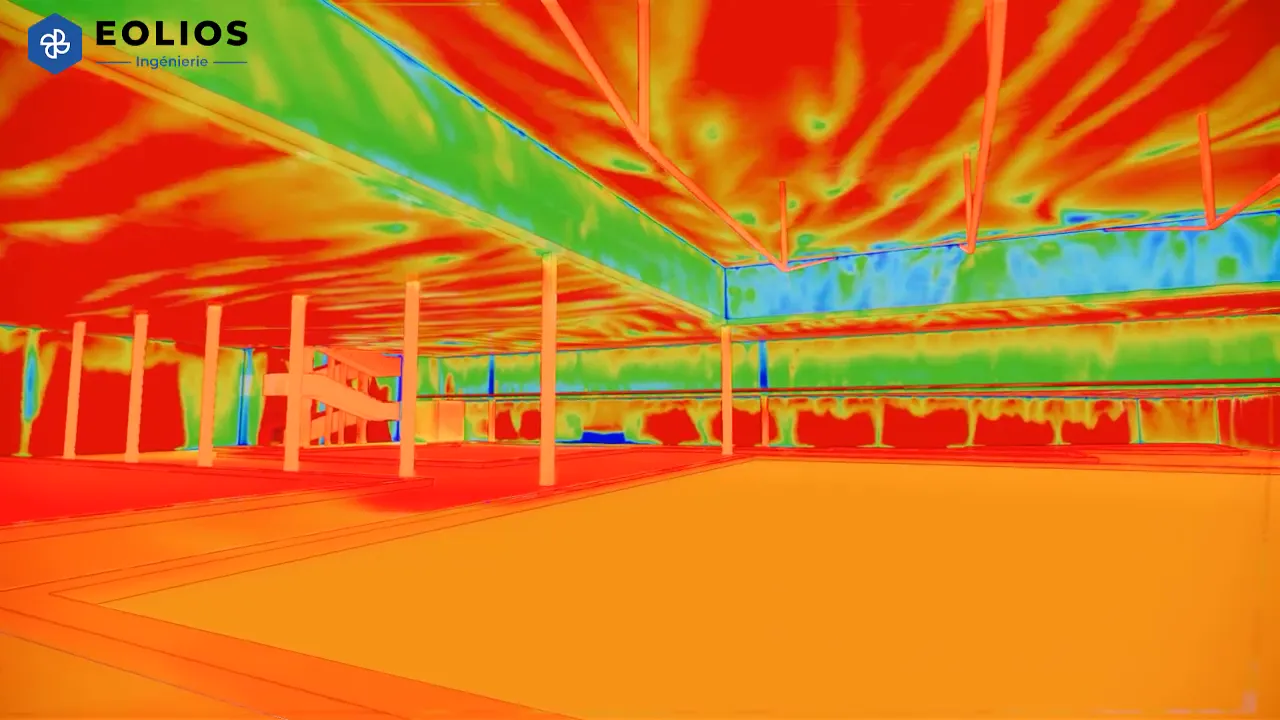
CFD simulation of the cooling towers installed on the roof of an ICPE-classified building: temperature and humidity isosurfaces, then streamlines, with south-westerly and north-easterly winds.
Updated on 25 November 2026
In less than a minute and a half, we see where the warm plume and the moist plume of a cooling tower go, and how they change with the wind.
Click a passage to play it in the player.
This video illustrates EOLIOS's article on cooling towers and ICPE regulations. It shows the plumes from towers installed on the roof of an industrial building.
For two wind directions, south-west then north-east, the plume is seen from three angles: a temperature isosurface, a humidity isosurface and streamlines coloured by temperature. This shows whether it risks being drawn back into the towers.
Cooling towers combine a health issue, Legionella, a regulatory constraint, ICPE heading 2921, and an airflow difficulty, plume recirculation.
The intake, by a cooling tower, of part of its own warm, moist plume. It degrades cooling and can encourage the dispersion of droplets.
CFD simulation calculates the trajectory of the plume and its dilution for each wind condition. It checks for non-recirculation and the protection of fresh air intakes before installation.
View the full study: article on cooling towers and ICPEThe video shows the plumes for two winds. The full article presents how cooling towers work, the Legionella risk, the ICPE framework and the prevention approach.
View the study results: article on cooling towers and ICPEThe video, recirculation and the link with ICPE regulations.
A CFD simulation of the plumes from rooftop cooling towers: temperature and humidity isosurfaces and streamlines, for two wind directions.
They represent temperature: red for the warmest discharged air, blue for the ambient air.
A cooling tower plume is laden with vapour and droplets. Its moist path indicates the health risk, not just the thermal one.
Heading 2921 covers evaporative cooling installations that disperse water into an air stream.
The Legionella risk, the ICPE framework and prevention are presented in the full article on cooling towers.
Explore our expertise, projects and technical papers to go further than the FAQ.
The simplest thing is to talk it through together. Our engineers reply with an initial technical read.