
The ESSOC law: a State serving a society of trust
The ESSOC law — also known as the law for "a State serving a society of trust" — is a French law enacted on 10 August 2018. Its aim is to simplify relations between the administration and citizens, businesses and associations.
The acronym ESSOC stands for "État au service d'une société de confiance" (a State serving a society of trust). The law is part of an effort to modernise the French administration, making it more accessible and more efficient for citizens and businesses alike.
It includes measures intended to reduce the administrative burden on businesses, to make procedures easier for individuals and to strengthen users' rights in their dealings with the administration. It also aims to encourage innovation and experimentation within the administration.
"A State serving a society of trust": the law of 10 August 2018, which notably establishes a right to make a mistake and a logic of trust between the administration and the public, serving simplification and innovation.
The main measures of the ESSOC law
Among the law's flagship measures, several provisions transform the relationship between the public and the administration:
The flagship provisions
- A right to make a mistake for individuals and businesses: correcting a declaration or application error without being penalised.
- The option for businesses to conclude agreements with the administration to simplify their reporting obligations.
- Generalisation of mediation to settle disputes between the administration and the public or businesses.
- The creation of a right to disconnect for employees outside working hours.
- Simplification of building permits, including a tacit building permit when the administration fails to respond.
The ESSOC law applied to fire safety
Before the law, fire-safety rules were fairly strict and could be hard to apply in certain buildings. For example, for category 4 and 5 public-access buildings (ERP), it was mandatory to install a mechanical or natural smoke-control system, even when other safety measures were already in place: fire doors, smoke detectors, and so on.
The ESSOC law introduced a simplification measure by allowing public buildings to be exempted from certain regulatory obligations. This exemption must be justified by a fire-safety study carried out by an expert and approved by the relevant safety commission. The justification covers three points: smoke control, the stability of load-bearing elements and ease of intervention.
The equivalent-effect solution (EES) makes it possible to replace a regulatory requirement with a different solution, provided it is demonstrated to achieve a level of safety equivalent to that of the baseline rule.
An exemption justified by an engineering study
The law limits the scope of possible derogations by specifying that only means-based requirements can be addressed by an equivalent solution. The project owner is therefore required to prove that the baseline rule cannot be implemented, and to demonstrate that the results obtained are equivalent to those that would follow from applying the baseline rule.
The three points justifiable by an EES
- The smoke control of the volume(s) concerned.
- The stability of the load-bearing elements of the structure.
- The ease of intervention for the emergency services.
An exemption is never a reduction in safety
The equivalence demonstrated by calculation can then be verified on site: smoke tests confirm at handover that the real behaviour of the smoke matches the simulations in the file.
Ensuring people's safety despite the exemption
It is important to stress that the smoke-control exemption must not compromise the safety of the people present in the building in the event of fire. The introduction of other safety measures must therefore be carefully assessed to guarantee a sufficient level of safety.
Although the ESSOC law allows an exemption, in some situations it may be strongly recommended to install a smoke-control system to ensure a fast, safe evacuation in the event of fire.
When smoke control remains essential
When premises include enclosed spaces, flammable storage areas or host a large number of people, installing a smoke-control system can prove essential to guarantee the safety of the occupants.
Calling on a consultancy certified in smoke-control engineering
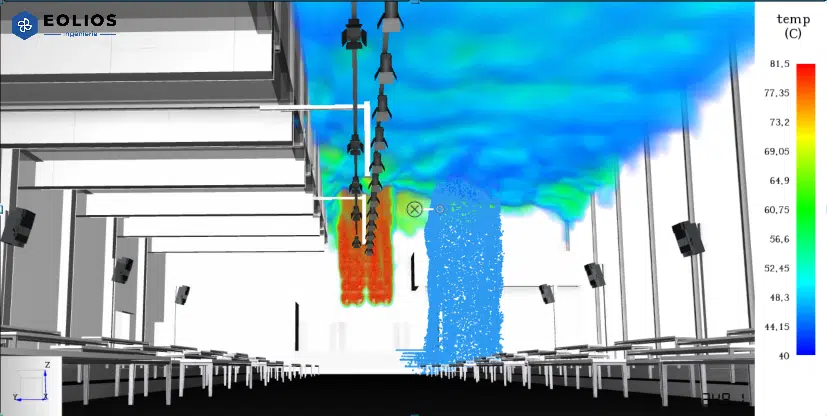
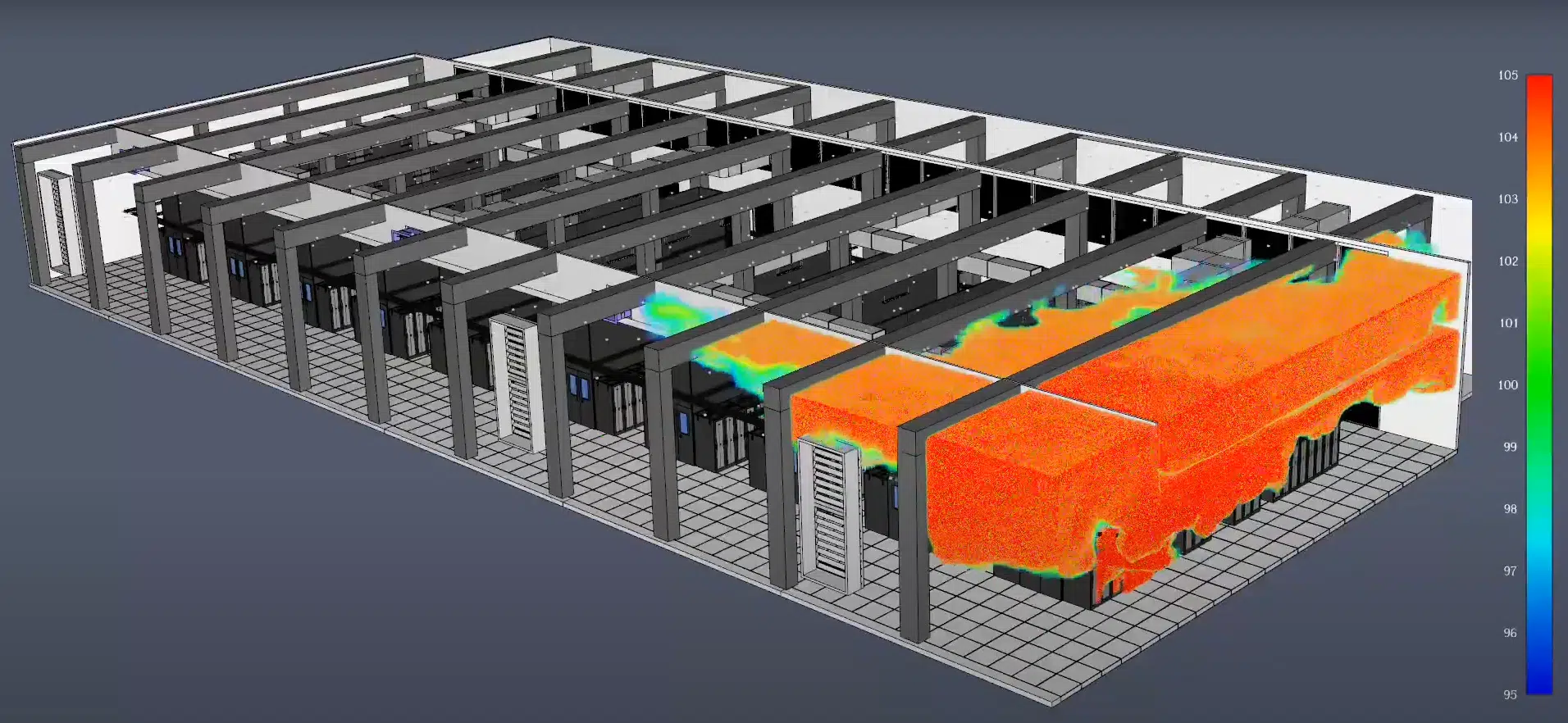
It is now possible to assess the performance of the smoke-control system using a CFD analysis and to study the movement of the smoke, the temperature and the visibility profile while accounting for various fire scenarios.
The regulatory path of an EES
- The project owner relies on an accredited competent body (ORC) to propose equivalent-effect solutions.
- They submit an application file to obtain a certificate confirming the fire-safety objectives are met.
- The accredited body reviews the file, validates the EES and issues a certificate of compliance with the objectives.
- Once the works are complete, the verifier certifies that the fire-safety objectives have been met.
Equivalent-effect solution, accredited-body file, FDS/CFD simulation: our engineers build and defend your fire-safety case.