Dynamic energy simulation
Our business is to provide DTS ("dynamic thermal simulation") engineering services to help our clients optimize and validate bioclimatic designs and the choice of systems installed in buildings.
Comfort
- Occupant comfort level
- Thermal behaviour by zone
Energy
- Needs & consumption (HVAC)
- Bioclimatic performance
Tools
- IES Virtual Environment (IES VE)
- ArchiWizard (solar studies)
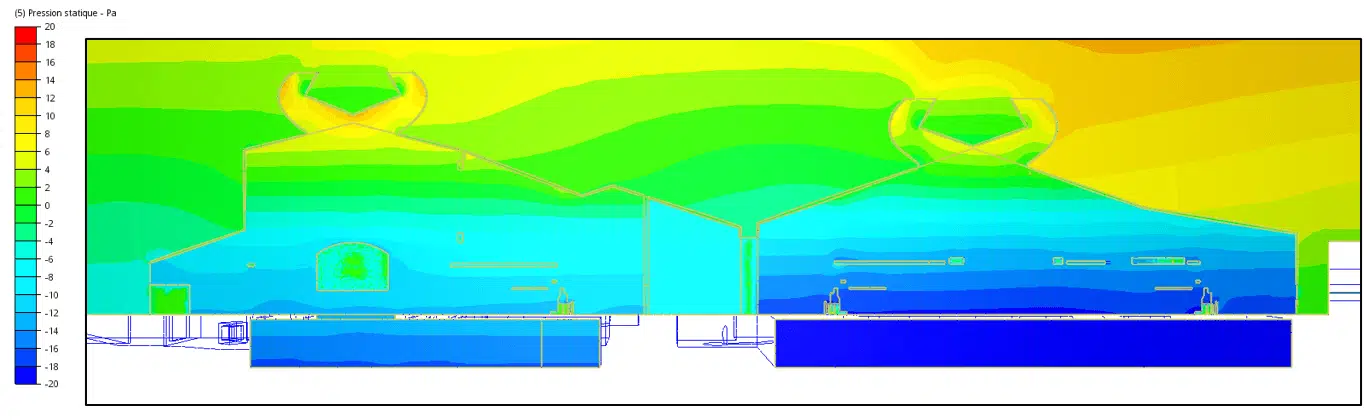
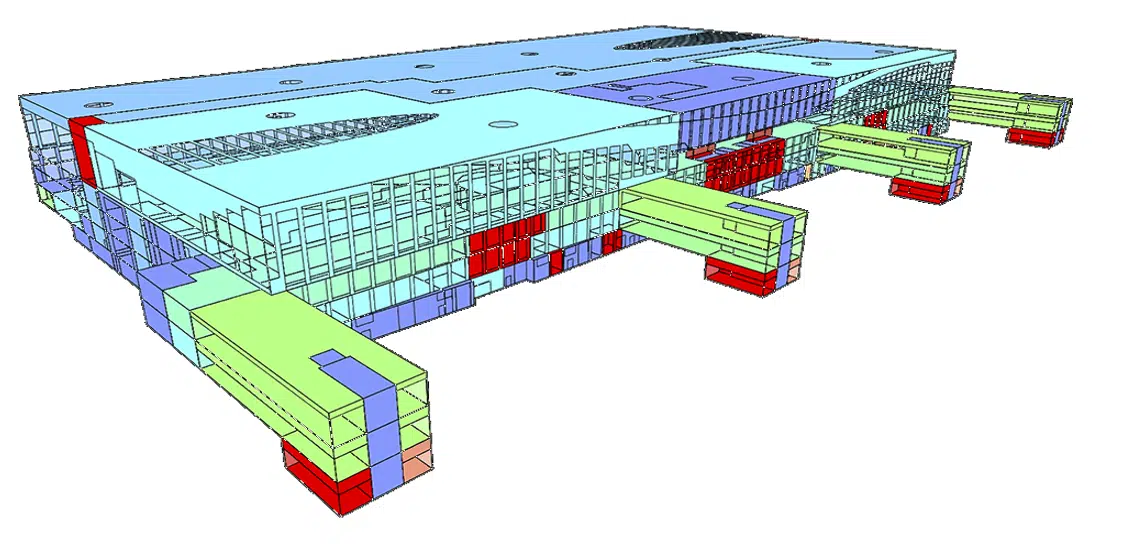
Dynamic thermal simulations are carried out on many buildings of all sizes and uses. They make it possible to estimate the comfort level of occupants in the premises, as well as the specific needs and consumption (heating, ventilation, cooling…) of each building. It is thus possible to better understand the thermal properties of the different zones of a building and to predict its thermal and energy behaviour.
EOLIOS engineers specialized in building thermal performance use the ArchiWizard software for solar studies and IES Virtual Environment (IES VE), which offers a wide range of thermal-simulation features. These make it possible to carry out fast, accurate multi-criteria simulations to characterize the bioclimatic performance of the building.
Energy efficiency and return on investment
Energy-modelling methods compute the amount of energy consumed and its financial cost for any newly designed or existing building. The particularity of this approach is that, in the energy-modelling process, all the nuances that affect the energy consumption of the building and its systems are taken into account. The complex relationships between systems (influence, efficiency…) are integrated. The result provides a consistent and reliable picture of energy consumption over the building life cycle.
The result is displayed for each consumption item (for each system) separately, which is convenient for deeper analysis and decision-making. The following areas are addressed by building energy-simulation methods:
- development and selection of measures to improve the energy efficiency of buildings;
- assessment of the return on investment of energy-saving measures;
- assessment of the effectiveness of bioclimatic solutions at the design and project stages;
- selection of the most appropriate energy tariffs and subscriptions;
- determination of the cost of energy resources for the correct assessment of operating costs.
Verifying performance throughout the year
The selection of equipment capacities in the design is based on the "calculated" outdoor-air parameters, which differ from the real values and their fluctuations.
Building energy modelling helps estimate how long the indoor-air parameters may not be maintained at the required level. This estimate can be carried out both for an average year and for a year with extremely high summer temperatures (heatwaves) and particularly low winter temperatures. With this information, the designer can reasonably decide on the adequacy of the selected equipment — under normal as well as extreme weather conditions.
Calculating points for certifications (LEED, BREEAM…)
Building energy modelling — or BEM — holds one of the key places in the LEED and BREEAM certifications.
Meeting the requirements of environmental certification systems makes it possible to determine the effectiveness of the design solutions and to improve the building's energy efficiency. This in turn contributes to the reduction of greenhouse-gas emissions.