Understanding the comfort challenges in large volumes
EOLIOS is an expert in comfort within large glazed volumes. Our CFD simulations reveal discomfort zones and optimize the design for a high-performing, well-controlled indoor climate.
Analysis
- Solar radiation & thermal gains
- 3D CFD modelling of air flows
- Comfort assessment to PMV & PPD
Optimization
- Hot zones & air stagnation
- Optimization of air supply & mixing
- Real site climate scenarios
Design
- Natural-ventilation potential
- HVAC sizing & control
- Validation of architectural & façade choices
Spaces of high architectural value but thermally complex
Atriums, reception halls and high-ceilinged spaces hold a central place in contemporary architecture. True showcases of office, cultural or commercial buildings, they stand out for their generous volumes, their largely glazed walls and their direct link with the outdoors. This transparency, a source of light and spatial quality, also becomes a major technical constraint: solar gains, the stratification of air masses and the thermal inertia of the structures continually alter the balance of indoor comfort.
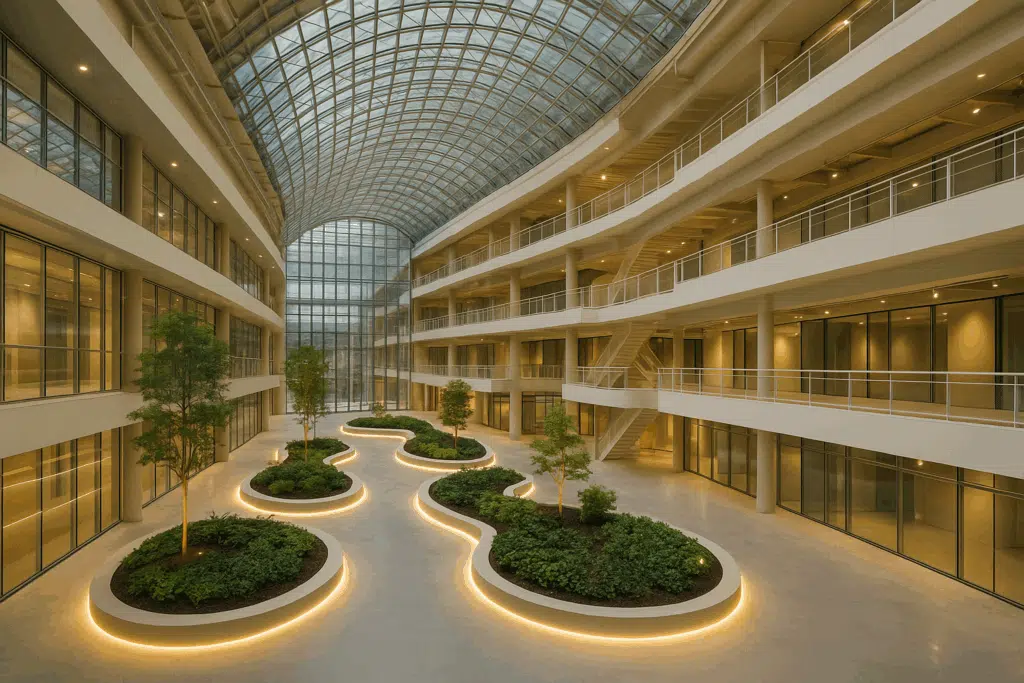
In these open volumes, controlling the indoor climate relies on a subtle dialogue between architectural design and the physics of flows. Warm air naturally tends to accumulate in the upper section, while the glazed walls absorb and release solar radiation in rapid cycles. These effects, amplified by height and variable occupancy, create temperature gradients that are difficult to offset with a simple regulatory or static approach.
The dominant phenomena: radiation, stratification and inertia
Thermal comfort in a large hall depends on a combination of interdependent physical phenomena. Solar radiation, first, is the main source of incident energy: it passes through the glazing, turns into heat on contact with the interior surfaces, then radiates again towards the occupants.
Thermal stratification, next, appears as a stack of air layers at different temperatures: warm air rises, the denser, cooler air stays in the lower section, sometimes causing differences of several degrees between the floor and the glass roof. Finally, the thermal inertia of the materials influences the building's responsiveness: massive walls or floors with high thermal capacity dampen variations, but can also release the accumulated heat late, prolonging episodes of discomfort.
Understanding these phenomena requires a dynamic approach, able to reproduce the reciprocal exchanges between convection, conduction and radiation. It is precisely this complex interaction that EOLIOS seeks to model in order to predict the building's real behaviour over time.
The comfort and energy-performance objectives
Ensuring comfort in a high-ceilinged space is not just about maintaining an average temperature: it is about creating a uniform, stable environment, where air velocities, radiant temperatures and vertical gradients stay within acceptable ranges for the majority of occupants. In these atypical volumes, the balance between comfort and energy performance is often fragile: excessive air mixing can spoil the sense of well-being, while undersizing the supply or cooling causes localized overheating zones.
The challenge is therefore twofold: guaranteeing the perceived quality of the indoor climate while controlling the systems' energy consumption. Reaching this balance requires a fine understanding of the physical phenomena, a coupled approach to thermodynamics and airflow, and the use of simulation tools able to reproduce the three-dimensional reality of comfort.
The EOLIOS approach: modelling the indoor climate
CFD simulation, a multi-physics analysis tool
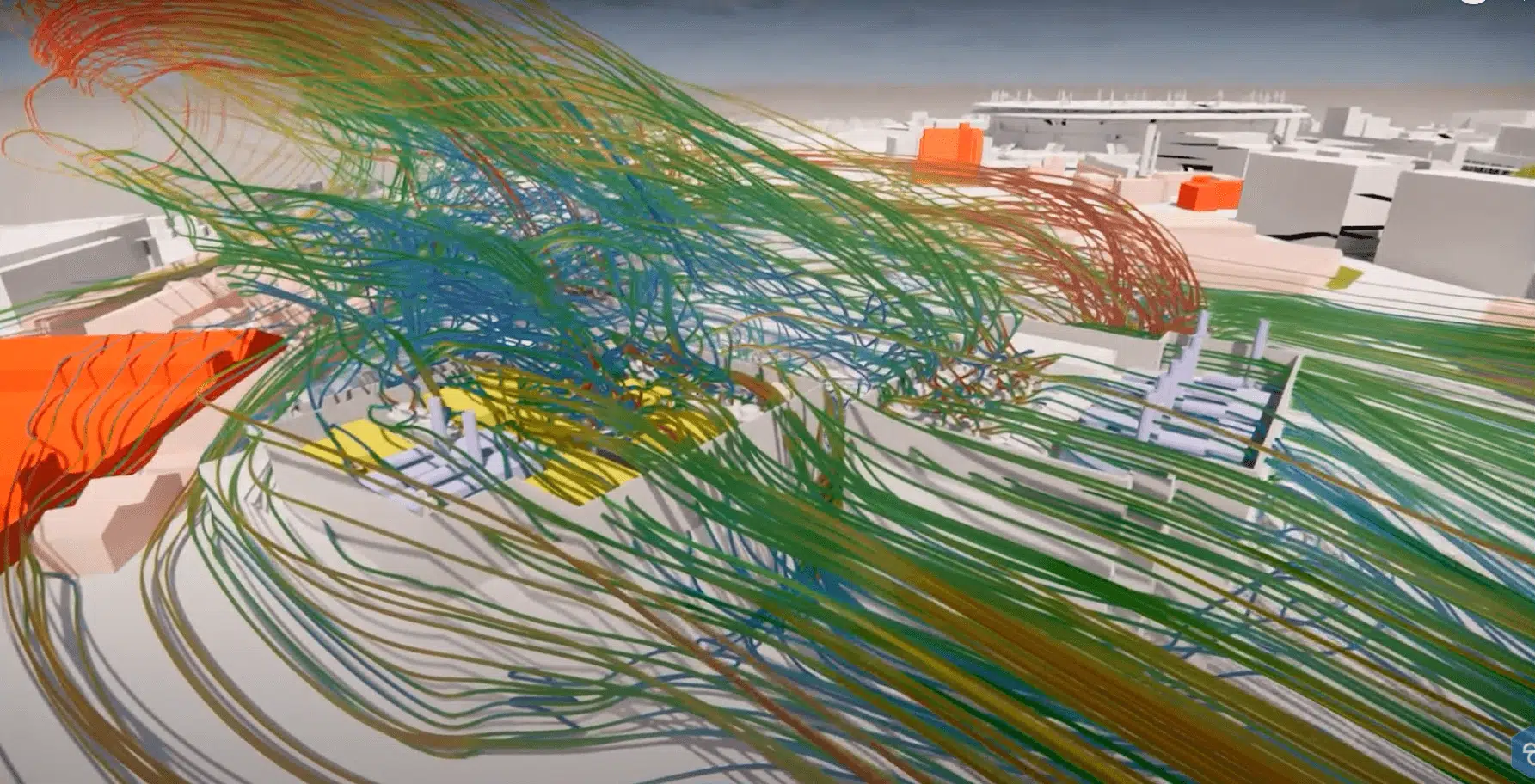
Faced with the complexity of the phenomena that develop in an atrium or high-ceilinged hall, numerical simulation is today the most powerful tool to understand and control indoor comfort. EOLIOS relies on computational fluid dynamics (CFD) to reproduce precisely the interactions between air, surfaces, heat and radiation. These three-dimensional models simultaneously solve the conservation equations of mass, momentum and energy, offering a complete reading of the volume's thermo-aeraulic behaviour.
This multi-physics approach makes it possible to analyse not only air velocities and pressures, but also heat transfers by convection and radiation. It provides a dynamic view of how the building works, highlighting stagnation zones, stratification phenomena or temperature imbalances between the different air layers. Thanks to the precision of the models, EOLIOS reproduces the real perceived comfort conditions and derives concrete optimization levers for control, supply or air diffusion.
Accounting for solar radiation and climate scenarios
Solar gains are the main source of thermal imbalance in glazed spaces; their intensity, orientation and duration vary with the season, the time of day and the transparency of the glazing. To reproduce these conditions faithfully, EOLIOS incorporates real meteorological data into its CFD models, combined with the position of the sun on the site. This approach makes it possible to simulate direct, diffuse and reflected radiation, taking into account the solar factor of the glazing, the shading from neighbouring façades and the spectral behaviour of the materials.
Coupling radiation and convection makes it possible to compute the mean radiant temperature, an essential parameter to assess thermal perception; the zones strongly exposed under the glass roof or near the façades are thus identified precisely. The simulations are run for various extreme scenarios — hot summer, cold winter, mid-season — to guarantee comfort across all usage conditions, even the most unfavourable. This methodology gives EOLIOS studies a strong predictive value: it assesses the building's behaviour in its real climate, not in a fixed theoretical assumption.
Assessing comfort through the PMV and PPD indices
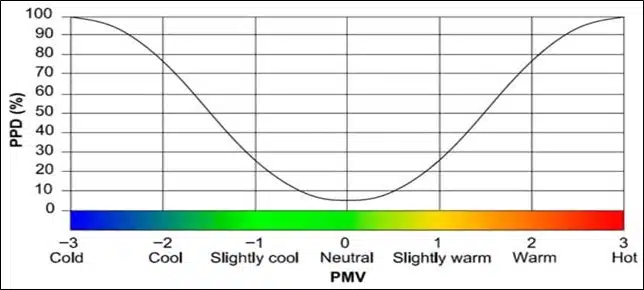
Beyond temperatures or air velocities, the perception of comfort rests on a combination of physical and physiological factors. To objectify this perception, EOLIOS relies on the standardized indicators PMV (Predicted Mean Vote) and PPD (Predicted Percentage of Dissatisfied), defined by the ISO 7730 standard.
The PMV quantifies the average thermal sensation of a group of occupants on a scale from –3 to +3, from intense cold to excessive heat; the PPD, derived from it, estimates the percentage of people likely to be dissatisfied. These indices take into account air temperature, mean radiant temperature, air velocity, relative humidity, as well as activity level and clothing. By integrating these criteria into its CFD calculations, EOLIOS assesses not only the physical conditions, but also their impact on human perception — identifying localized discomfort zones and adjusting the design to move towards neutral comfort (PMV ≈ 0, PPD < 10%).
From diagnosis to climate strategy
Identifying the levers acting on diffusion and temperature
CFD analysis is not limited to describing air flows: it reveals the precise mechanisms behind the thermal imbalances. By visualizing the distribution of velocities, temperatures and vertical gradients, EOLIOS identifies the recirculation zones, the poorly mixed volumes or the hot spots linked to localized solar gains. From these observations, it becomes possible to formulate targeted action strategies: adjusting the position of a supply diffuser, changing a diffusion angle or revising the control sequencing — optimizations that are often minimal in hardware terms, but that profoundly transform comfort in the occupied zones.
In high-ceilinged halls, control of the air mixing plays a central role: a subtle balance must be struck between velocity and uniformity — a flow that is too fast generates discomfort, while an insufficient flow encourages stratification. EOLIOS studies quantify these effects and derive the most relevant settings for each configuration.
Integrating solar dynamics and energy control
Solar gains are a decisive variable in the thermal behaviour of large glazed volumes; their intensity and distribution vary with the season, the time and the geometry of the façades, directly influencing the mean radiant temperature and the occupants' perception. In its simulations, EOLIOS characterizes the effects of solar radiation under various representative operating regimes — hot summer, cold winter, mid-season — highlighting the most sensitive zones and the imbalances they can generate.
These results make it possible to establish control recommendations: adapting the supply air flow, modulating the cooling floor or implementing solar shading. The aim is not to simulate the control in real time, but to help with its tuning and prioritization, by defining the most effective levers to stabilize comfort while limiting consumption. CFD thus becomes a decision-making tool for the tuning and sizing of the climate systems.
Designing hybrid strategies: supply, draught and natural ventilation
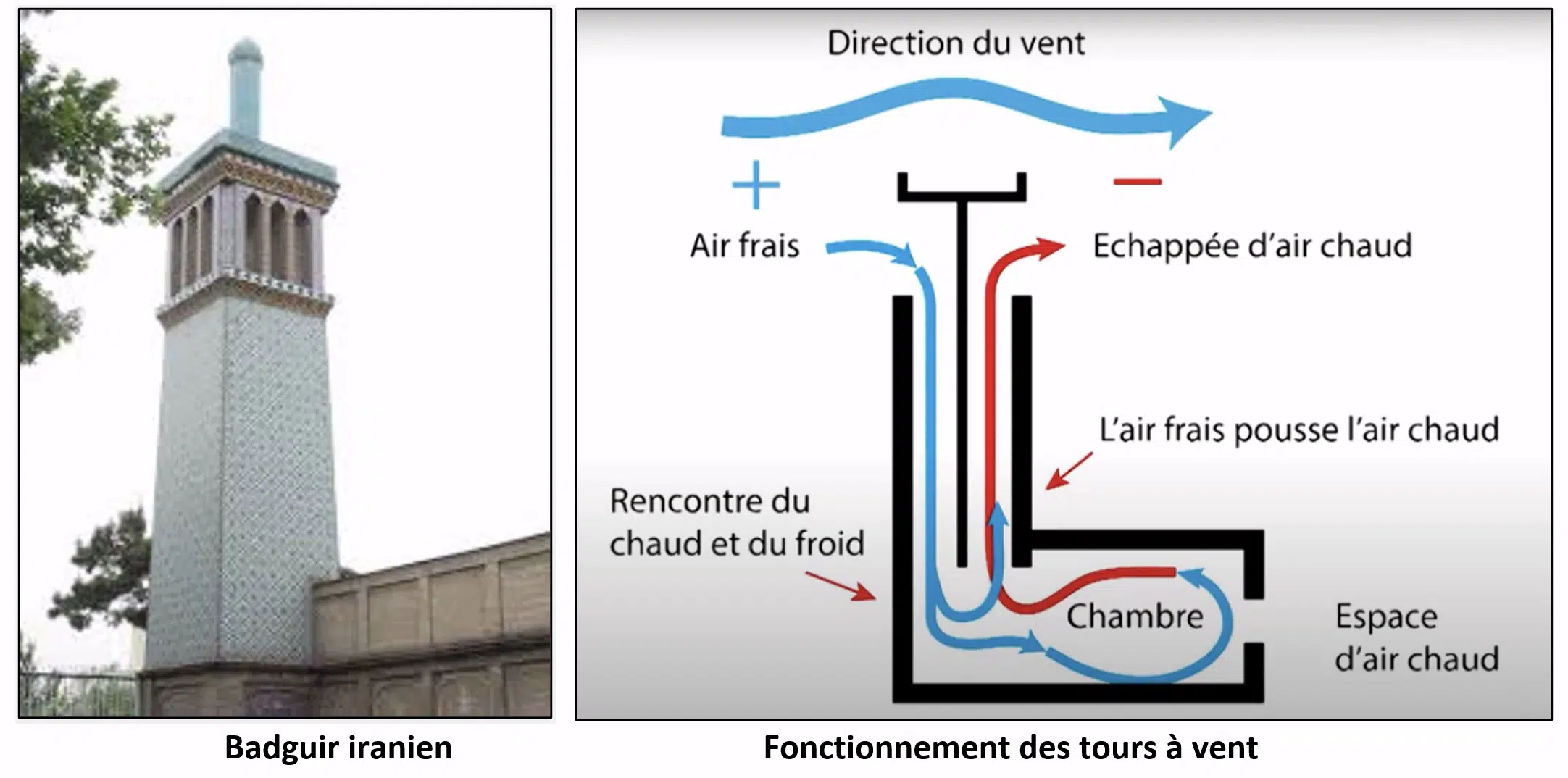
Large indoor volumes often have such inertia that they can take advantage of natural phenomena to regulate their climate. EOLIOS systematically studies the potential of natural ventilation and night-time free cooling, in order to assess to what extent outdoor air can contribute to cooling or renewing the volume. The simulations show how differences in air density between warm and cool layers generate a natural thermal draught, usable to evacuate the heat accumulated during the day.
This passive operating mode, combined with intelligent mechanical control, makes it possible to develop particularly high-performing hybrid strategies: natural ventilation at night, assisted supply during the day, modulation of the openings according to wind direction. This integrated approach, at the crossroads of physics and architecture, reduces energy dependence while ensuring constant air quality and thermal comfort.
Predictive comfort and simulation-assisted design
Understanding before building
Numerical simulation offers the possibility of observing a building even before it is built. By virtually reconstructing the geometry, the materials and the climate conditions, EOLIOS analyses the real behaviour of a high-ceilinged space from the design stage. This predictive approach makes it possible to anticipate the thermal and aeraulic phenomena liable to affect comfort: warming under the glass roof, air-stagnation zones, imbalances between sunlit façades and shaded areas.
The studies carried out form a true virtual laboratory, in which the architectural and technical choices can be tested, compared and optimized before any implementation — bringing a concrete physical view to decisions often driven by aesthetic or functional constraints.
Adjusting and securing the design
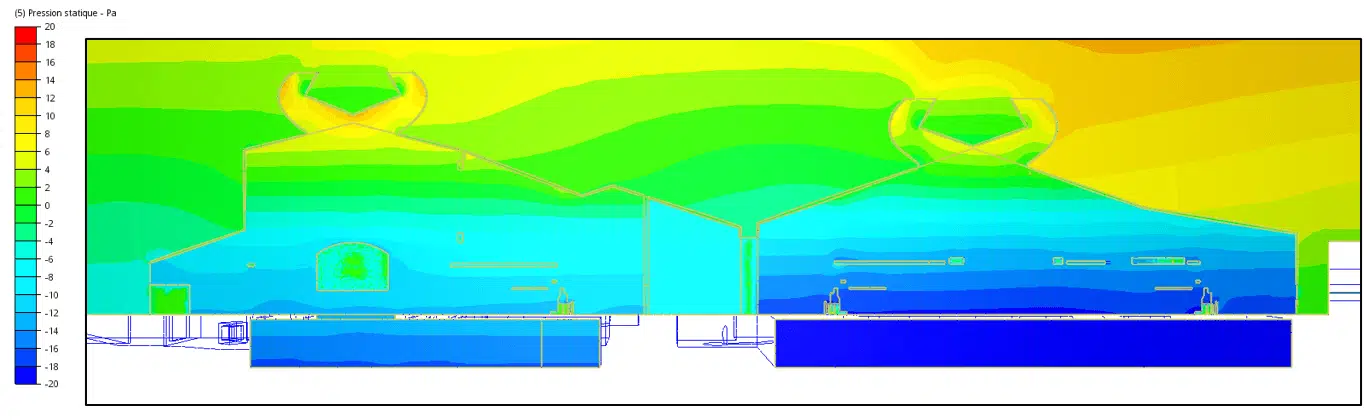
The results from CFD are not fixed images: they serve to validate and adjust the design. The three-dimensional maps of temperature, velocity and pressure make it possible to assess the performance of the climate system precisely, to check the consistency of the air supply and to detect the zones to optimize. These analyses make the choices more reliable by identifying the most sensitive parameters — nozzle orientation, air flow rates, supply temperature, solar factor of the glazing.
This scientific approach, based on measurement and comparison, strengthens the quality of projects and reduces the uncertainties linked to great heights or complex geometries. It ensures that the building, once built, will faithfully reproduce the expected performance.
Designing comfort as a performance criterion
In the EOLIOS approach, comfort is not a consequence of the project: it becomes a central performance criterion. The CFD studies incorporate the notions of thermal comfort and radiation from the sketch stage, supporting architects and HVAC engineers in their choices of spatial organization, air diffusion and façade transparency. This collaborative approach fosters an integrated design, where physical constraints become architectural opportunities.
Finally, the use of simulation brings an essential dimension of predictability: it guarantees that comfort, thermal stability and energy performance will be achieved, whatever the mode of operation. This control of the indoor climate before construction is a decisive asset for atrium and large-hall projects, where the perception of the spaces depends directly on the quality of the thermal and luminous atmosphere.