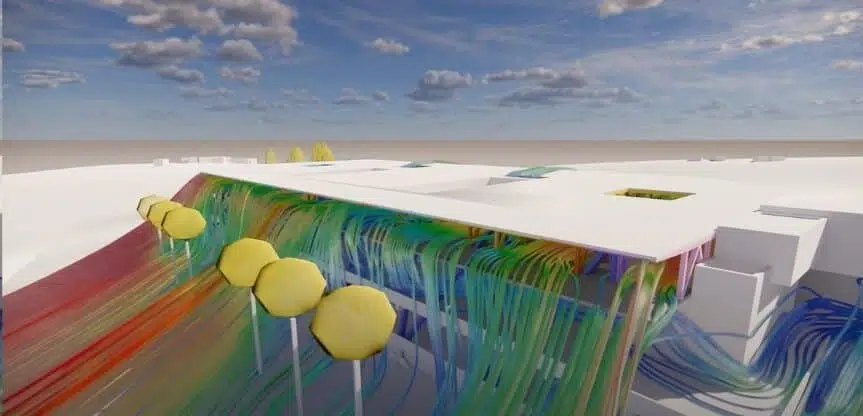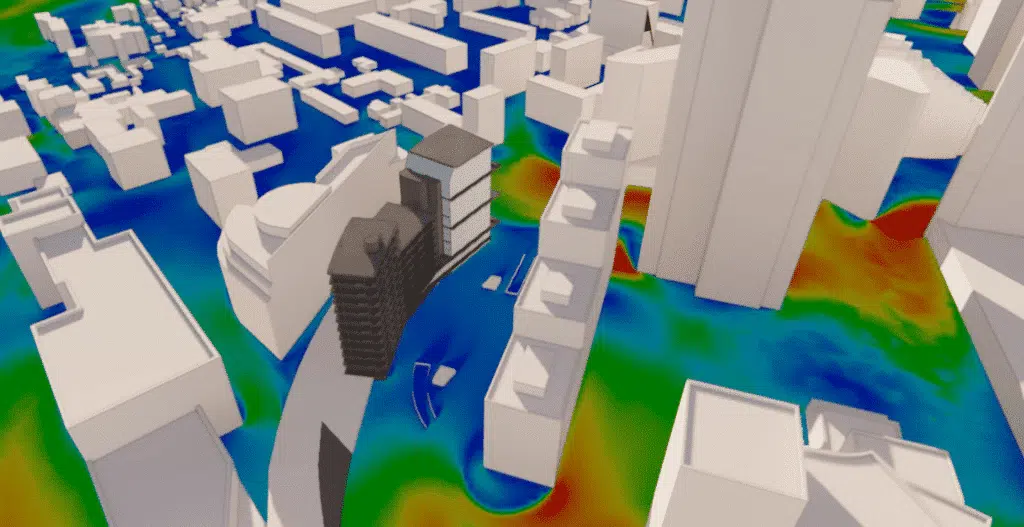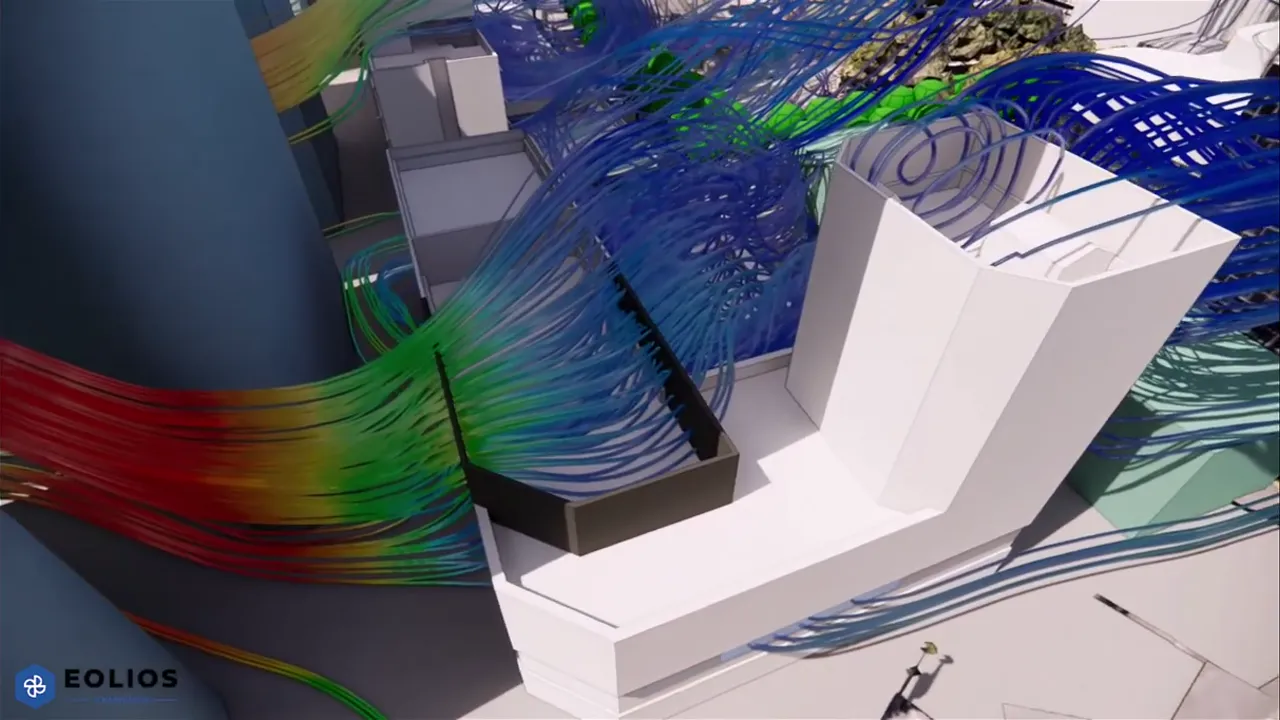
CFD simulation of the wind potential of a Balenciaga building in Milan: a stream tube of south-west wind is followed from the site, around the building, then under its roof where wind turbines could be installed.
Updated on 25 November 2026
A complete tour of the wind around and under a building, to understand where it speeds up enough to turn wind turbines. This is the basis for optimising the roof geometry.
Click a passage to play it in the player.
This video comes from the CFD study of the wind potential of a Balenciaga building in Milan, carried out by EOLIOS. The building has a roof with an aerodynamic profile, under which wind turbines could be installed.
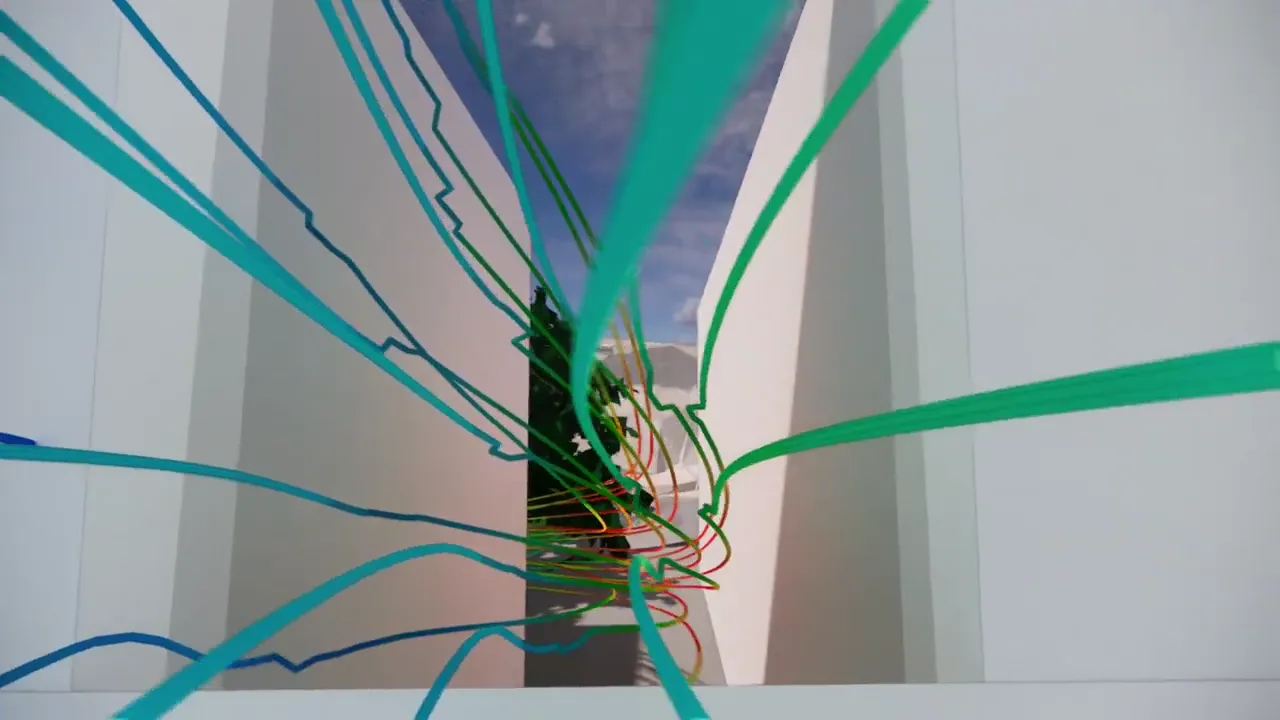
It follows a stream tube of south-west wind for about twelve minutes: approaching the site, flowing around the building and its trees, then passing under the roof and between the beams of the roof structure. The colours indicate speed: we see where the air slows down and where it speeds up.
For this project in Milan, the aim was to assess whether it made sense to install wind turbines under the building's roof without compromising its architecture.
A bundle of streamlines coming from the same area. Following it shows how the same mass of air flows around an obstacle, slows down or speeds up.
EOLIOS built a precise digital twin of the site, with the beam arrangements, air volumes and neighbouring buildings, then simulated the wind for several orientations to optimise the geometry for the best wind turbine output.
View the full study: wind potential of the Balenciaga buildingThe video shows the wind's path to the areas considered for wind turbines. The full study explains which phenomena increase the wind potential and which designs were proposed to the project teams.
View the study results: wind potential of the Balenciaga buildingThe video, the stream tube and the link with the wind energy study.
A CFD simulation of the south-west wind around a Balenciaga building in Milan, followed as a stream tube from the site to under the roof.
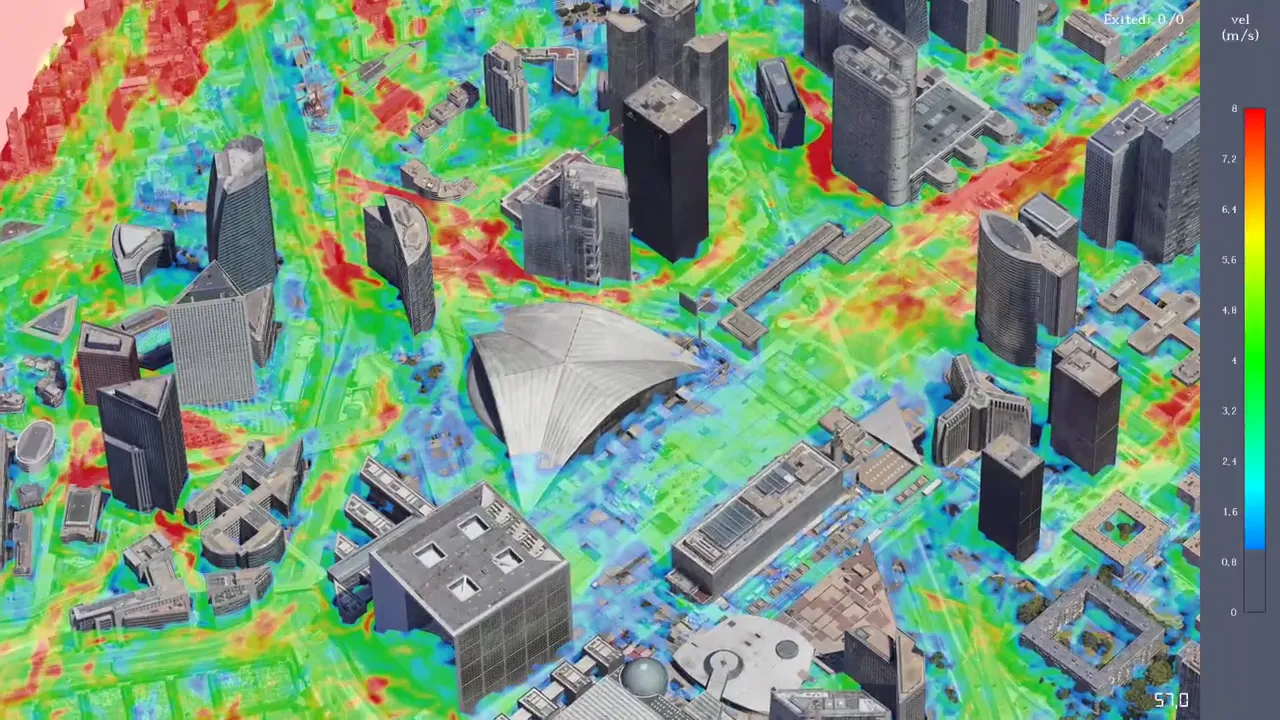
They represent air speed: red for fast air, green for medium speeds and blue for slow air.
It follows the wind step by step, from its approach to the site to inside the roof structure. The chapters let you go straight to the passages that interest you.
Its profile guides and narrows the wind. Where the passage narrows, the air speeds up, which can increase a wind turbine's output.
The phenomena that increase the wind potential and the proposed designs are presented in the full Balenciaga building study.
Explore our expertise, projects and technical papers to go further than the FAQ.
The simplest thing is to talk it through together. Our engineers reply with an initial technical read.