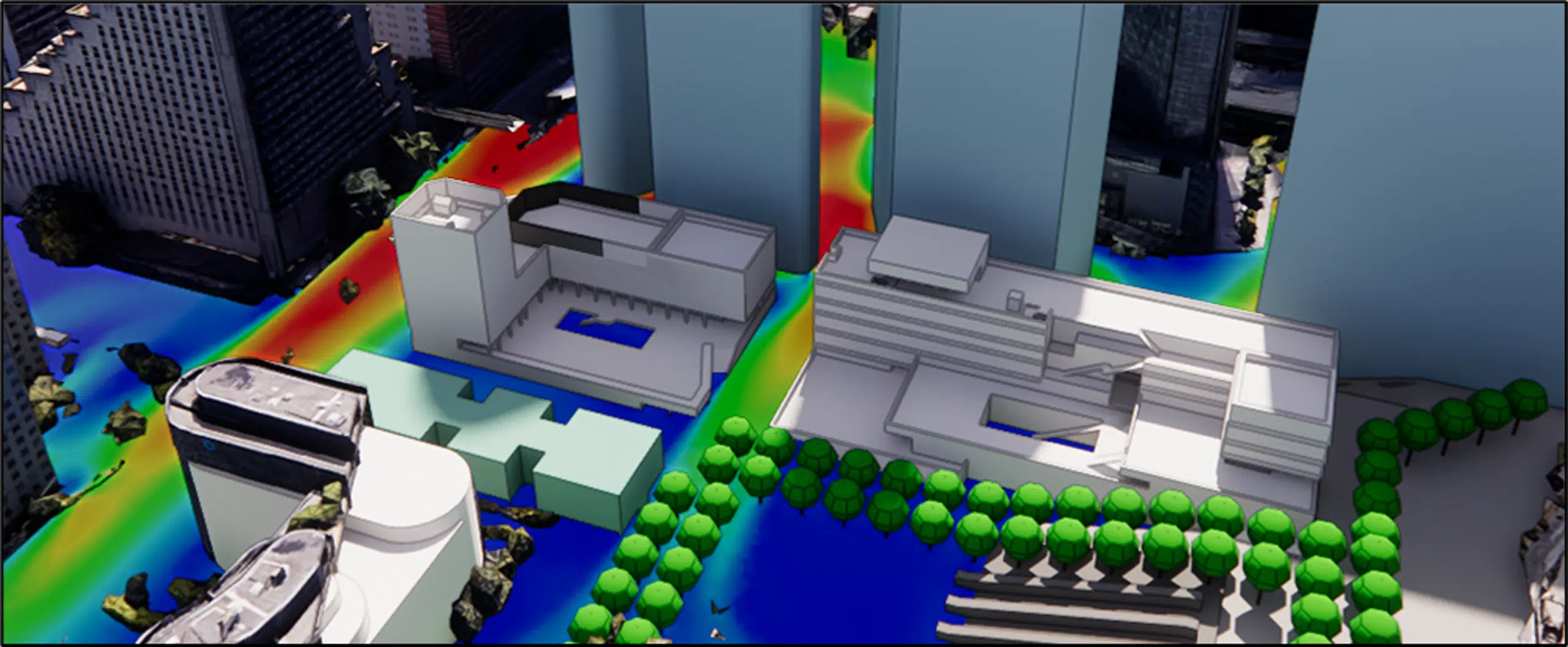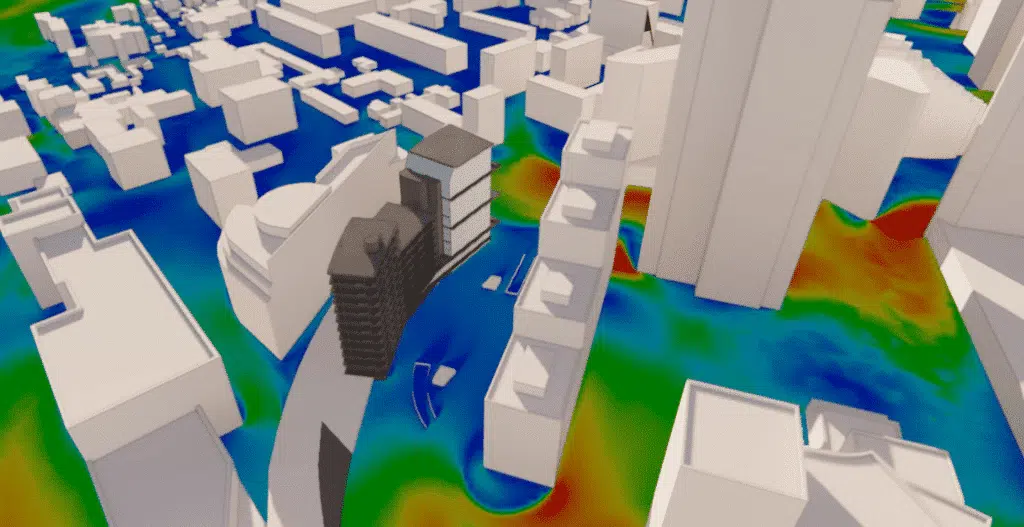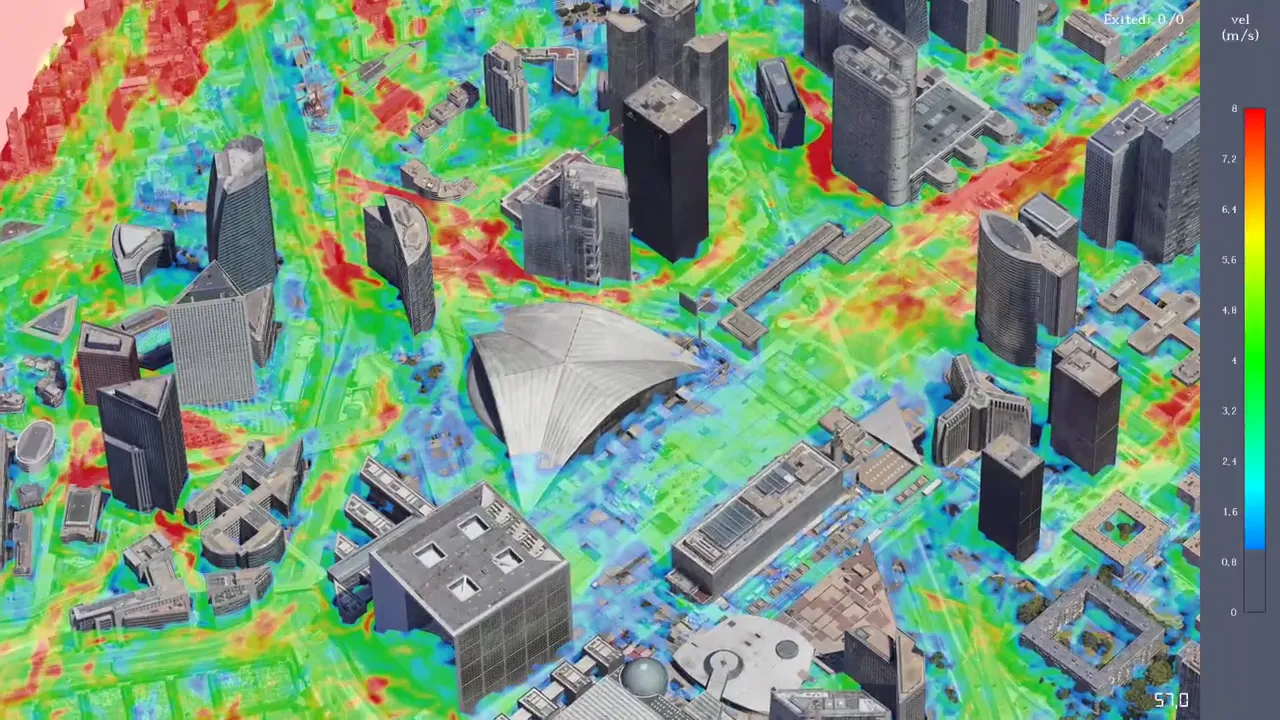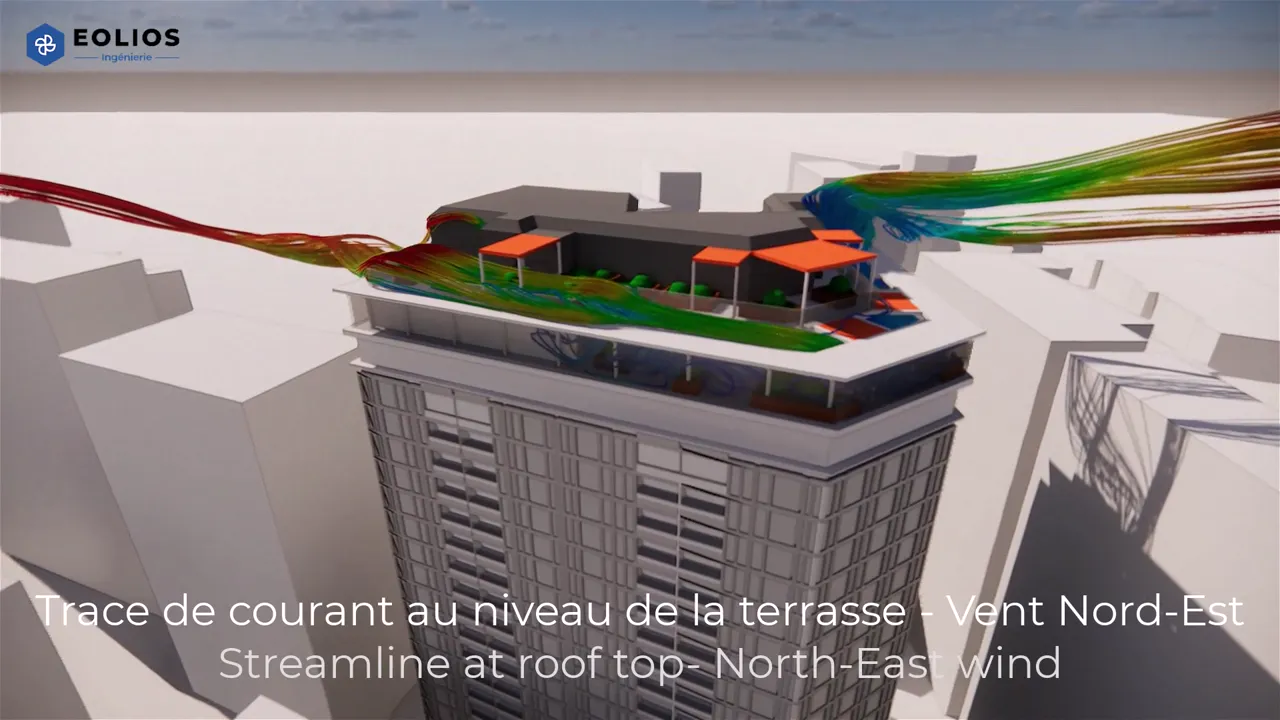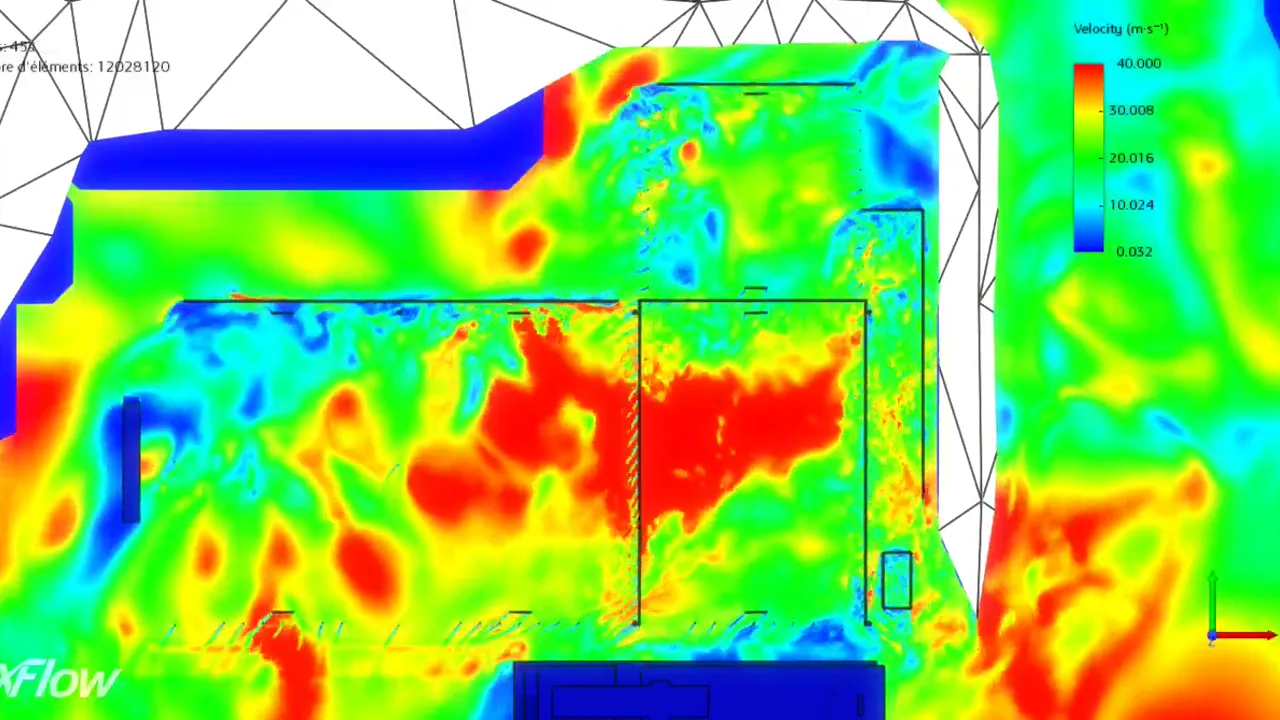
CFD simulation of the wind around a future school in the heart of La Défense: accelerated winds at the foot of the towers, vortices, passages between buildings and outdoor areas used by pupils.
Updated on 25 November 2026
Two and a half minutes inside a wind calculation at La Défense: where the air accelerates at the foot of the towers, where it swirls, and what pedestrians will feel in the passages and outdoor areas of a future school. This is the basis for identifying exposed areas and providing solutions.
Click a passage to play it in the player.
This video comes from the wind comfort study for a planned secondary school and European school in the La Défense district, in Courbevoie. The site is surrounded by high-rise buildings, which strongly alter airflow at ground level. The simulation reproduces in 3D the existing district and the project buildings.
The camera alternates between flyovers and ground-level views. The speed planes show the calm areas, in blue, and the accelerated winds, in red; the streamlines show the air curling around the towers and rushing between the buildings.
The project includes a secondary school and a European school in a very dense urban area, among high-rise buildings. For children, accelerated winds raise questions of comfort and safety. EOLIOS studied the airflow on the future site to understand the effect of the surrounding obstacles.
Acceleration of the wind when it is forced through a narrow space, for example between two buildings. At ground level, it creates areas of accelerated wind that are uncomfortable, even dangerous, for pedestrians.
The study characterised the site's wind (speed, direction, terrain roughness), then simulated the airflow around the 3D model of the district. The results made it possible to identify the most exposed areas, those this video shows.
View the full study: pedestrian comfort at La DéfenseThe video makes visible the phenomena the study quantified: accelerated winds at the corners, the Venturi effect between buildings, vortices at the foot of the towers. These results were used to propose solutions for users' comfort and safety, detailed in the full study.
View the study results: pedestrian comfort at La DéfenseThe video, wind at pedestrian level and the link with the comfort study.
A CFD simulation of the wind in the La Défense district, around a planned secondary school and European school. The speed planes and streamlines show where the air accelerates, where it swirls and what pedestrians feel at ground level.
A tower deflects towards the ground part of the wind that strikes it high up, where it is faster. This air comes back down along the façade and accelerates at the corners, creating accelerated winds at pedestrian level.
Because that is where users' comfort is decided: walking, waiting, playing in a schoolyard. A wind that is acceptable on a roof can become unpleasant, even dangerous, in a narrow passage at ground level.
On the speed planes, blue indicates calm air and red accelerated winds. The streamlines show the path of the air around the buildings.
The exposed areas and the solutions proposed for users' comfort are presented in the full pedestrian comfort study at La Défense.
Explore our expertise, projects and technical papers to go further than the FAQ.
CFD expertise, delivered projects and technical dossiers: the whole Air & Wind field in one place.
The simplest thing is to talk it through together. Our engineers reply with an initial technical read.