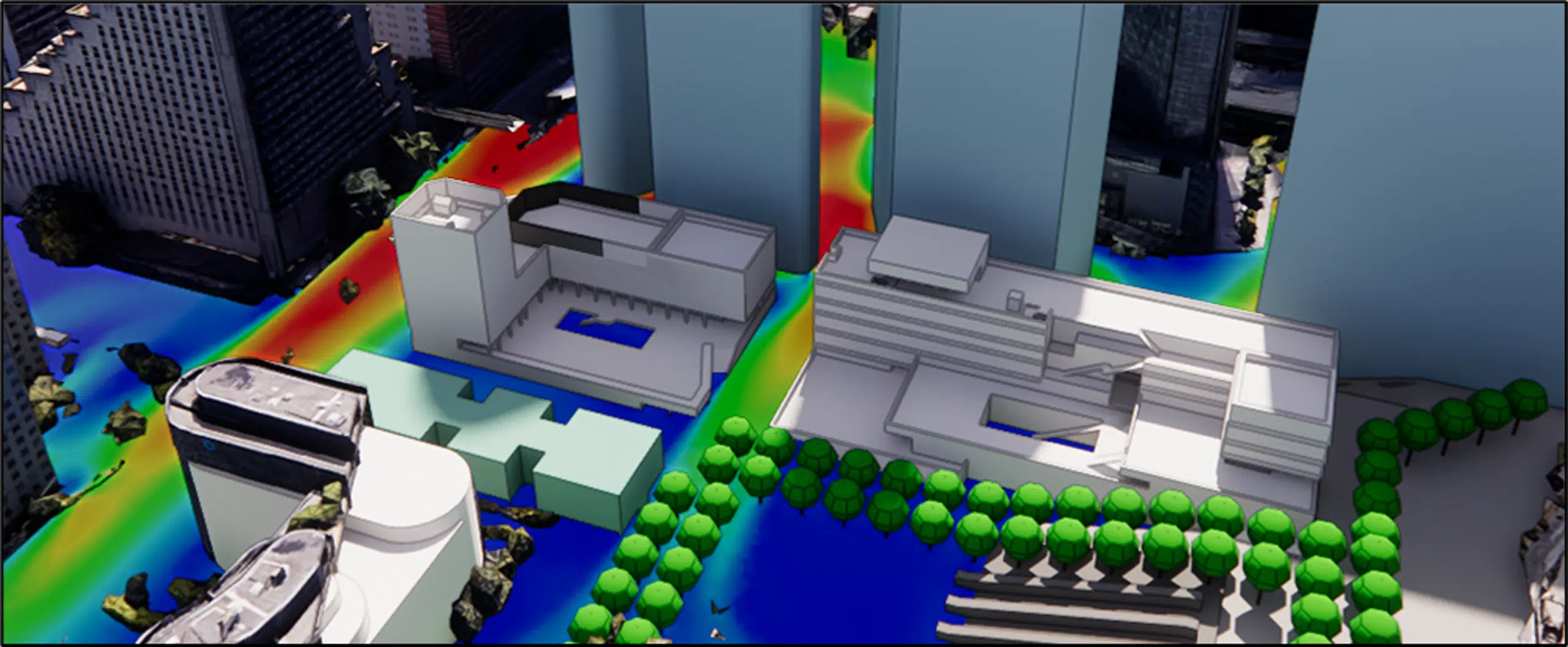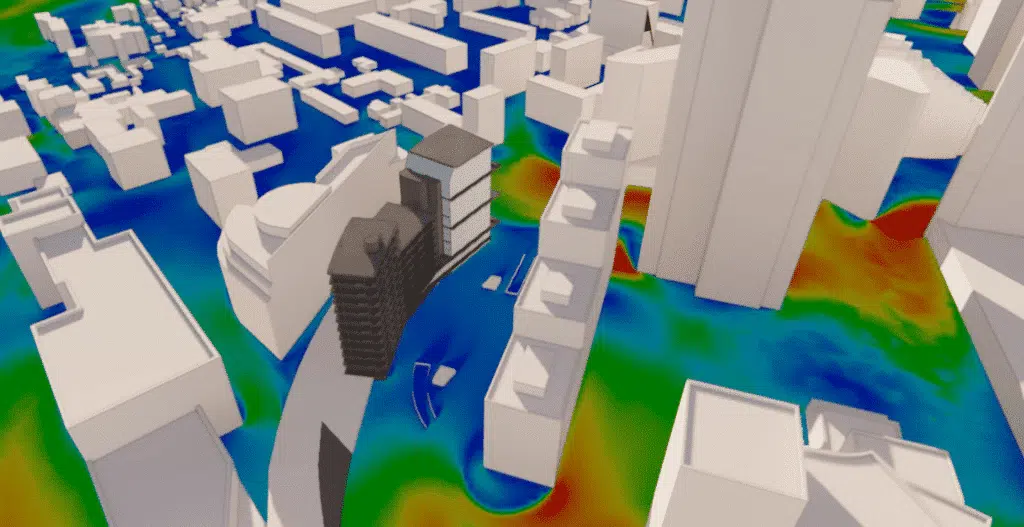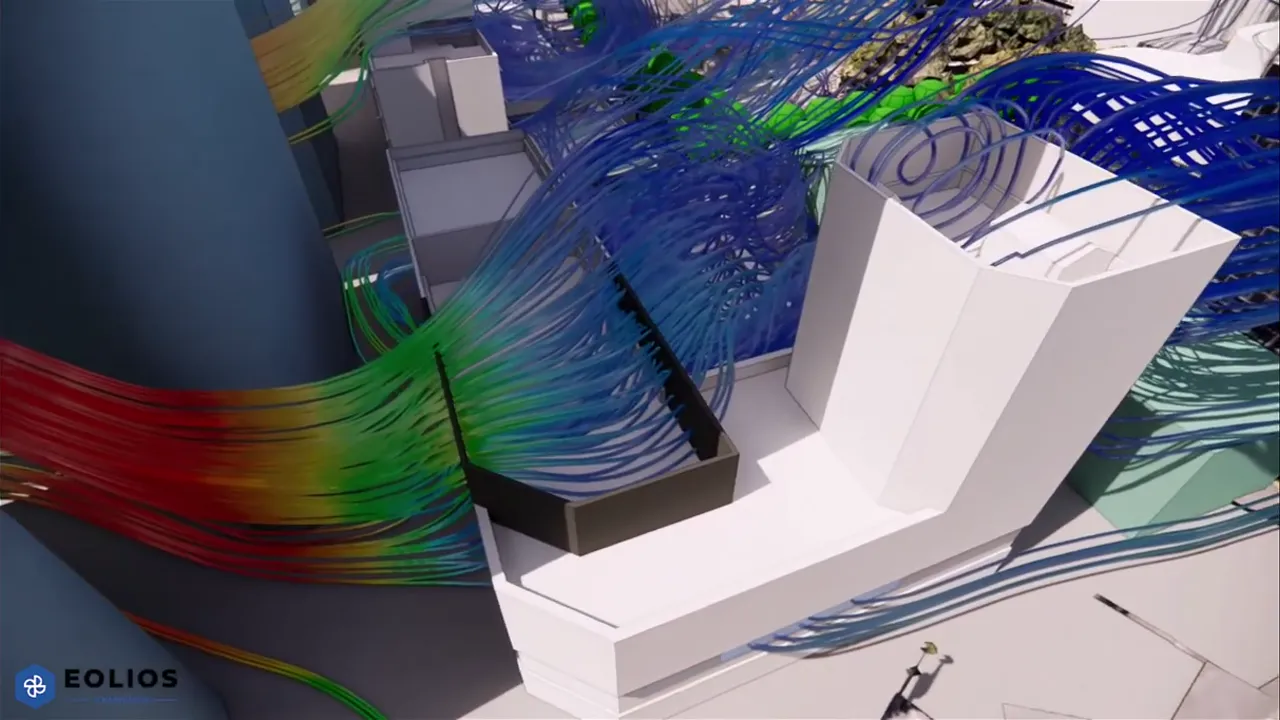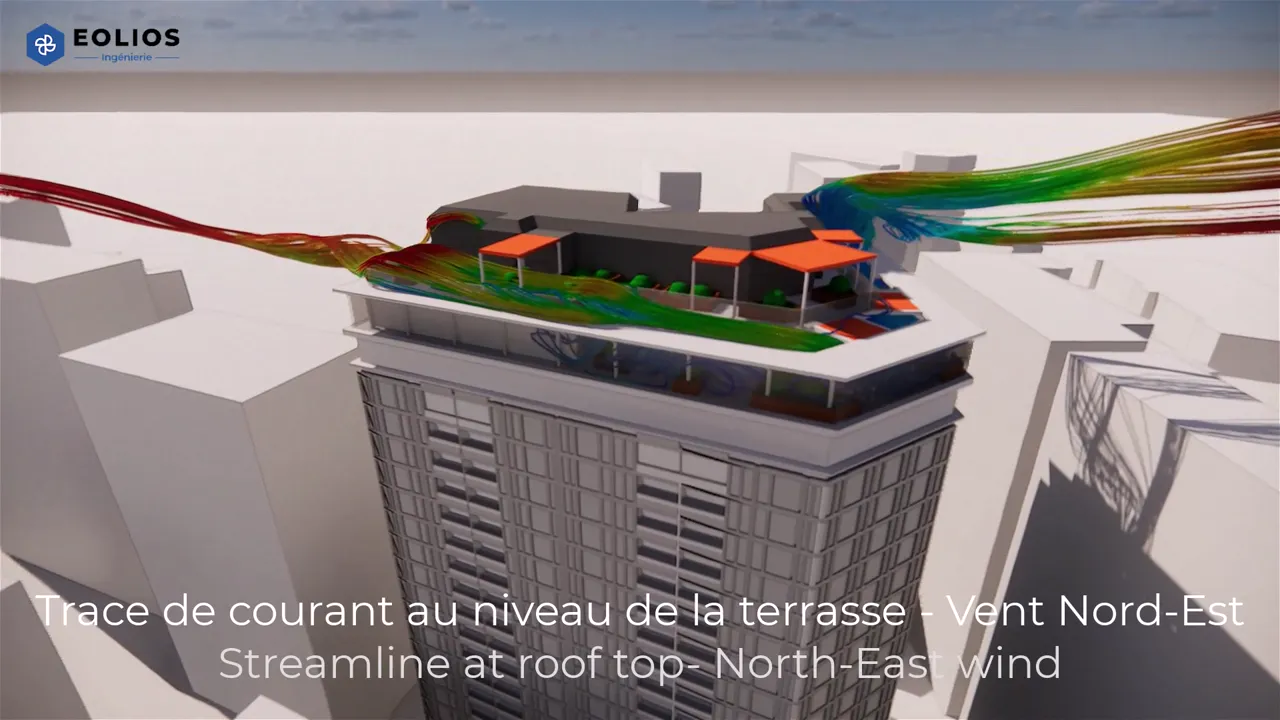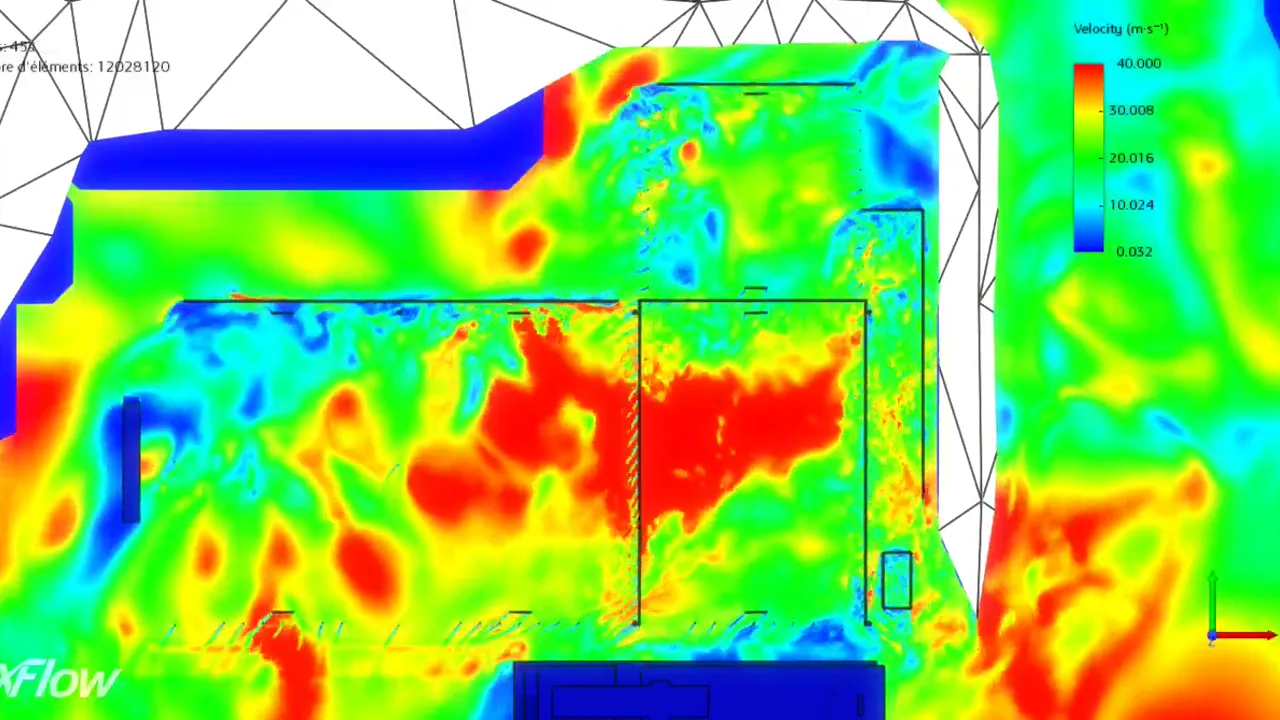
LES CFD simulation of the wind over the La Défense district: seen from above, the flow fluctuates constantly, with gusts rushing between the towers and calm areas sheltered by the buildings.
Updated on 25 November 2026
In just over a minute, we see that the wind in a district of towers is never uniform: it slips between the buildings in gusts. This unsteadiness is what makes pedestrians feel uncomfortable.
Click a passage to play it in the player.
This video comes from the CFD study of pedestrian comfort at La Défense, carried out by EOLIOS for a secondary school and a European school in Courbevoie. The district, very dense and bristling with high-rise buildings, creates many obstacles to the wind.
It presents an LES simulation: instead of a fixed, averaged flow, we see the wind fluctuate constantly. The colours show air speed near the ground: the red gusts sweeping through the district between the towers, and the sheltered blue areas.
Building a secondary school and a primary school in the middle of a business district requires understanding how the neighbouring towers alter the wind at ground level, where pupils move around.
Large Eddy Simulation of turbulence. It follows vortices and gusts over time, whereas a conventional simulation only gives an average flow.
EOLIOS defined the inlet wind profile according to the Eurocode, using data from a representative weather station, then mapped velocities near the ground to identify exposed areas and propose design measures.
View the full study: pedestrian comfort at La DéfenseThe video shows the turbulent nature of the wind in the district. The full study presents the map of near-ground velocities, the exposed areas identified and the solutions proposed for pupils' comfort.
View the study results: pedestrian comfort at La DéfenseThe video, LES simulation and the link with the pedestrian comfort study.
An LES CFD simulation of the wind in the La Défense district, seen from above: air speed near the ground, with the gusts between the towers and the sheltered areas.
They represent wind speed: red for the strongest gusts, green for moderate speeds and blue for calm areas.
Pedestrian comfort depends as much on gusts as on average speed. LES shows these fluctuations, which are invisible in a steady-state simulation.
The towers catch the wind at height and deflect it down towards the ground, then the air speeds up between closely spaced buildings.
The map of near-ground velocities and the proposed design measures are presented in the full La Défense pedestrian comfort study.
Explore our expertise, projects and technical papers to go further than the FAQ.
CFD expertise, delivered projects and technical dossiers: the whole Air & Wind field in one place.
The simplest thing is to talk it through together. Our engineers reply with an initial technical read.