EOLIOS, specialist in air-quality studies
We help you understand the risks associated with pollution at the scale of cities, buildings and systems.
Modelling
- Atmospheric release of pollutants
- Indoor air quality
- Trichloramine dispersion in swimming pools, HVAC validation
Studies & audits
- Impact studies for new industrial sites
- Site audits, surveys and measurements
- Dust-pollution study
Risks & capture
- Odour-dispersion studies
- Covid and virus risk study
- Sizing of capture systems in industry and laboratories
Air quality and pollutant dispersion: major issues
Air quality in the city
Outdoor air pollution is one of today's major environmental problems. Urban areas are characterised by a wide variety of pollutant sources: building heating, ventilation and air-conditioning (HVAC) systems, traffic, industry, and even certain tree species that promote allergenic risks. Urban air pollution is associated with a wide range of acute and chronic health effects.
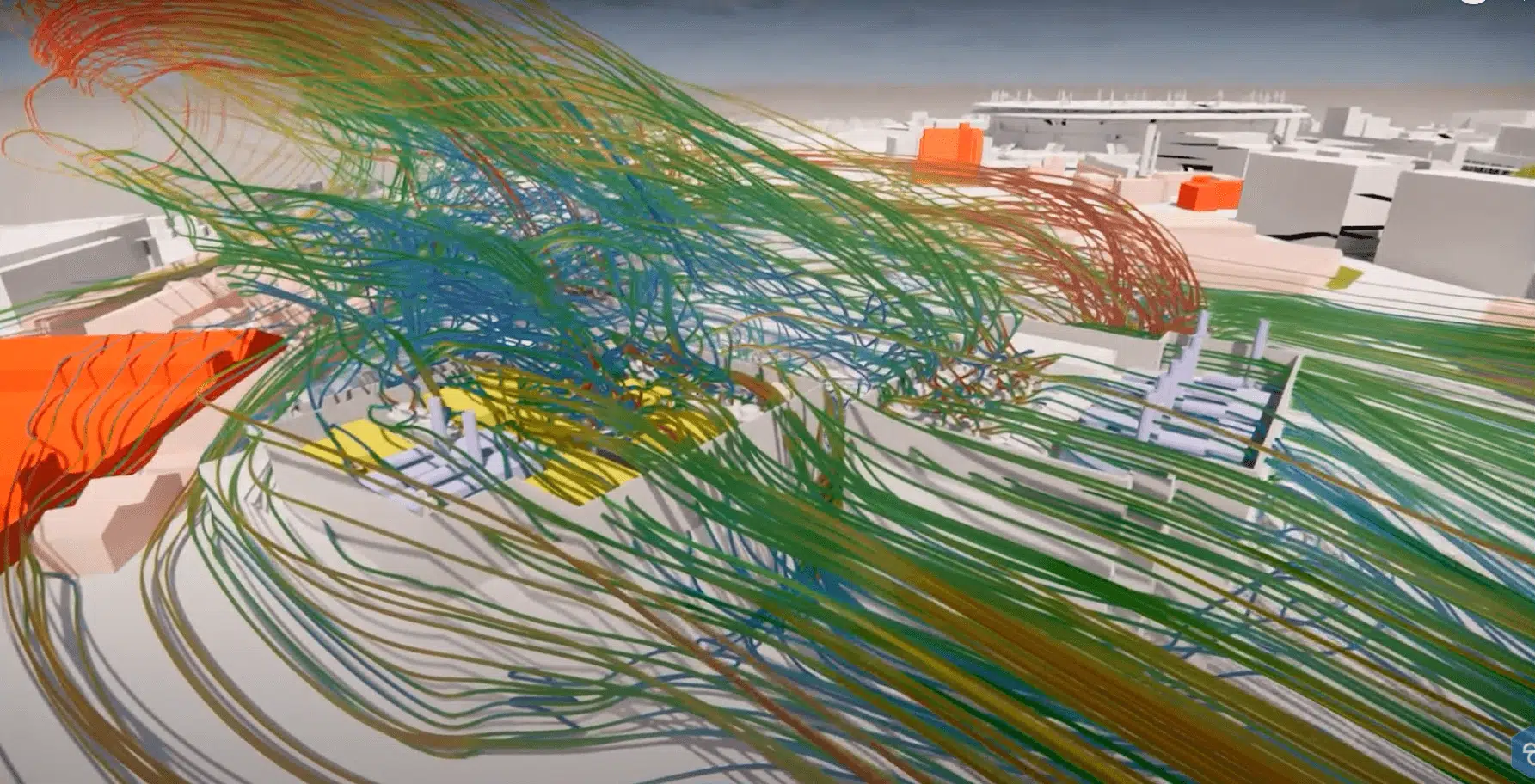
Moreover, outdoor air quality affects indoor air quality through mechanical and/or natural ventilation, which replaces indoor air with outdoor air. Conversely, in highly ventilated areas, pedestrian wind comfort and safety can be degraded. In every practical situation, a compromise must therefore be found between urban ventilation (for indoor and outdoor air quality) on the one hand, and pedestrian wind comfort and safety on the other. Urban wind flow is strongly linked to urban morphology — density, layout, shape and dimensions of the buildings. Urban pollution flows can be assessed at large scale by measurement.
Air quality and control of the dispersion of atmospheric pollutants are key issues for industrial facilities. Whether stack plumes or suspended fine particles, these emissions must be controlled to limit their impact on the environment and populations. CFD modelling (Computational Fluid Dynamics) is a powerful tool to analyse these phenomena and ensure compliance of projects with the regulations in force.
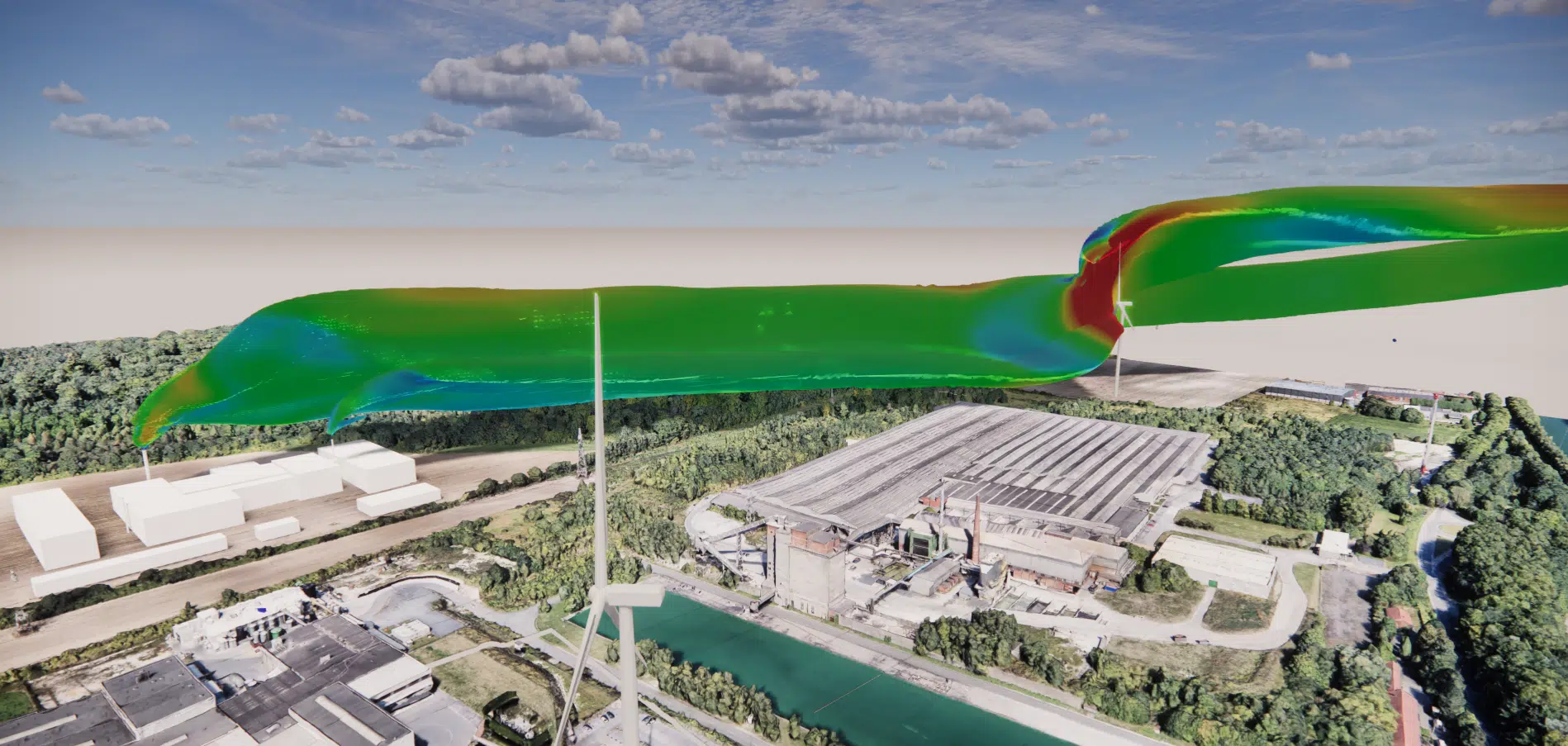
Impact study and air-quality simulation
Preserving air quality: a regulatory matter
The presence of atmospheric pollutants — fine particles (PM10, PM2.5), heavy metals (lead, cadmium), nitrogen oxides (NOx) and sulphur oxides (SO2) — can have an impact on human health. To limit these risks, standards have been set at European and national levels; in France, they are governed by the regulations specific to installations classified for environmental protection (ICPE). These standards define thresholds not to be exceeded to guarantee air quality and public safety.
Operators must ensure that their emissions comply with these limits, particularly around sensitive areas (homes, schools, hospitals). Compliance with these thresholds is an essential criterion for any industrial project.
Technical paper: ICPE installations and Legionnaires' disease — understanding the risks of cooling towers
Simulations to assess and anticipate industrial emissions
CFD modelling is a key tool in environmental impact studies: it makes it possible to simulate the dispersion of atmospheric pollutants under realistic conditions. By incorporating parameters such as local weather, topography and the built environment, CFD provides an accurate representation of pollutant dispersion, making it possible to check the compliance of emissions with the standards in force.
CFD also makes it possible to simulate specific scenarios — such as the siting of new infrastructure — in order to anticipate their effect on pollutant dispersion. These simulations help to adjust projects according to the results obtained. Finally, CFD provides clear 3D visualisations of pollution plumes, which make the results easier to understand and allow effective communication with authorities, decision-makers and local residents, by making visible the potential impact of emissions on the environment.
Modelling the spread de la pollution industrielle
The parameters that influence dispersion
The dispersion of pollutants in the atmosphere is influenced by many environmental and structural factors. CFD modelling incorporates these parameters to accurately simulate pollutant dispersion in a variety of environments. Understanding these elements is essential to assess the impact of industrial emissions and ensure compliance with environmental standards.
The influence of weather conditions
The nature of the dispersion of chemical pollution (cold or hot) and of dust, whatever its source, is influenced by the local wind regime. Weather conditions play a key role: the wind speed and direction determine the trajectory of the plumes, while temperature and humidity influence the density of the gases and their ability to rise or stay near the ground. For example, strong winds favour rapid dilution of pollutants, while weak winds or atmospheric stagnation can cause local accumulation.
For each study, we carry out a detailed climate analysis, based on local weather data. This analysis makes it possible to define, with the client, the most representative or critical simulation scenarios, taking into account seasonal variations and extreme conditions.
Obstacles and surroundings: buildings, infrastructure and terrain
The surrounding infrastructure — buildings, industrial facilities or wind turbines — significantly alters the airflows and influences pollutant dispersion. These structures can create turbulence zones, wake effects or air recirculation, altering the trajectory and concentration of the plumes.
The natural terrain — hills, valleys, ground variations — acts in a similar way, channelling or blocking the airflows. In hilly areas, pollutants can remain locally trapped; in open terrain, dispersion is generally easier.
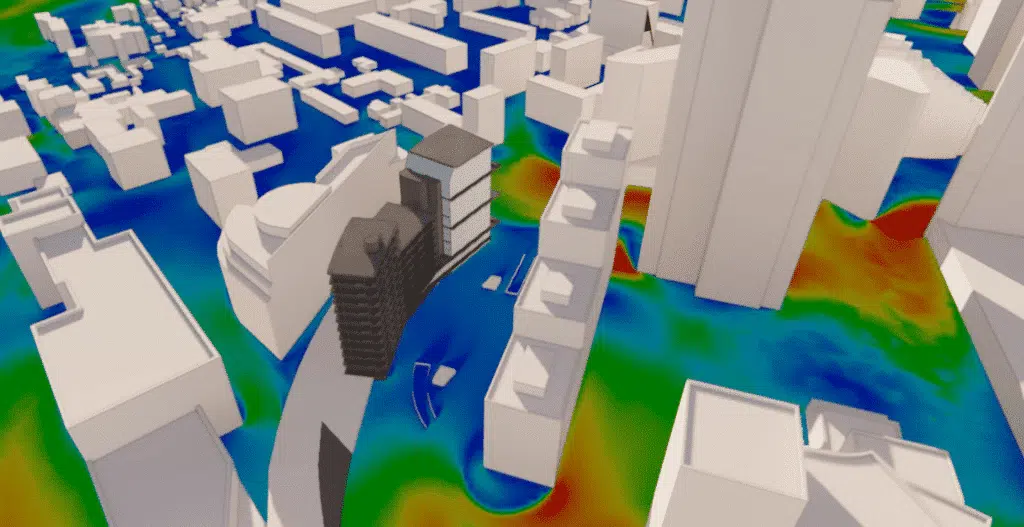
Our CFD simulations incorporate these elements to provide accurate results tailored to each site, in dense urban environments as well as in open rural ones. This approach makes it possible to anticipate the sensitive zones and to propose solutions to limit the impact of emissions, offering an overall view of the dispersion mechanisms in service of air-quality control and regulatory compliance.
Our expertise in air-quality studies
At EOLIOS, our CFD modelling expertise goes far beyond simple simulations. We design tailor-made studies that guarantee reliable, accurate results, and help our clients achieve concrete objectives: on-site measurement campaigns, regulatory compliance, optimisation of installations or clear communication of environmental impacts.
Realistic models for reliable results
Every project is unique. That is why we create detailed 3D models tailored to the specifics of the studied site: industrial buildings, surrounding infrastructure, terrain, or disruptive elements such as wind turbines. This bespoke approach makes it possible to simulate real situations and obtain accurate, essential results to assess pollutant dispersion in a variety of environments:
- ✓
Study the impact of odours in the city or near an industrial, agricultural or waste-treatment site.
- ✓
Study the impact on environmental safety by identifying the zones where the maximum permissible concentration (MPC) of pollutants may be exceeded.
- ✓
Analyse the uneven distribution of residual pollutant concentrations.
- ✓
Impact study in the event of accidental release of pollutants.
- ✓
Traffic impact study.
More than results: support towards your objectives
Our work does not stop at producing accurate simulations. We work with our clients to meet specific needs: ensuring compliance with environmental standards, producing impact maps for environmental impact assessments, or anticipating local residents' concerns. Thanks to clear, detailed 3D visualisations, we make the results accessible to all the project's stakeholders — authorities, decision-makers and local residents. These visual renderings are effective tools for communication and validation.