Monitoring indoor air quality
Good air quality is essential to health and safety — in industry, in the office and at home.
Pollutants are harmful particles that travel with the air; their concentration is measured in ppm (parts per million). The higher the pollution, the worse the air quality. These pollutants can cause health problems, a drop in productivity, discomfort and stress.
Polluted indoor air causes, in the short term, coughing, dizziness, headaches, mucous-membrane irritation and fatigue; in the long term, respiratory and cardiac diseases. According to the World Health Organization, indoor air pollution accounts for about 3% of the global burden of disease — while we spend up to 90% of our time indoors.
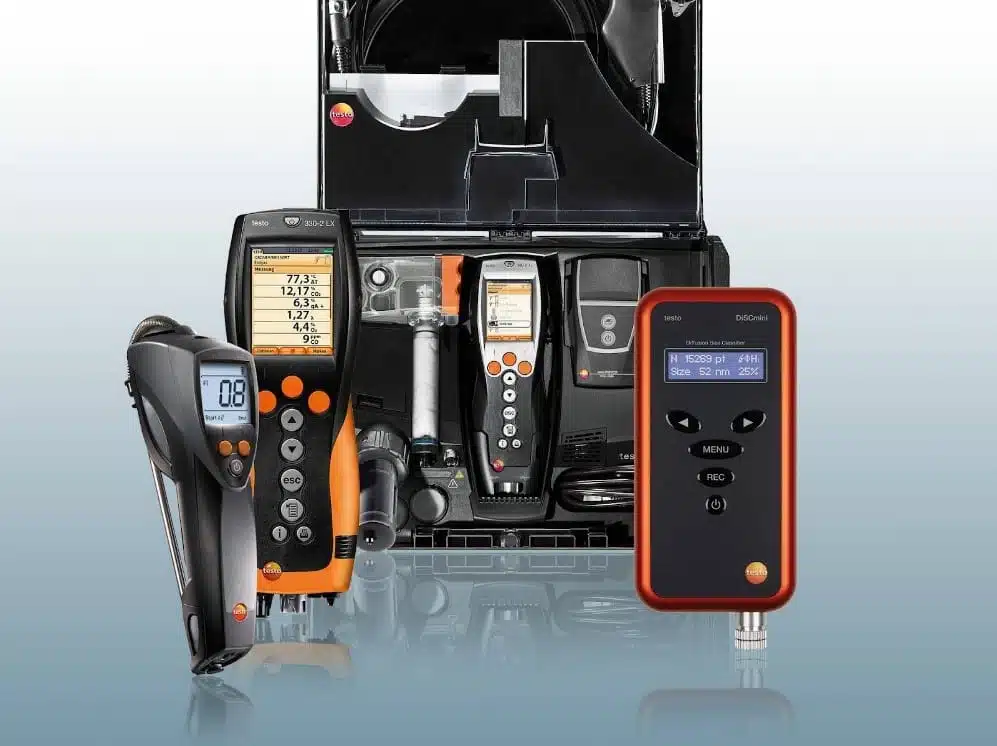
It is therefore important to monitor indoor air quality in order to: ensure that pollution does not exceed the limit values; check that the control measures work; choose the right level of personal protective equipment (PPE); and ensure that workers' health is not put at risk.
Indoor air pollutants
What are VOCs?
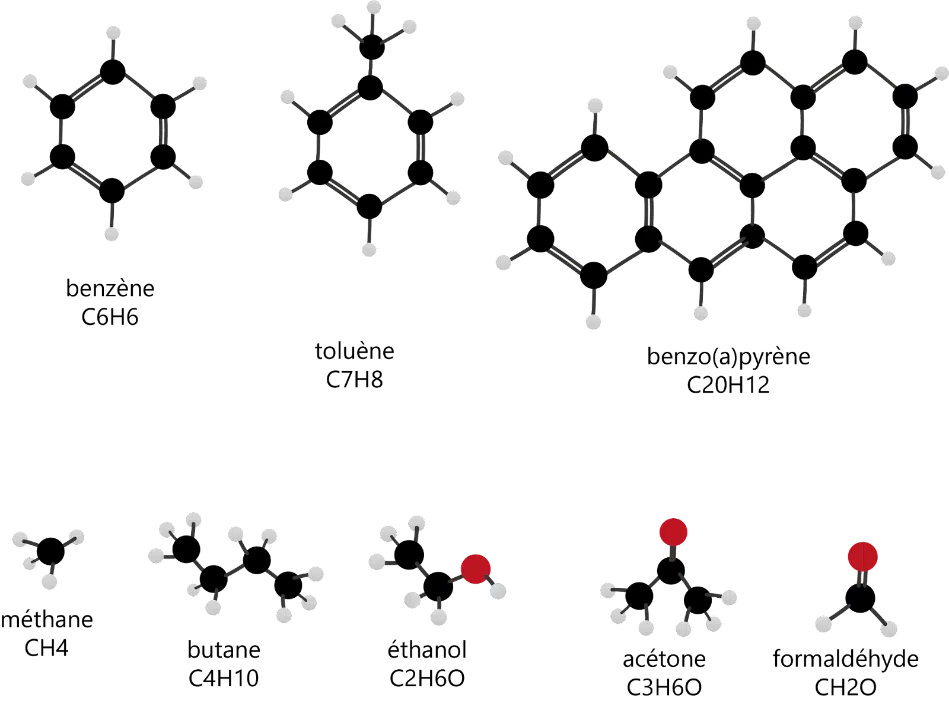
Volatile organic compounds (VOCs) are chemicals containing carbon. Their sources are many: cosmetics, air fresheners, fossil fuels, vehicles, industry. VOCs play an important role in both indoor and outdoor air pollution.
Not all are harmful, but some are considered atmospheric pollutants — benzene, formaldehyde, toluene; others, such as methane (emitted by marshes and ruminants), are naturally present and important for the Earth's biogeochemical cycle.
Exposure to VOCs can be reduced through several measures: ventilating indoor spaces properly, using low-VOC cleaning products and building materials, limiting excessive use of chemicals and favouring clean energy sources. Environmental regulations also aim to control and reduce VOC emissions. EOLIOS is able to assess VOC emissions and track their concentration in the air as well as their indoor impact.
What are fine particles?
Fine particles are airborne particles with a diameter less than or equal to 2.5 microns — hence their name PM2.5. They come from vehicles, power plants, industrial facilities, biomass fires and more generally from combustion. They contribute to air pollution and have a negative impact on health and the environment.
Where do pollutants come from?
- ↳
Tobacco smoke;
- ↳
Household and DIY products;
- ↳
Construction and decoration materials;
- ↳
Furniture and finishes;
- ↳
Heating and cooking appliances;
- ↳
Mould and allergens;
- ↳
Combustion equipment (industrial furnaces, generators).
The main factors that degrade indoor air
Insufficient ventilation, temperature-control problems, humidity that is too high or too low, painting work, renovation dust, cleaning equipment, chemicals and pesticides all degrade air quality. Good ventilation, eco-friendly products and humidity management are essential.
Indoor comfort and air quality
Indoor comfort is essential to the health and productivity of occupants, and contributes to energy savings. It rests on several criteria.
The absence of draughts
Air velocity reduces the build-up of pollutants, removes moisture and evens out the temperature; it should stay below 0.2 m/s in occupied zones.
Temperature uniformity
Marked thermal stratification must be avoided: the temperature should be uniform, in summer as in winter.
Good air quality
It depends on air humidity (too low, the air is dry and uncomfortable; too high, it favours bacteria, mould and dust mites), on ventilation (replacing indoor air with fresh outdoor air) and on air cleanliness (filtering the outdoor air so as not to reintroduce pollution).
CFD simulation of indoor air pollution
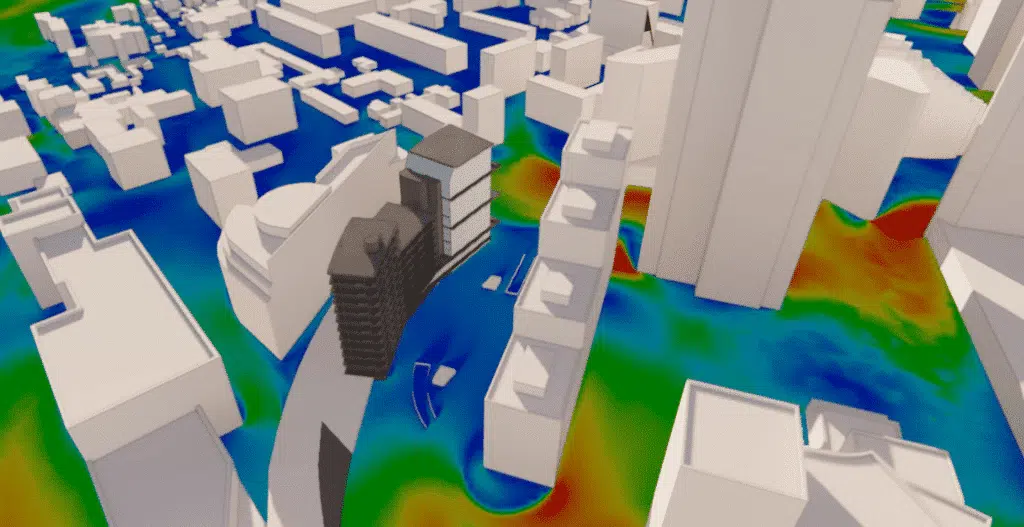
CFD modelling is a versatile tool for solving engineering problems related to analysing the propagation of impurities and particles in the air. It reproduces the movement of the air, taking into account heat and mass transfer, gaseous impurities and their dispersion, as well as the transport of suspended mechanical particles. It is thus possible to study the dispersion of pollutants in a room: they follow the airflow streamlines, through aeraulics.
The concentration of pollutants in a room varies with the ventilation method used. Airflow modelling is carried out using three-dimensional mathematical methods (the CFD approach). Analysing this distribution makes it possible to develop adjustments to the design solution, in order to reach the required pollution-level parameters throughout the room.
Example: the spread of a virus
Some viruses are transmitted orally, via droplets. We carry out CFD simulations to study the behaviour of droplets and aerosols and find suitable solutions to minimise the risk of oral infection — by predicting their spread and the impact of airflows on the risk of contamination.
The solutions EOLIOS offers
EOLIOS makes it possible to check and optimise the processes, drawing where necessary on on-site measurement campaigns carried out ahead of the study.
We model the ventilation of a room in several steps:
- 1
Audit — identifying the origin of the dust and pollutants.
- 2
Evaluation of the design solution — compliance, control of temperature, air velocity and humidity, via 3D CFD modelling.
- 3
Developing adjustments to the solution to reach the required pollution levels.
- 4
Detailed analysis near the process — air distribution, humidification, capture.
- 5
Specific contamination study for laboratories and cleanrooms.
By determining the air quality, the level of indoor comfort can be deduced. EOLIOS also designs ventilation systems — for example for cleanrooms — by determining the airflows so that pollutants do not reach the at-risk zones, ensuring high air quality.