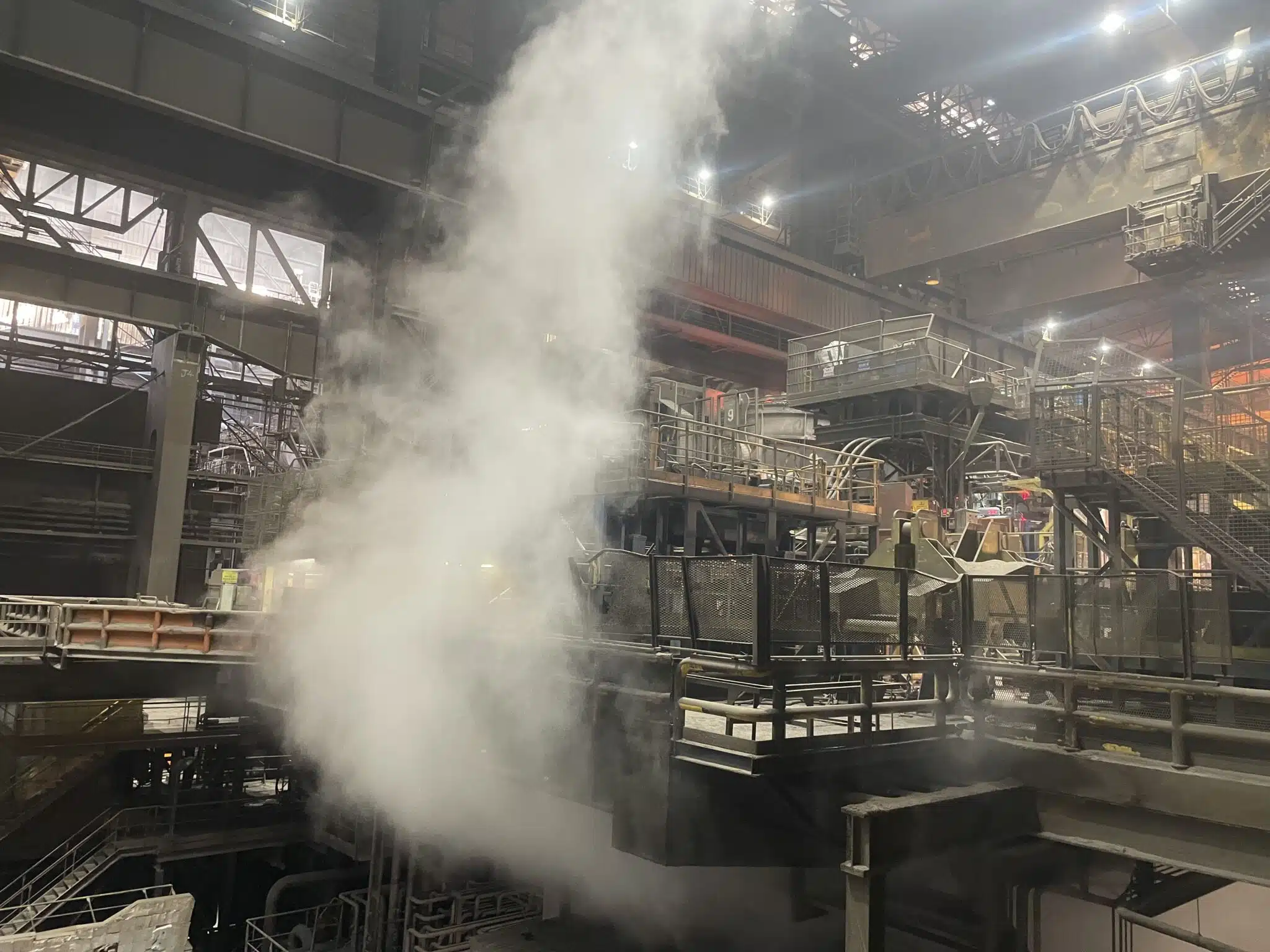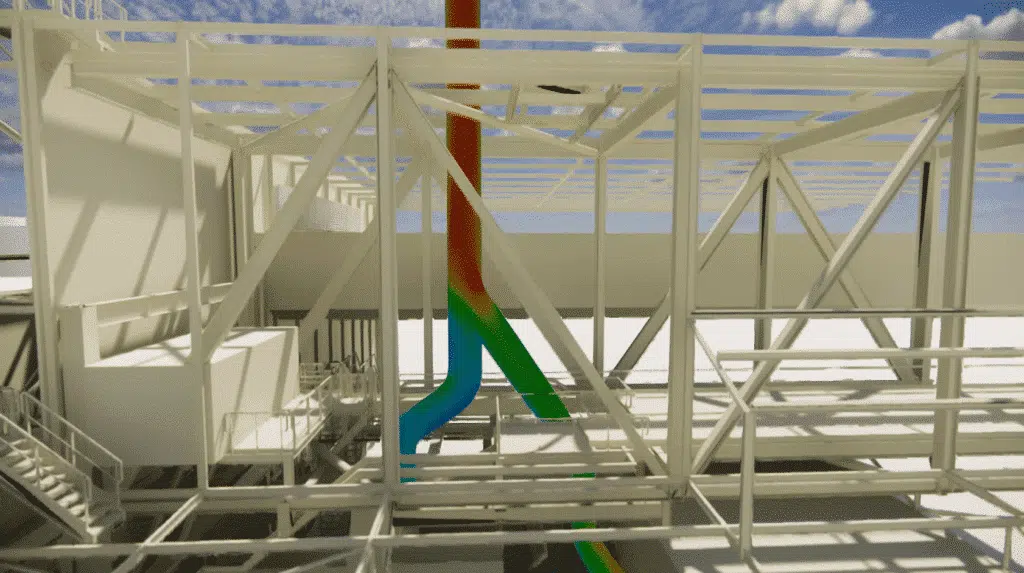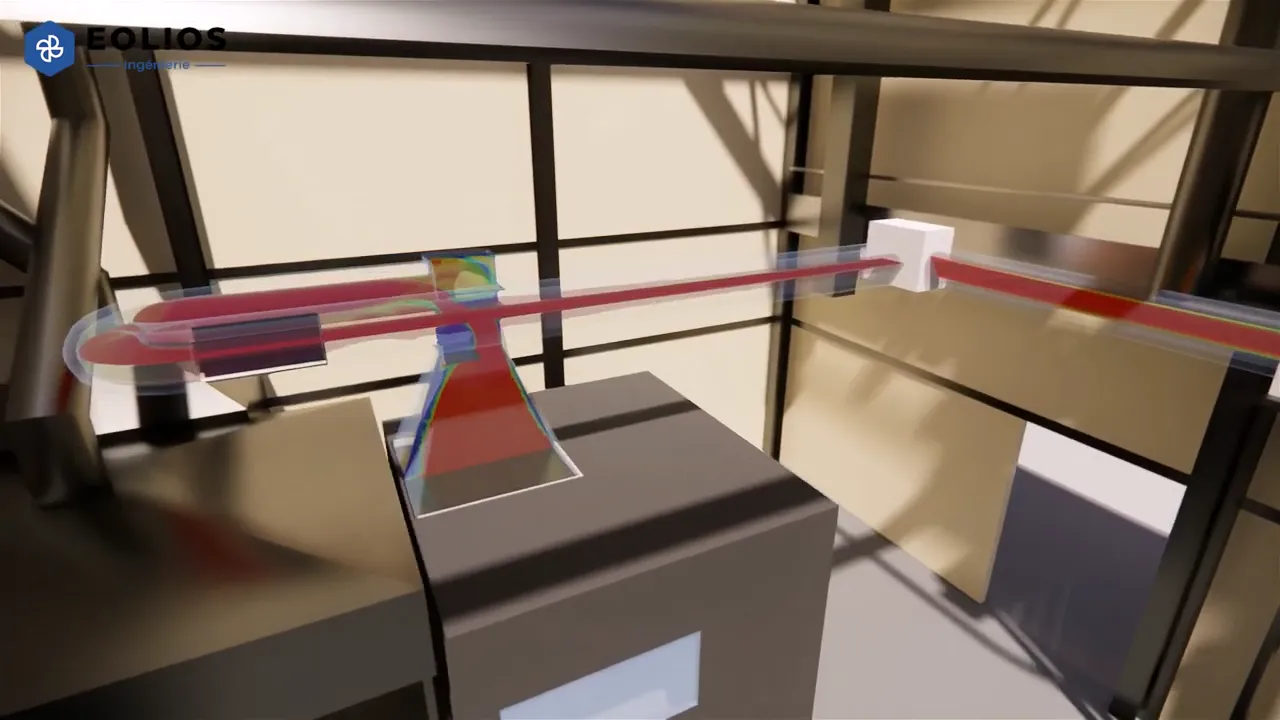
Footage shot during the audit of a steel plant: saturated steam escapes the extraction system, rises towards the roof and fills the hall. These are the leaks that EOLIOS then reproduced, and corrected, by CFD simulation.
Updated on 25 November 2026
One minute twenty of footage shot on site, without commentary, showing saturated steam escaping from a continuous casting line and filling the hall. These leaks caused corrosion, loss of visibility and production stoppages. The audit that filmed them provided the basis for the calibrated CFD model with which EOLIOS located their causes and tested solutions to eliminate them.
Click a passage to play it in the player.
This video was filmed by EOLIOS engineers during the thermal and airflow audit of a continuous casting line in a steel plant in the Brandenburg region, Germany. It is not a simulation: these are real images, taken in the hall during operation, showing the phenomenon the study had to solve.
It follows plumes of saturated steam, formed on contact with the hot slabs, which the extraction system fails to contain. They rise continuously, bypass the first-floor deck, reach the upper levels and then spread throughout the hall, to the point of veiling the roof lighting.
EOLIOS was commissioned to work on the continuous casting installation of a steel plant in the Brandenburg region. The existing extraction system did not capture all the steam: it built up under the first-floor deck and caused regular production stoppages. The task was to understand how the system actually worked, identify the causes of the leaks and propose effective, lasting solutions.
Plumes of air loaded with water vapour up to saturation, produced on contact with the hot slabs. As it cools, the vapour condenses into fine visible droplets: the steam reduces visibility, settles on metal surfaces and promotes their corrosion.
Before any modelling, the engineers carried out an on-site audit around the machine: measurements of air velocities, temperatures and humidity, smoke tests to visualise the leak paths, thermography and filming, including this video. These observations establish the initial state of the installation and show where, and how, the steam escapes.
Field footage plays a specific role in a CFD study: it serves as a reference. The numerical model must reproduce what is seen here (the plumes in the same place, the same rise towards the roof, the same stagnation under the deck) before it can be used to test solutions.
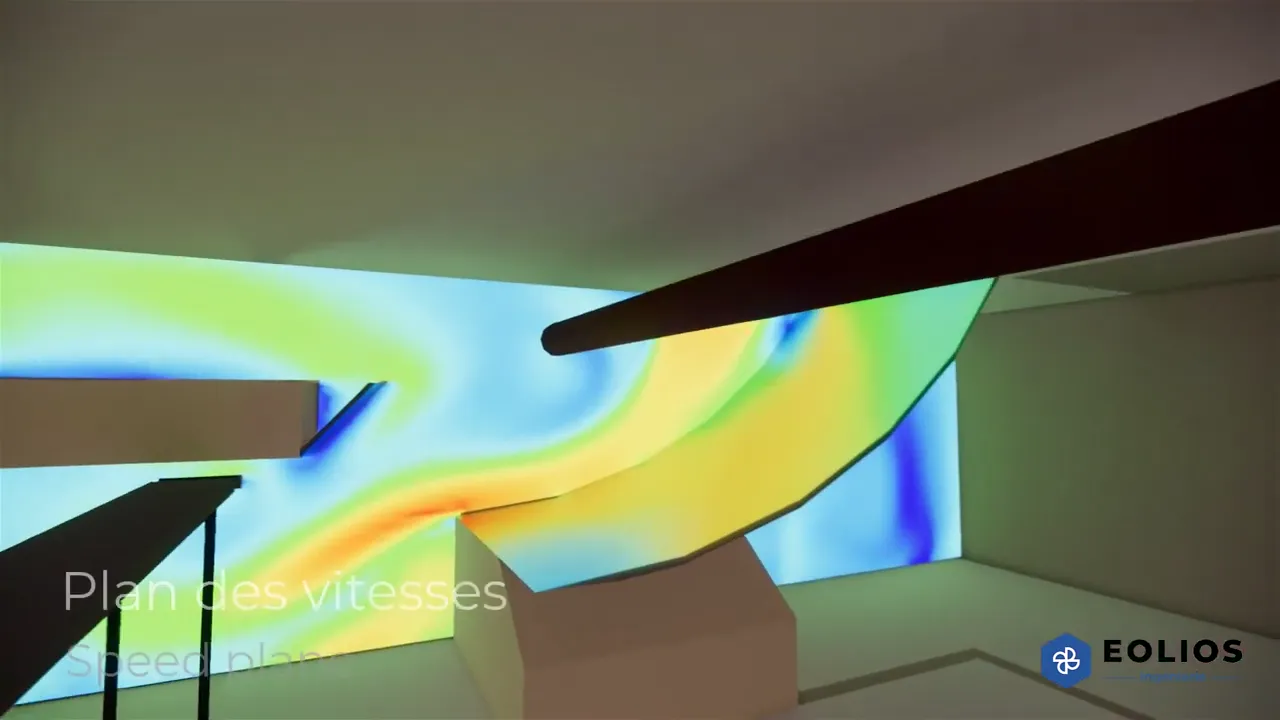
View the full study: saturated vapour capture on a continuous casting lineThe observations from this audit were used to build and calibrate a 3D CFD model of the machine and the hall, a true digital twin of the installation. This model reproduced the phenomena visible in the video: steam escaping the extraction system, rising to the first-floor deck and then spreading through the hall. It made it possible to identify their causes and compare several solutions to eliminate the leaks at source. The detailed results, from causes to the solutions adopted, are presented in the full study.
View the study results: saturated vapour capture on a continuous casting lineThe video, where the steam comes from and the link with the CFD study.
Real footage, shot without commentary during the audit of a continuous casting line in a steel plant: plumes of saturated steam escape the extraction system, rise along the structures, reach the upper levels and spread through the hall, until visibility on the first floor is reduced.
It forms on contact with the hot slabs: the air takes up water vapour until it is saturated, then the vapour condenses into fine droplets as it cools. If extraction at source is insufficient, these hot, humid plumes rise and disperse through the hall.
Because it is not captured at source: the plumes rise to the first-floor deck, get round it through the openings (stairways, duct penetrations) and then spread through the volume of the hall. This is the path the video shows, shot by shot.
It serves as a reference. Together with velocity, temperature and humidity measurements and smoke tests, it makes it possible to check that the numerical model reproduces the phenomena actually observed before using it to test solutions. This is what makes a CFD simulation a reliable decision-making tool.
The causes of the leaks, the solutions assessed and their comparison are detailed in the full study of steam capture on this line. The CFD simulation of the same line can also be watched as a video.
Explore our expertise, projects and technical papers to go further than the FAQ.
CFD expertise, delivered projects and technical dossiers: the whole Industrial process field in one place.
The simplest thing is to talk it through together. Our engineers reply with an initial technical read.