Study of the climatic and fire risks of an existing data center: modelling the dispersion of 3M™ NOVEC™ 1230 gas to guarantee service continuity.
The main challenge in designing a data center is the perpetual continuity of services: failures, maintenance and fires can occur, but the IT equipment must keep running without being damaged.
In this context, EOLIOS carried out a climatic-risk study and a fire-risk study in the data hall of the SAMU 95 (Pontoise hospital).
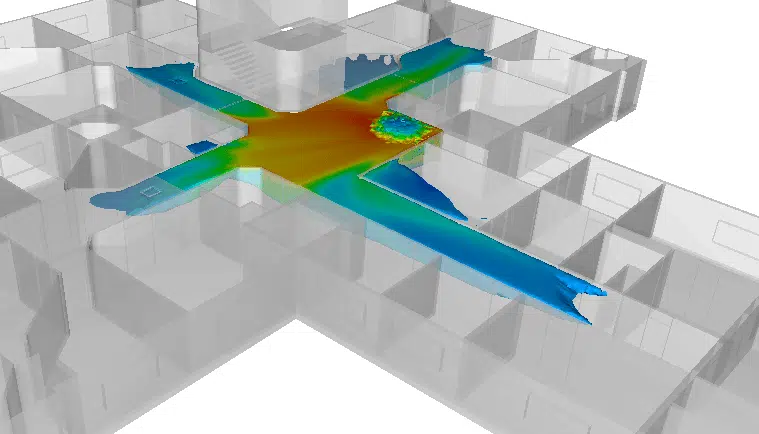
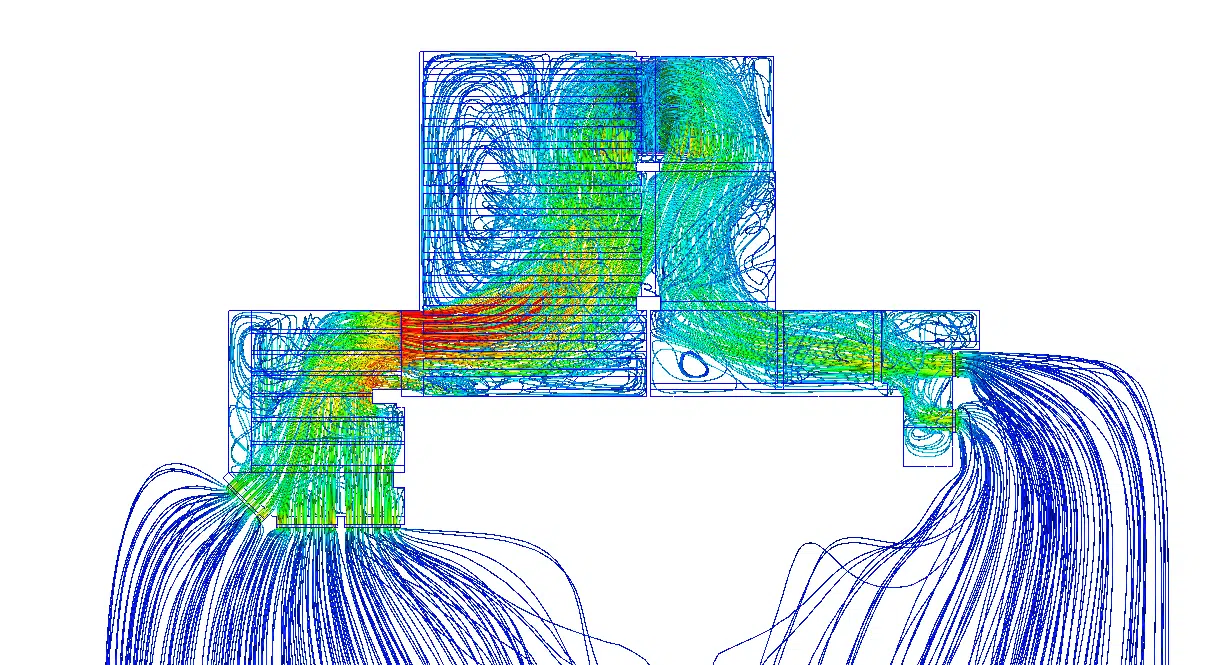
The objectives: visualise the temperatures at the server inlets, check the overall airflow of the room, then model the dispersion of 3M™ NOVEC™ 1230 gas in the event of a fire.
The essentials. For the SAMU 95 data center (Pontoise hospital), EOLIOS ran two CFD studies on a digital twin of about 10 million cells: a climatic strand (server-inlet temperatures, recirculations) and a fire strand modelling the dispersion of the 3M™ NOVEC™ 1230 extinguishing gas. Result: about 25 °C at the server inlets and a gas concentration above 5 % in every at-risk zone, compliant with the recommendations.
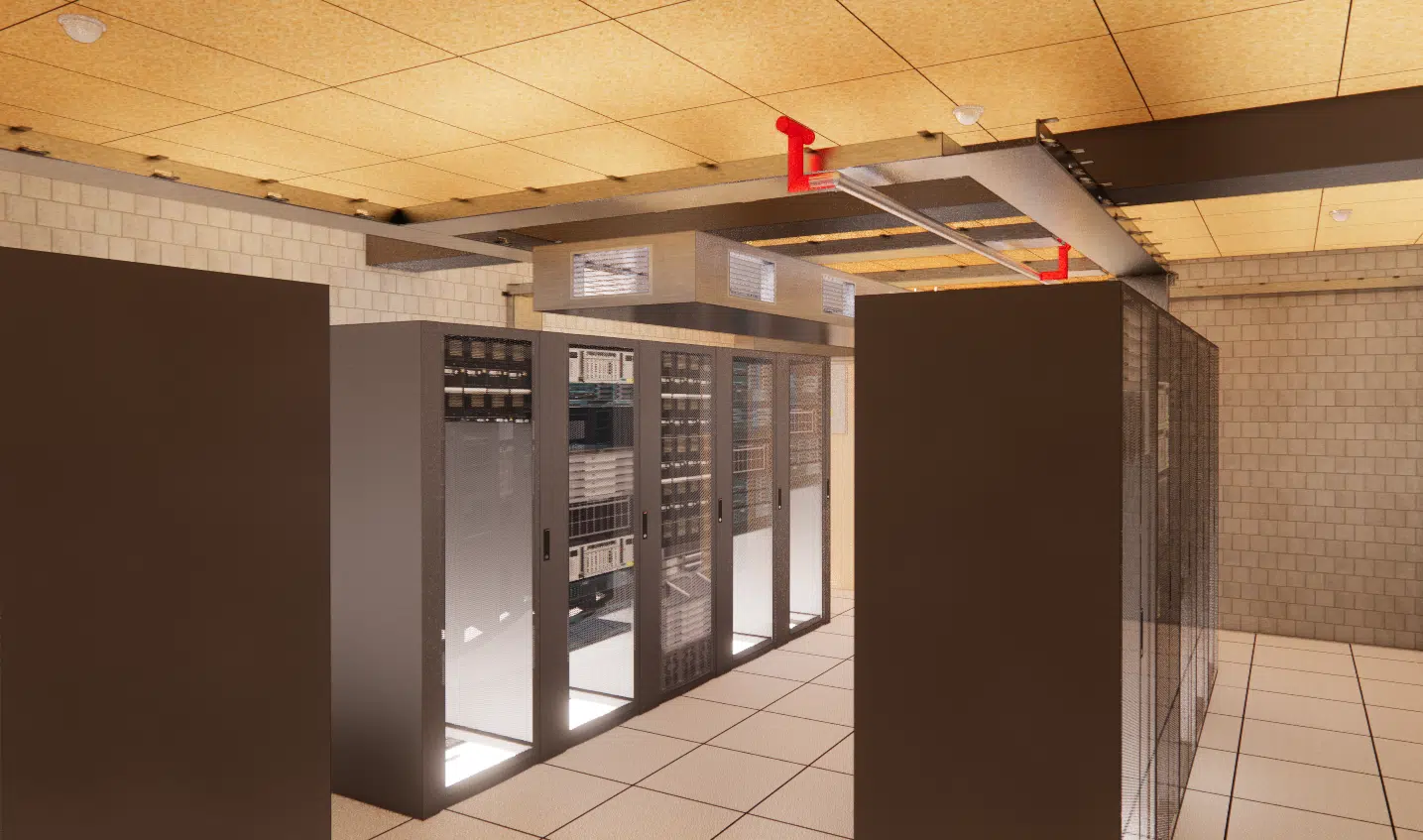
For this study, the entire data center was reproduced with 3D software. All HVAC systems are taken into account, as are the heat gains through the walls. The exact layout of the servers is implemented, accounting for the flow rate and power of each server.
The more accurate the digital twin, the closer the results are to reality: the mesh contains about 10 million elements, refined in the high-gradient zones.
A digital twin is a faithful 3D replica of the data center and its systems (servers, HVAC, raised floor, false ceiling) on which the simulation runs. It embeds the flow rate and power of each server and the heat gains through the walls; the more accurate the model, the closer the results are to reality.
The power balance of the air-handling unit reveals no overload. However, the absence of blanking panels in the racks, at the empty server slots, creates air recirculations that can be troublesome.
Under standard conditions, the temperature rise is well controlled: the temperature is around 25 °C at the server inlets. Despite the presence of bypasses, the climatic conditions are met, the cooling systems are effective, including in hot conditions. The design meets expectations.
Air recirculation is the return of hot air rejected by the servers back to their own inlets. It appears here where blanking panels are missing in the racks, at empty server slots: hot air bypasses the equipment and locally degrades cooling.
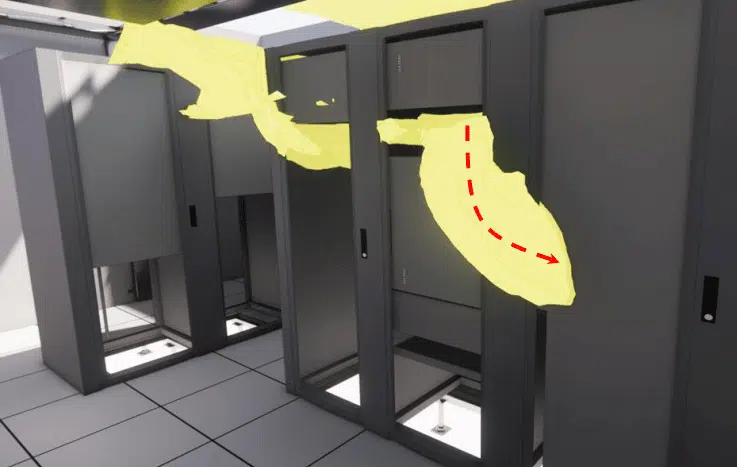
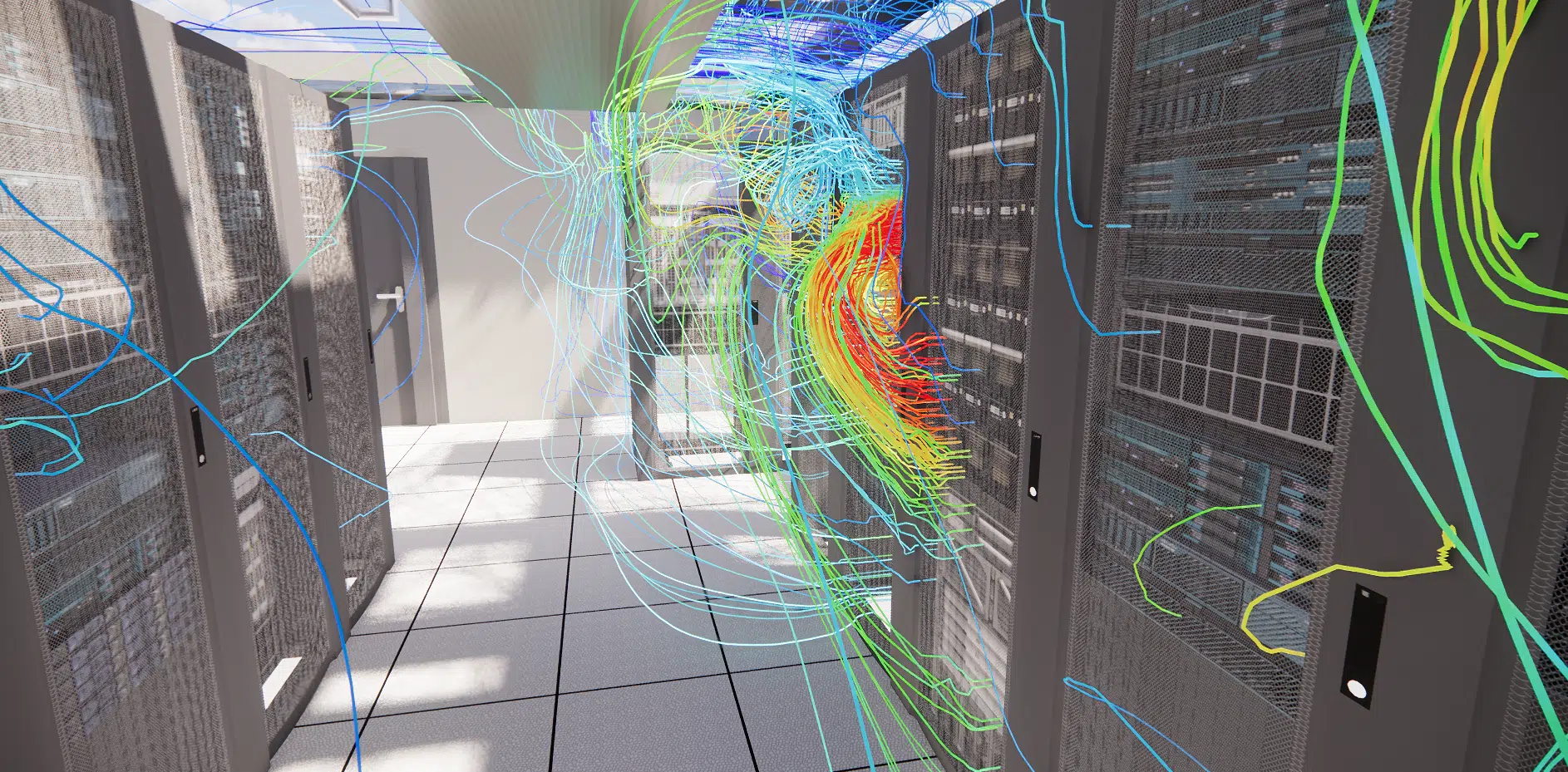
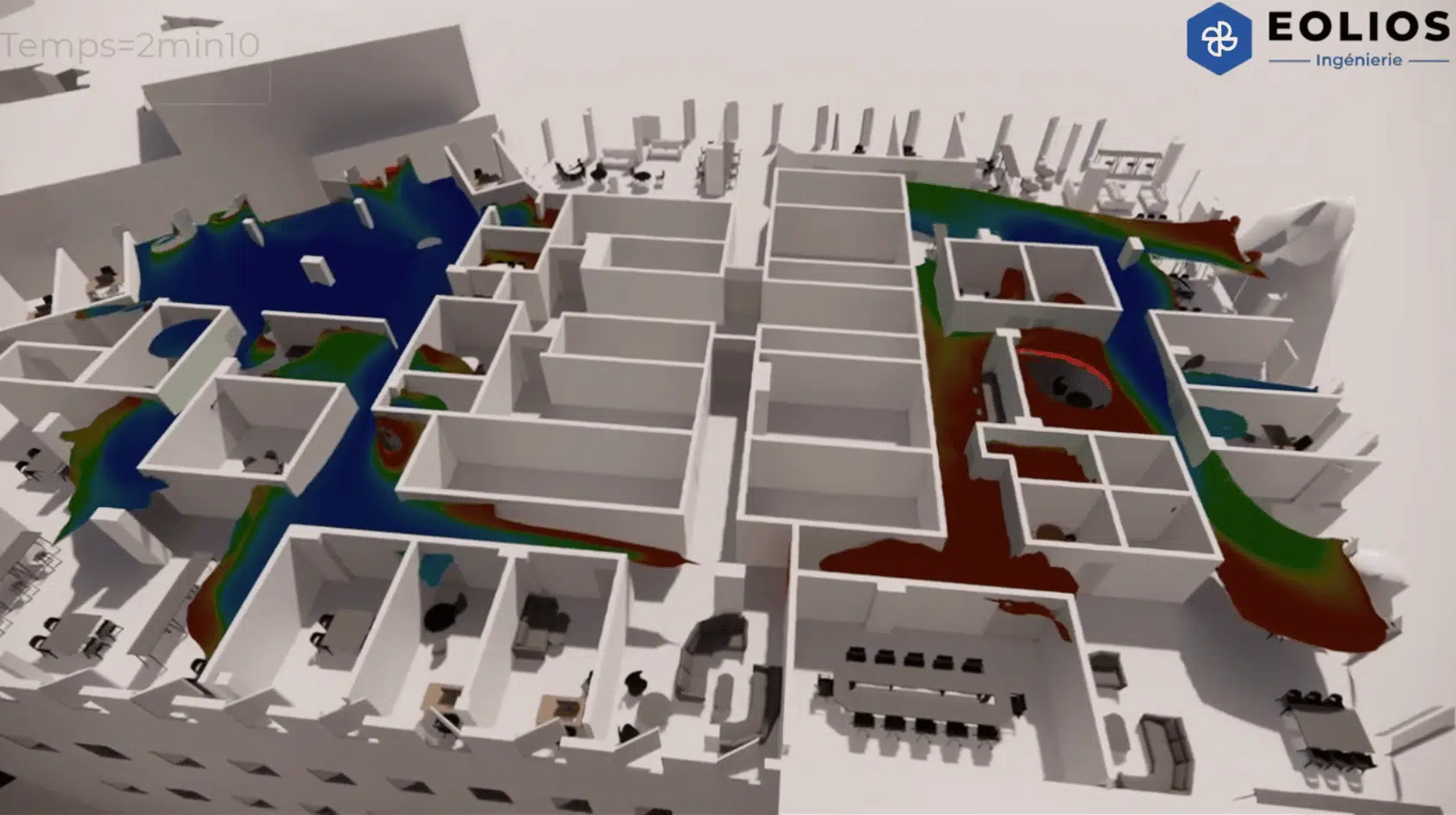
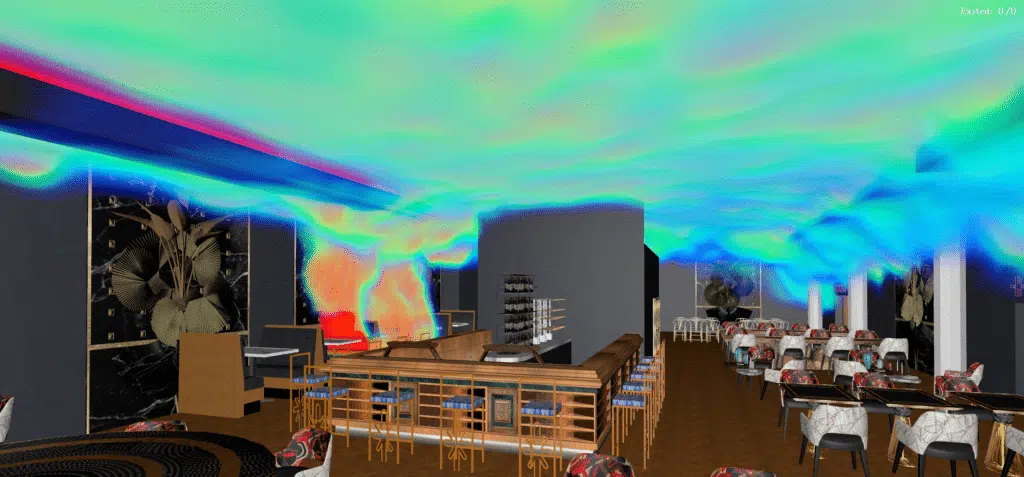
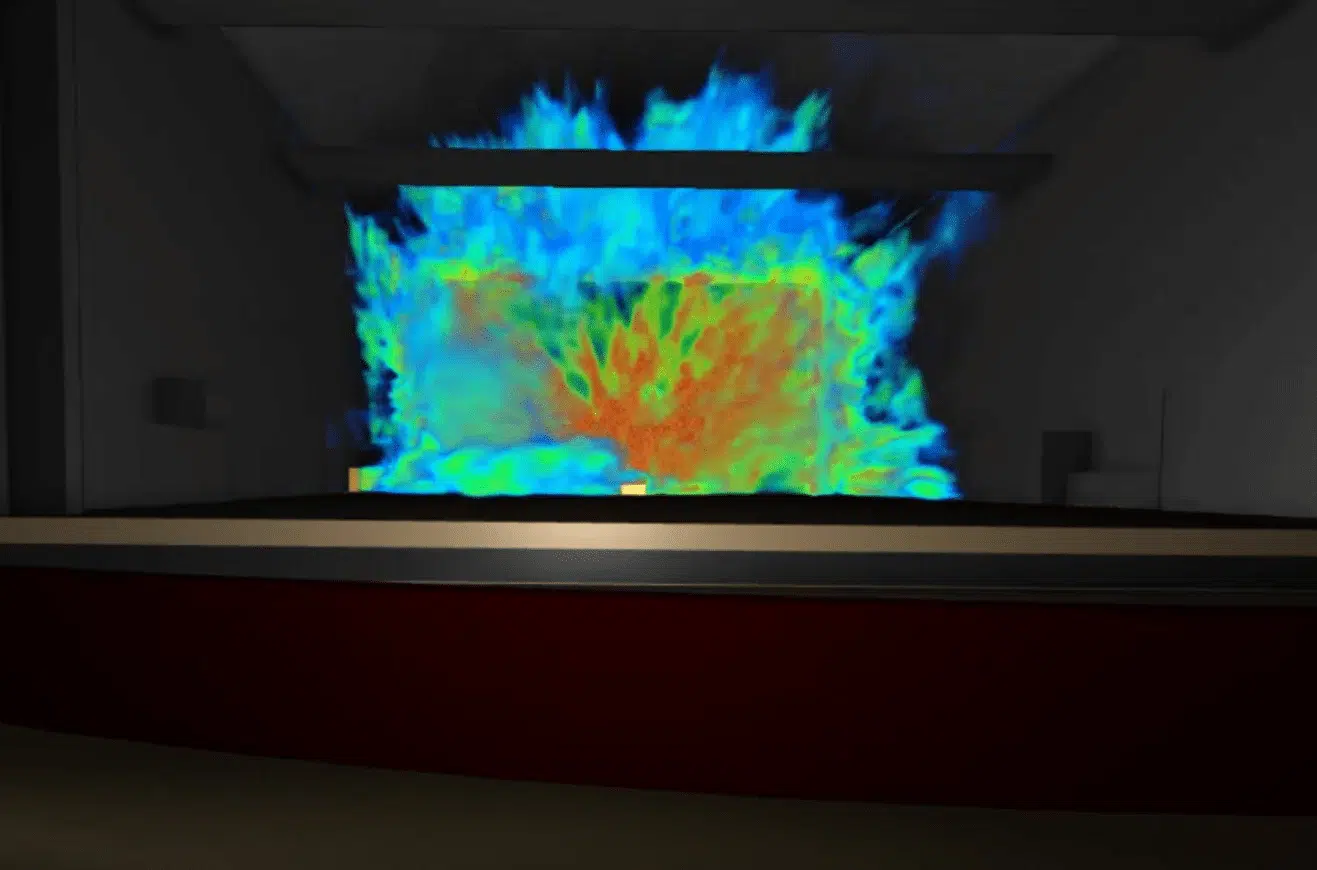
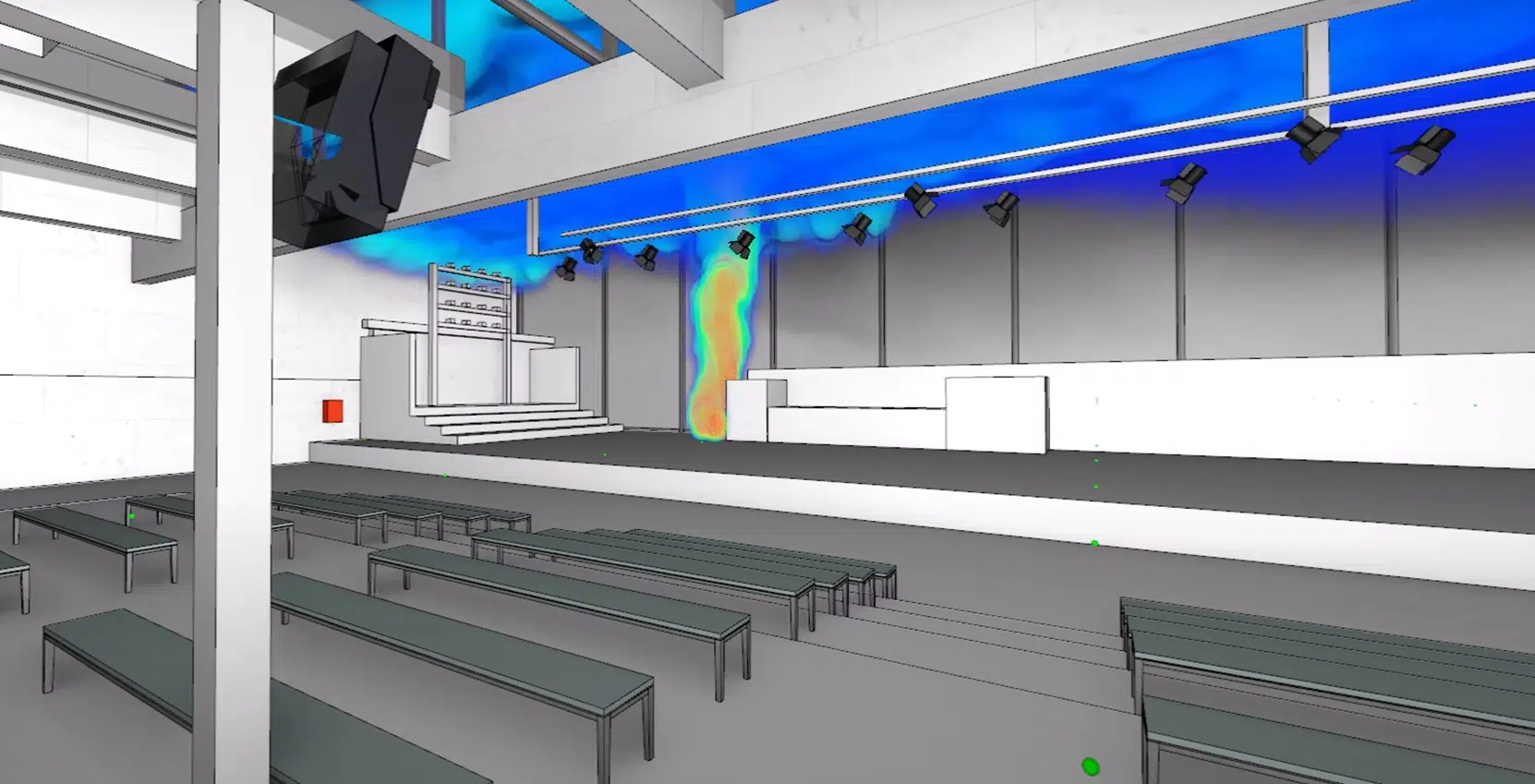
For the fire-risk study, all the gas characteristics are implemented in the simulation. The positioning of the 3 nozzles in the raised floor makes it possible to quickly prevent any risk in the event of a fire in this zone, and also a diffusion through the floor up to the data-hall level; the same applies to the nozzles in the false ceiling.
The results show that the gas dispersion is as expected: the system disperses enough gas for all the equipment and at-risk zones to reach a concentration above 5 % in the surrounding air. For this configuration, the system is therefore compliant with the recommendations.
NOVEC 1230 is an extinguishing agent from the fluoroketone family. It puts out fire by acting on the combustion reaction, leaving no residue, without conducting electricity or damaging electronic equipment, which makes it particularly well suited to data center fire protection.
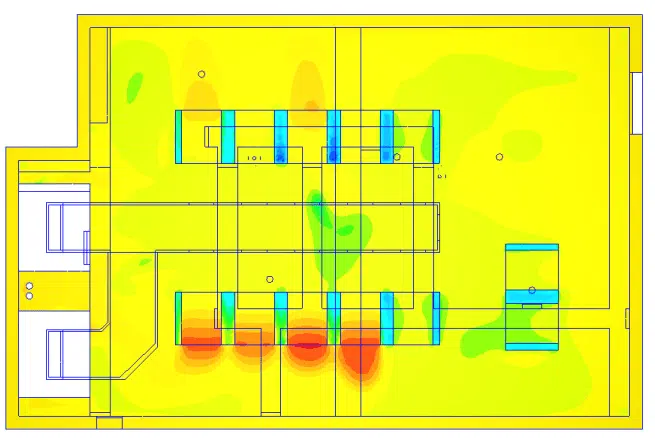
Numerical simulation makes it possible to anticipate many scenarios and to control the unexpected linked to poor design. For the climatic risk, the multiphysics modelling accounts for all the phenomena behind recirculation loops or hot spots. For the fire risk, CFD represents the spatial and temporal evolution of the gas diffusion in light of its characteristics.
EOLIOS's experience in thermal and general airflow engineering makes it possible to offer innovative, relevant solutions to climatic and fire risks.
Key takeaway. On a data center, CFD checks two things before construction: that cooling holds under normal and hot conditions, and that in a fire the extinguishing gas reaches the target concentration everywhere. Simulating the gas distribution avoids the blind spots a simple volume calculation cannot detect.
NOVEC gas dispersion, climatic risk and a data center's digital twin.
Because the effectiveness of an automatic gas suppression system depends on how the gas distributes across the protected volume. CFD verifies, before any incident, that every at-risk zone reaches the target extinguishing concentration, with no blind spot under the raised floor or in the false ceiling. See our paper on data center fire safety (IEAG).
NOVEC 1230 is an extinguishing agent from the fluoroketone family. It puts out fire by acting on the combustion reaction, leaving no residue, without conducting electricity or damaging electronic equipment, which makes it well suited to data centers.
In this configuration, all the equipment and at-risk zones reach a gas concentration above 5 % in the surrounding air. The system is therefore compliant with the recommendations.
Yes. The power balance reveals no overload and the temperature is around 25 °C at the server inlets. The absence of blanking panels in the racks does, however, create air recirculations to keep an eye on.
The entire data center is reproduced in 3D, with the flow rate and power of each server and the HVAC systems. The mesh of about 10 million elements, refined in the high-gradient zones, keeps the results close to reality.
Explore our expertise, projects and technical papers to go beyond the FAQ.
CFD study of the SAMU 95 data center (Pontoise hospital): a digital twin of about 10 million cells, climatic-risk analysis (recirculations, ~25 °C at the inlets) and modelling of the dispersion of the 3M™ NOVEC™ 1230 extinguishing gas (raised-floor and false-ceiling nozzles) up to a compliant concentration > 5 %, to guarantee service continuity.
CFD expertise, delivered projects and technical dossiers: the whole Smoke control field in one place.
The simplest thing is to talk it through together. Our engineers reply with an initial technical read.