CFD simulation of thermal comfort
The more complex a space — large volume and height, uneven layout of heat sources, high occupant density, large glazed surfaces — the less effective standard engineering techniques prove at organizing an optimal air-distribution pattern.
Comfort & air
- Thermo-aeraulic comfort optimization
- Thermal stratification study
- Air quality study
Systems
- HVAC system sizing
- Failure scenario study
- HQE target no. 8 — CFD study
Pollutants
- Transient temperature rise
- Relative humidity, CO2
- Trichloramine, Covid risk analysis
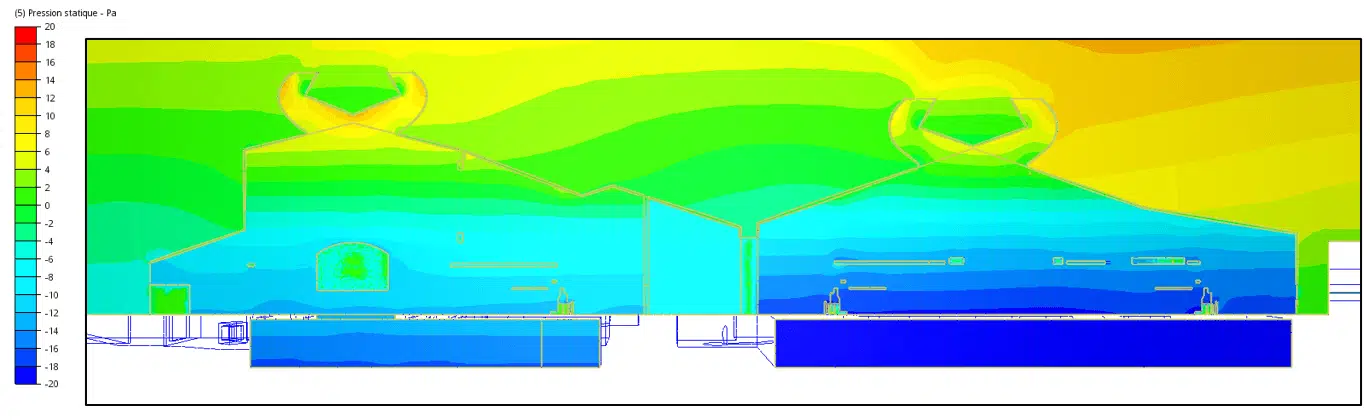
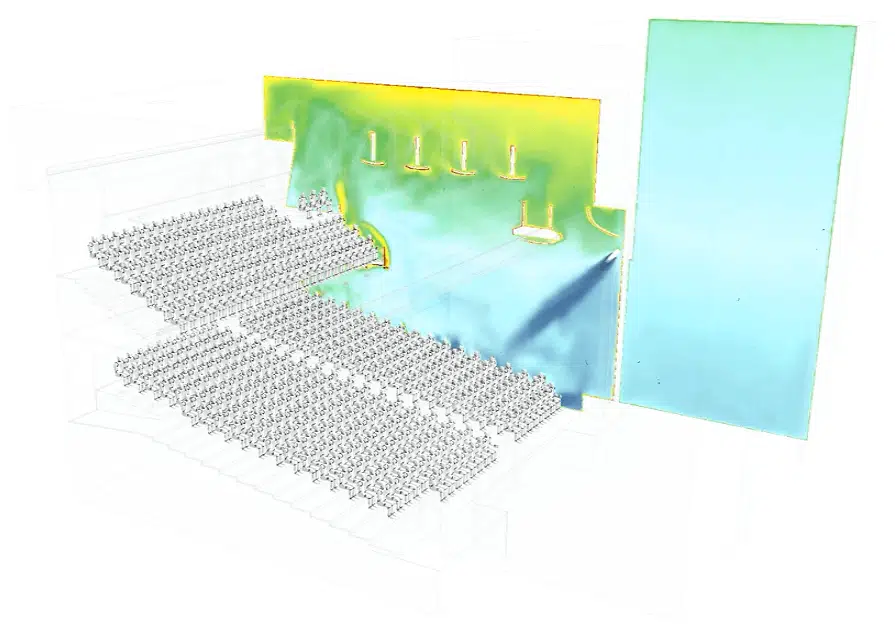
This produces cold draughts in workplaces, the spread of odours in restaurant rooms, clear discomfort in retail and entertainment complexes, the appearance of condensation on pool and atrium walls, summer overheating of the upper floors of atriums, or noticeably different temperatures from one part of an auditorium to another depending on the influence of the air-conditioning systems.
Our work covers four complementary aspects:
- Analysis and assessment of design solutions for heating, ventilation and air-conditioning systems: the model reproduces the distribution of temperature, air velocity, CO2 concentration and humidity throughout the volume.
- Development of adjustments to design solutions that guarantee the required values of the microclimate parameters within the room volume.
- Study of solutions under failure conditions, during critical periods (crowding, climate…) or in a transient scenario (variables evolving over time), in order to consolidate the designs.
- Sizing of the production (heating, cooling) and distribution systems, and audit of the technical rooms.
Indoor comfort modelling
Our international experience shows that the numerical modelling of aerodynamics has enormous innovative potential for architectural-orientation and construction challenges. In HVAC engineering, we bring our expertise to:
- the modelling of the microclimate of indoor spaces;
- the modelling of air-distribution devices;
- the study of indoor air quality, in relation to common pollutants and COVID-19 contamination risks;
- the study of failure scenarios and comfort in extreme cases;
- the design of systems for hyper-controlled environments (cleanroom, cold room, data center, museum…).
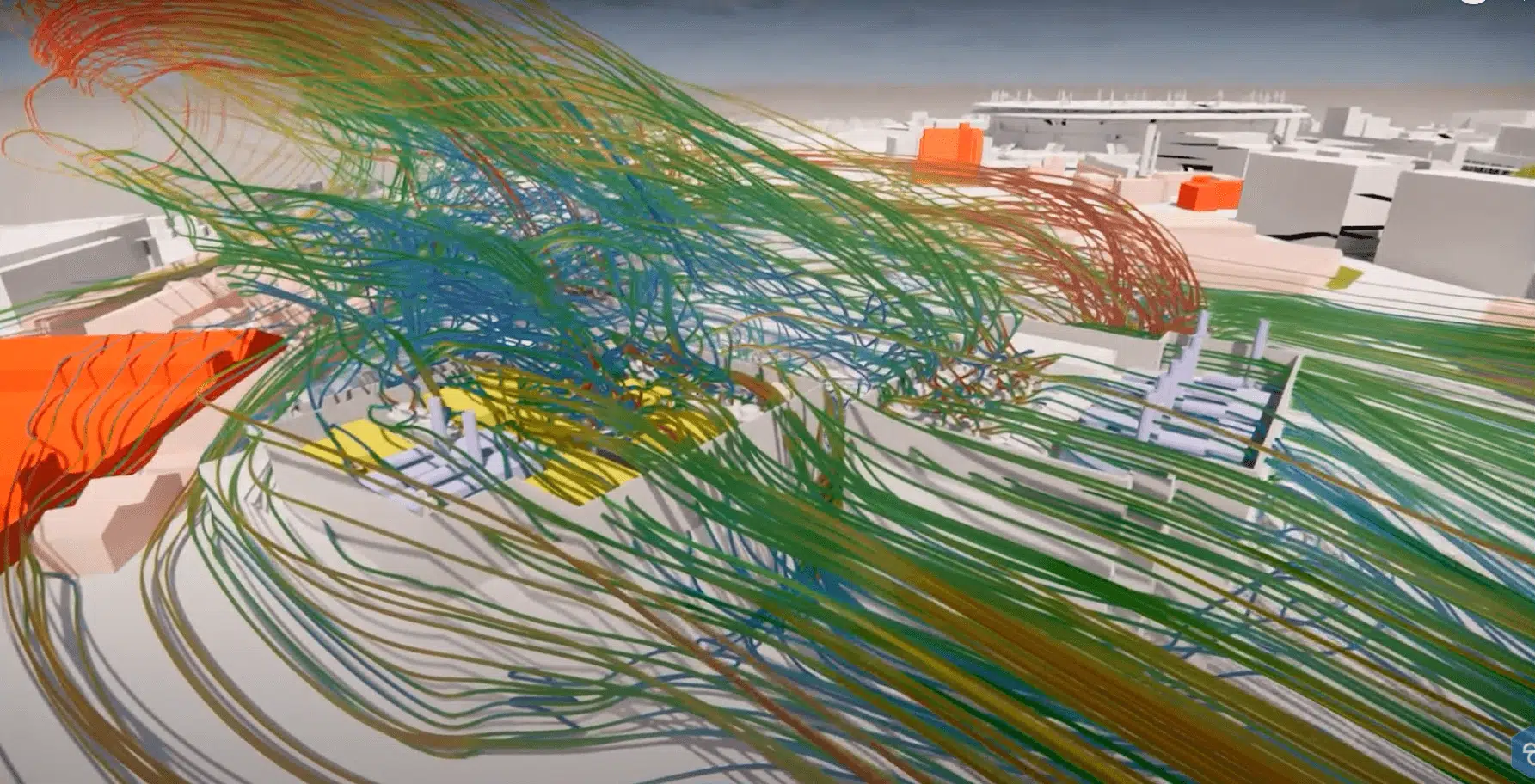
CFD modelling makes it possible to reproduce explicitly and precisely the physical process of air movement within a room volume. It thus offers a universal approach for determining microclimate parameters, for any room configuration, all heating, ventilation and air-conditioning parameters, and all seasonal influences.
CFD modelling is therefore a virtual simulation of a room or building: certain heating, ventilation and air-conditioning parameters are set as boundary conditions, then the distribution of the controlled microclimate parameters across the volume is analysed.
Why EOLIOS CFD simulations are different
Our studies impose no fixed boundary conditions on the outside of the model. So, for example when studying glazing, the surface temperatures depend on the various convective exchanges. This makes it possible to approach the real temperature distribution at every point in the room.
In practice, CFD simulations are carried out to confirm that the computed indoor environment meets the requirements. If the model shows a deviation from the required values, the design solutions are corrected to eliminate or limit those deviations; the model is then compared and repeated until satisfactory results are obtained.
Expertise: climatic comfort optimization — glass roofs and atriums