
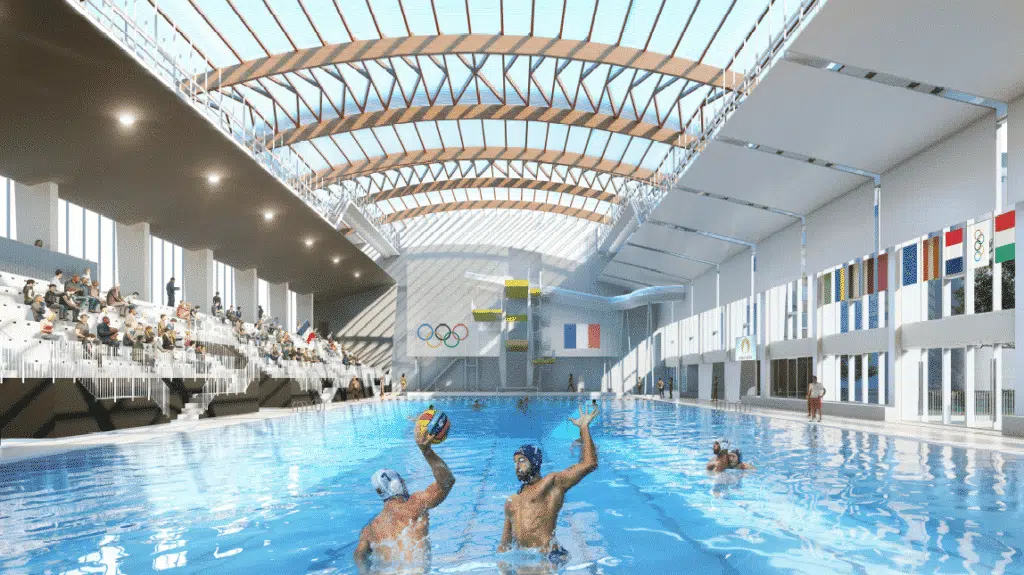
CFD study of the thermal comfort and trichloramine diffusion in a wading pool: protecting the young users and the staff.
This study focuses on a wading pool (children's pool), where the control of air quality is particularly sensitive: the young users move closest to the water surface, exactly where the chlorination by-products concentrate.
It is essential to regulate the trichloramine level in the air in order to maintain the comfort conditions of the users and the staff. The CFD simulation makes it possible to characterise effectively the distribution of trichloramine in the space and to compare different ventilation systems.
The challenge of controlling airflow in a large space such as a swimming pool is threefold: maintaining temperatures, reducing the condensation risks, and extracting the potentially harmful trichloramine.
In brief. A CFD study of thermal comfort and trichloramine (NCl₃) diffusion in a wading pool, where children breathe right at water level. EOLIOS couples the airflow and the pollutant diffusion to map the over-concentrations, compare several supply and extract strategies, and reconcile pollutant extraction, thermal comfort and control of evaporation.
The trichloramine (NCl₃), or nitrogen trichloride, is a by-product of water chlorination. Volatile, it is released at the water surface and accumulates in the low air layer — precisely the breathing zone of children in a wading pool. Irritating to the airways and the eyes, it degrades the comfort and health of the users and the staff.
Its evolution in the air is closely linked to the airflows: a well-designed ventilation renews the air and extracts these gases, whereas an unsuitable mixing lets over-concentration zones form.
Nitrogen trichloride produced by the reaction of chlorine with the organic matter brought in by bathers (sweat, cosmetics). Volatile and heavier than air, it concentrates right at water level and irritates the eyes and the airways.
The air layer between the water surface and the users' faces. In a wading pool it sits very low, where children breathe: it is the zone the ventilation must keep as clean as possible.
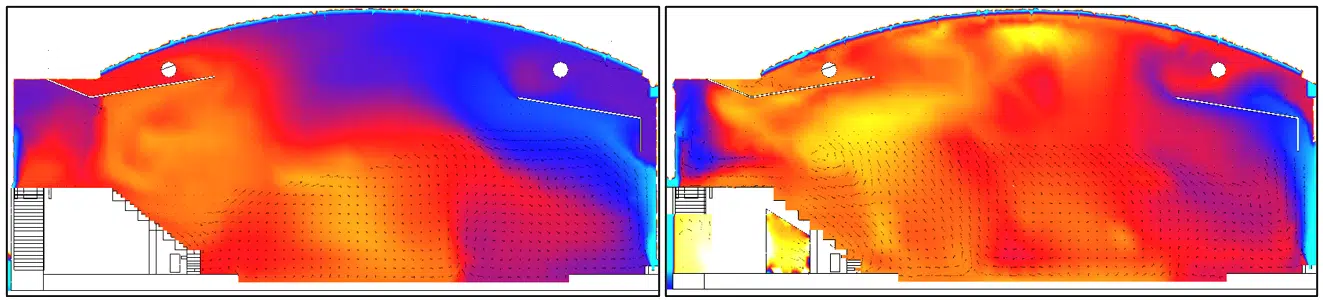
EOLIOS models the dispersion of the pollutant by coupling the airflow (air movements, temperatures, humidity) and the diffusion of the trichloramine. The quality of the results depends on the input data, in particular the physico-chemical emission laws.
In reality, the emission law is dynamic and depends on the ambient temperature and humidity. Several levels of complexity are possible: the first consists in using constant laws to integrate the diffusion of the pollutant, sufficient to compare ventilation strategies. The CFD simulation then reconstructs the pollutant concentration at every point of the volume.
The relation that describes the trichloramine flux released by the water surface. Constant as a first approach, it is in reality dynamic and depends on temperature and humidity; its quality drives the fidelity of the simulation.
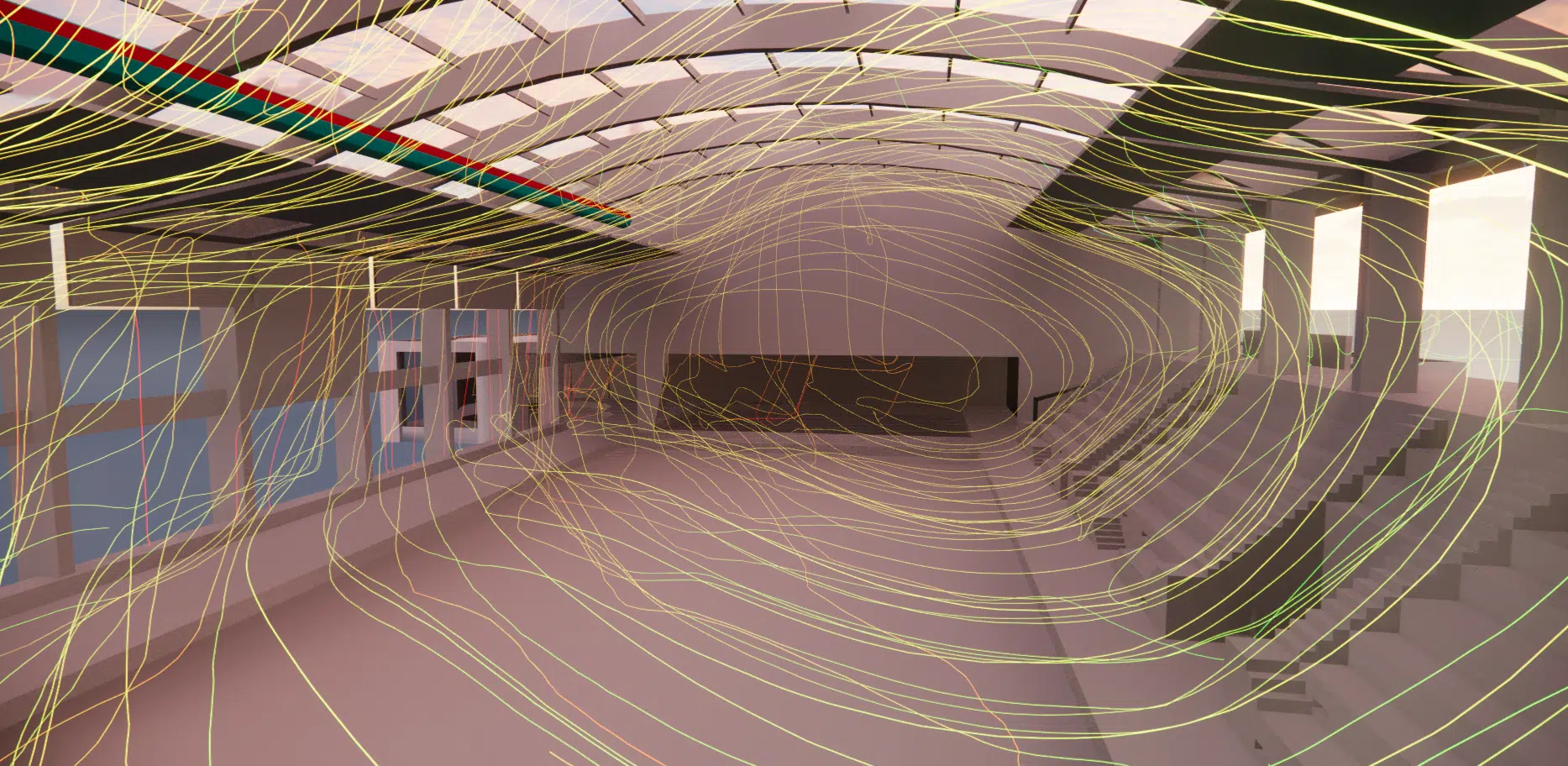
CFD makes it possible to compare different ventilation systems and to identify the zones impacted by the trichloramine over-concentrations. The supply and extract strategies are assessed: position of the grilles, flow rates, sweep of the water surface and of the deck.
A key challenge is to reconcile the effective extraction of the pollutant (extract as close as possible to the source, at deck level) with maintaining thermal comfort and limiting the evaporation of the water — a delicate balance in these warm and humid environments.
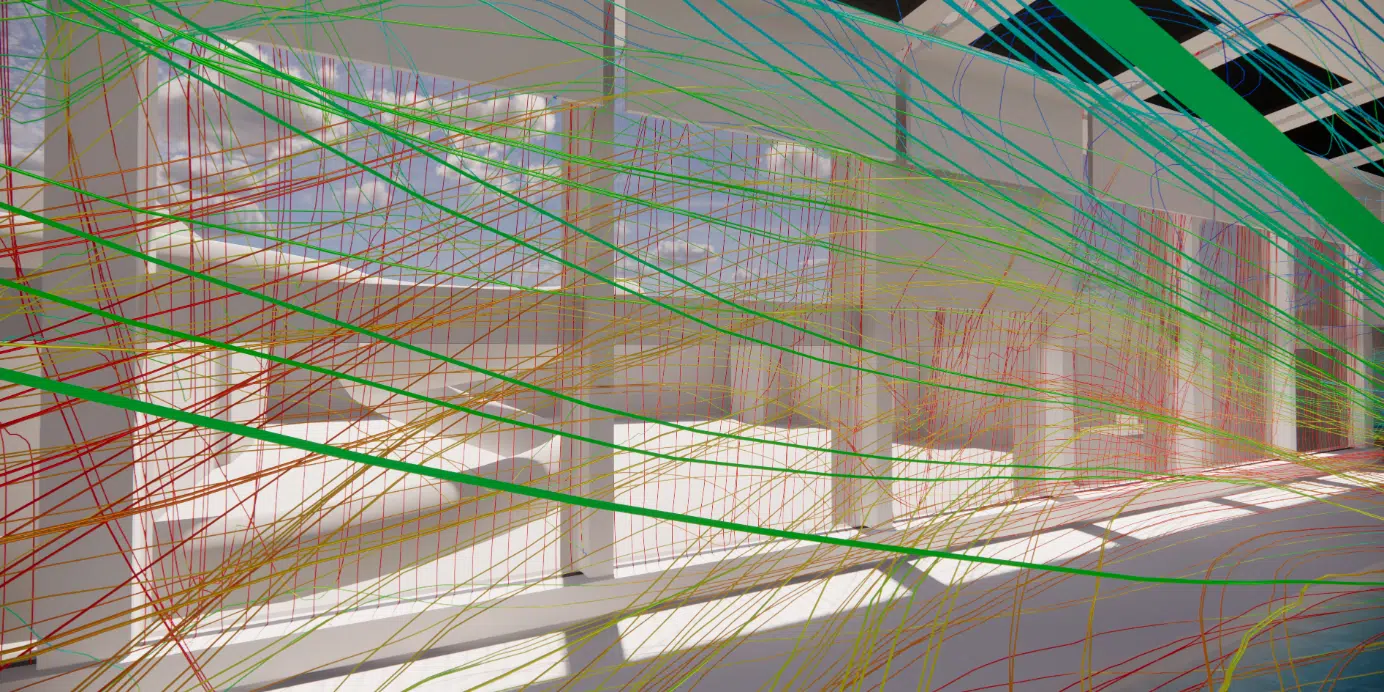
The simulations map the trichloramine concentration, the air velocities and the comfort in the occupied zone. They highlight the best-performing ventilation configurations to lower the concentrations in the children's zone, without creating uncomfortable draughts or increasing evaporation.
EOLIOS derives concrete recommendations from this: positioning and orientation of the vents, supply/extract flow rates, and air-renewal strategy — for a healthy, comfortable and compliant environment.
Key point. In a wading pool, the priority is the low layer where children breathe. CFD objectifies the trichloramine concentration there and makes it possible to choose the extract as close as possible to the source, without creating cold draughts on the young users.
Air quality, ventilation and comfort of the young users: the answers to the questions operators and clients ask before a CFD study.
Trichloramine (NCl₃) is a chlorination by-product, formed by the reaction of chlorine with the organic matter brought in by bathers. Volatile and heavier than air, it accumulates right at water level, exactly where children breathe. Irritating to the eyes and airways, it calls for ventilation that extracts it as close as possible to its source, as on our aquatic centre project in Hauts-de-Seine.
The simulation couples the airflow (air movements, temperatures, humidity) and the pollutant diffusion. It maps the concentration at every point of the volume and locates the over-concentration zones, in particular in the low air layer occupied by children.
They describe the trichloramine flux released by the water surface. As a first approach, constant laws are used, sufficient to compare ventilation strategies. In reality the emission is dynamic and depends on temperature and humidity; its quality drives the fidelity of the results.
The loaded air must be extracted as close as possible to the source, at deck level, without creating cold draughts on bathers or increasing water evaporation. CFD tests grille positions, flow rates and sweep direction to find this compromise in a warm and humid environment.
Maps of concentration, air velocities and comfort in the occupied zone, then concrete recommendations: positioning and orientation of the vents, supply and extract flow rates, air-renewal strategy, for a healthy, comfortable and compliant environment.
Explore our expertise, projects and technical papers to go further than the FAQ.
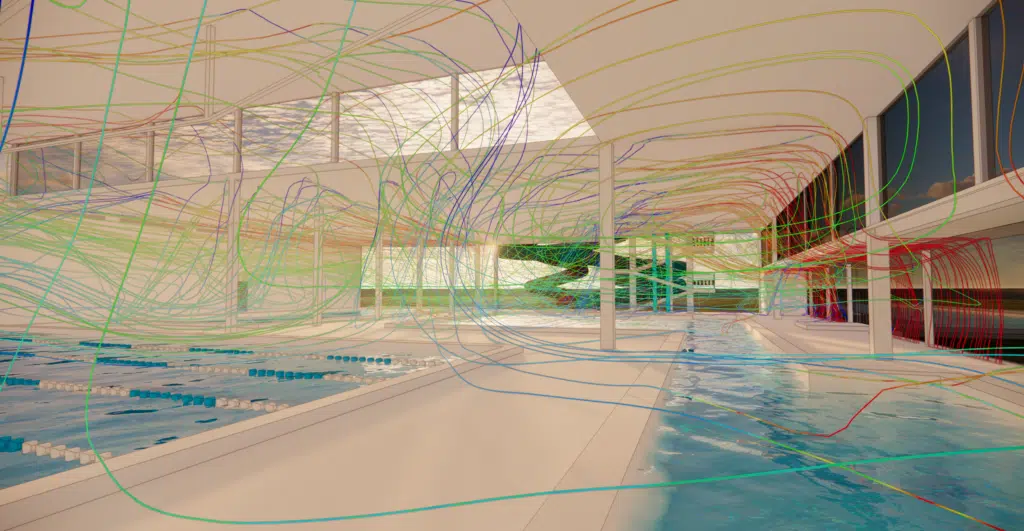 PoolAquatic Center — Hauts-de-Seine
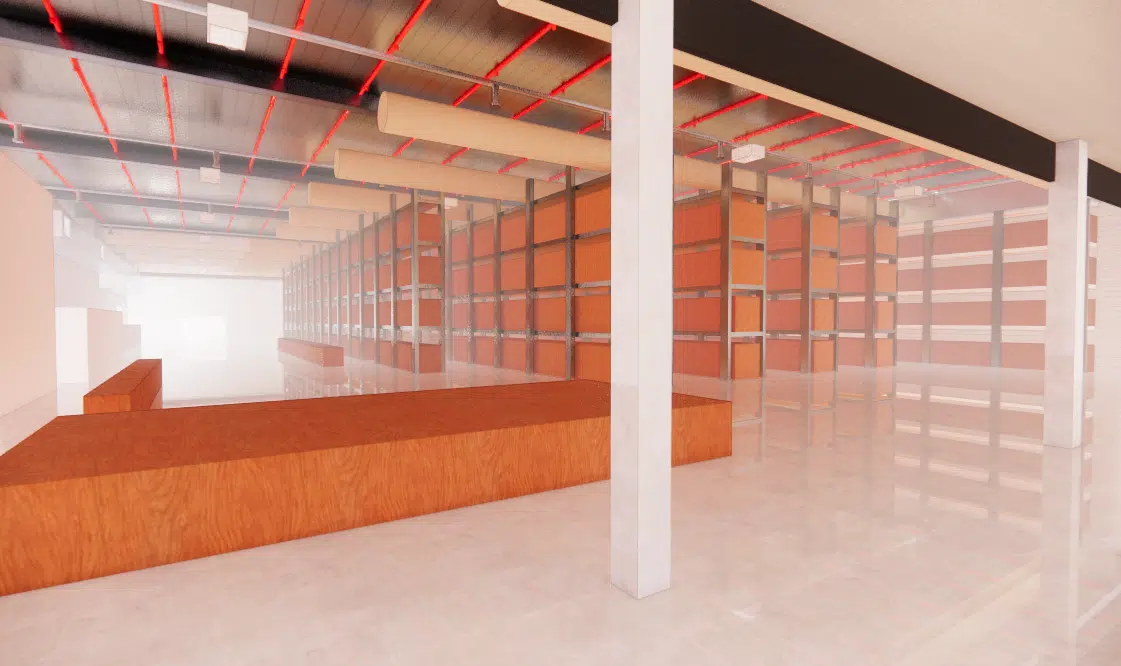 WarehouseHVAC engineering — Medical warehouse
 HotelSharaan by Jean Nouvel
 MuseumPalaeontology Gallery — MNHN
PoolSwimming pool — Montreuil
MuseumPalaeontology Gallery — MNHN
PoolSwimming pool — Montreuil
 IndustryPharmaceutical plant — HVAC
 Natural ventilationPrototype — Natural-ventilation chimney
 Cold roomCold room — Leipzig
 Sport / ArenaPalais Omnisports de Paris-Bercy
 IndustryPlant — Wind turbine
 Cold roomCold room — Resurfacing
 Atrium · 🔒Glass-roof comfort — Atrium
CFD expertise, delivered projects and technical dossiers: the whole HVAC engineering field in one place.
The simplest thing is to talk it through together. Our engineers reply with an initial technical read.