
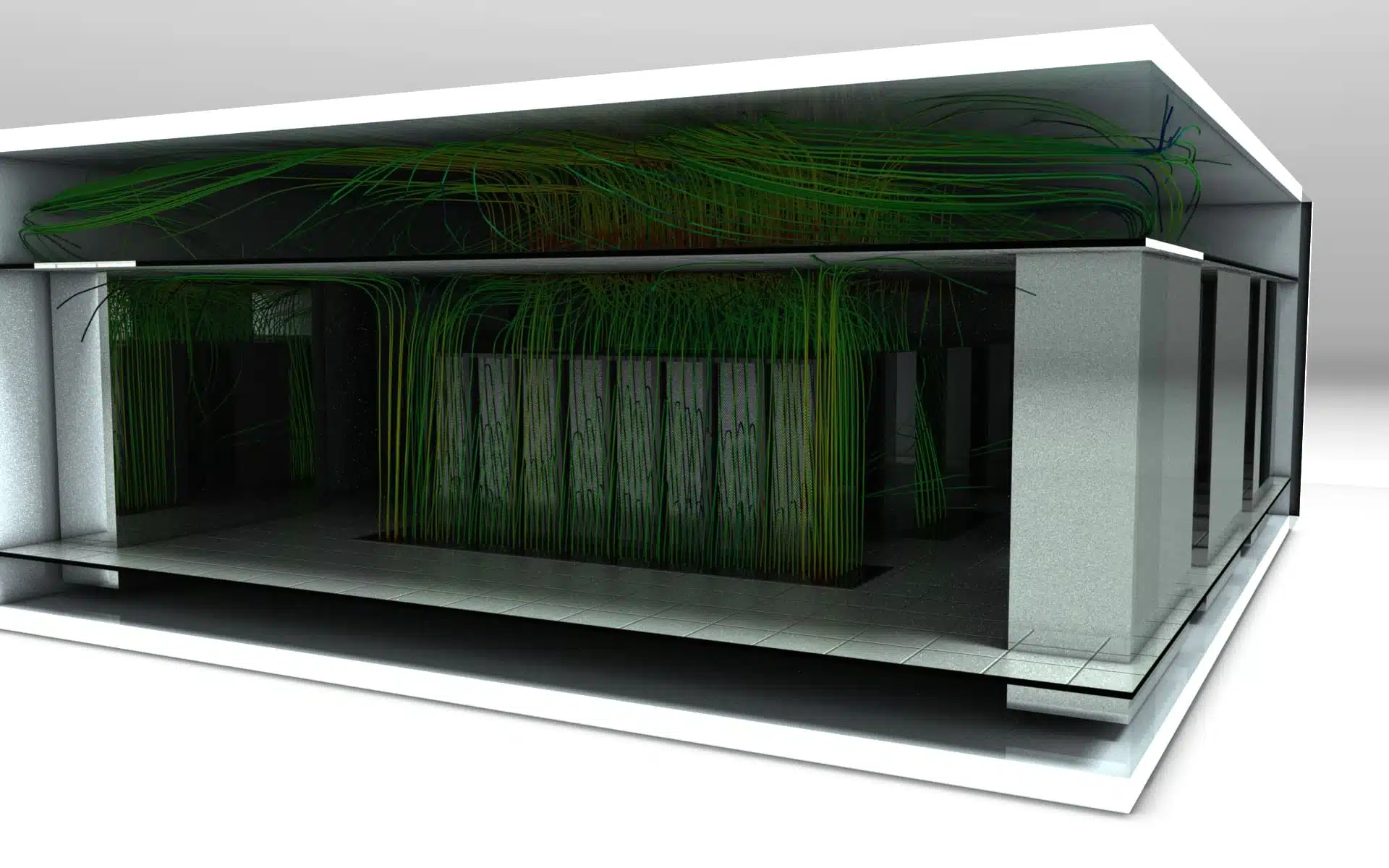
Creating data center digital twins
Our dual expertise in CFD modelling and in a fine understanding of digital infrastructures lets us create faithful, usable digital twins of existing or planned data centers, to anticipate the real behaviour of the installations, optimise their performance and strengthen their resilience.
Design
- 3D airflow modelling of the flows
- Thermal validation at the design stage
- Outdoor wind on the building
Operation
- Layout of the racks & IT
- Resilience to failures
- Support for modernisation
Performance
- Impact of high-density racks
- Gains from operational changes
- PUE & DCiE tracking
We support operators, infrastructure engineers, project owners and consultancies in the design, operation and modernisation of data centers. By combining field observation, technical-data gathering and numerical simulation, the digital twin becomes a concrete decision-support tool to make choices more reliable, validate assumptions and reach ambitious energy-performance targets.
Validating high energy performance
Assessing the design against outdoor conditions
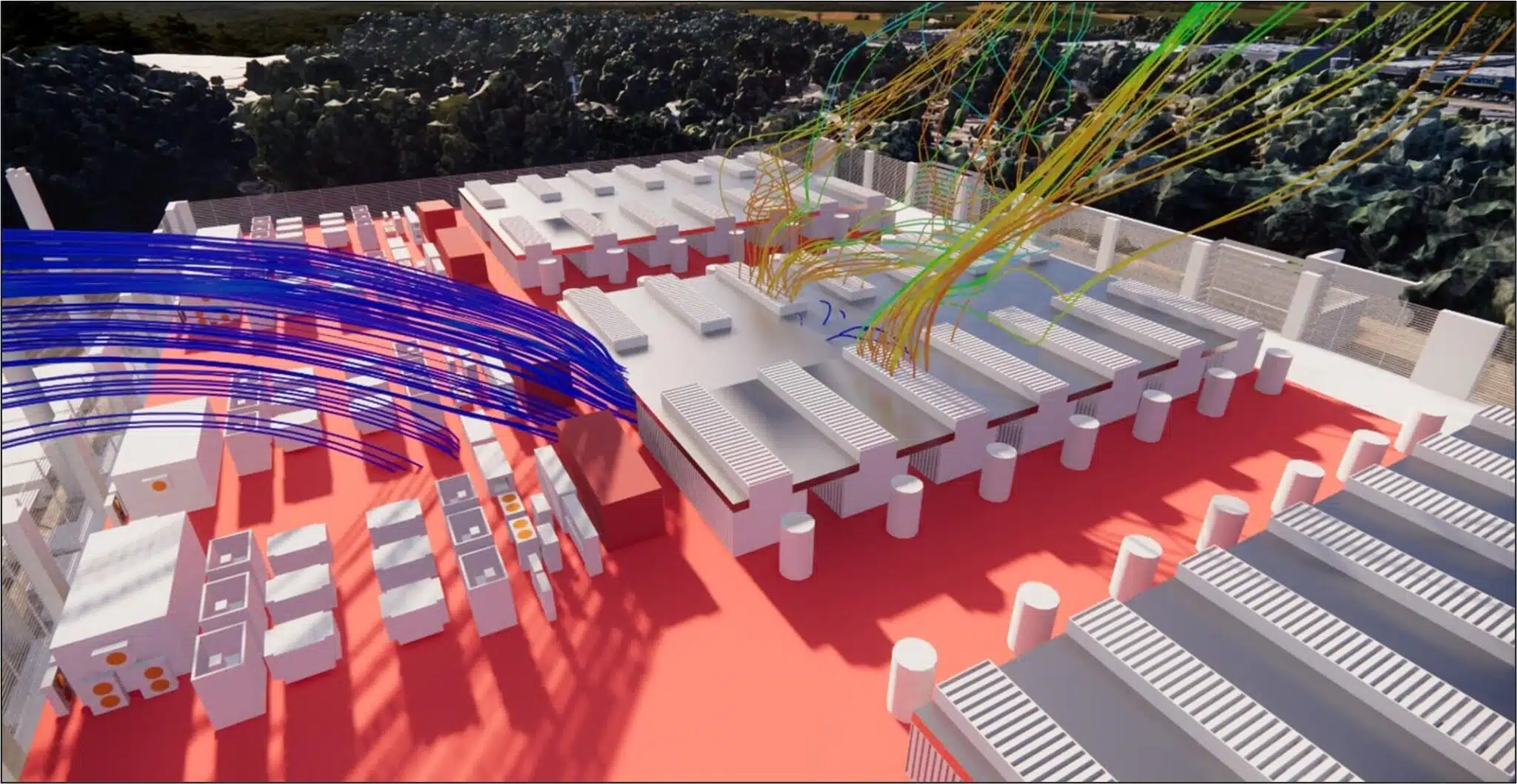
A data center's performance depends as much on its architecture as on its siting. The digital twin precisely simulates the wind and temperature conditions throughout the year, incorporating the specifics of the local environment — topography, vegetation, neighbouring buildings, ground roughness, prevailing wind regimes. This identifies the risks of hot-air recirculation, the stagnation zones and the overpressure effects on the ventilation equipment.
These simulations are particularly useful for rooftop or dense-urban data centers, where shadowing effects and vortices disrupt the free cooling or the heat exchangers. They test robustness against extreme conditions — gusts, heatwaves, thermal inversions — in a resilience-focused approach.
Checking the effectiveness of the cooling devices
By modelling the entire facility — racks, contained aisles, AHUs, plenums, ducts — we simulate the overall airflow and thermal behaviour, taking into account the real flows, the per-rack loads, the pressure losses and the control. Different configurations are tested (partial load, activity peak, load ramp-up, loss of redundancy) to check that admissible temperatures are maintained, avoid overheating, quantify the effectiveness of hot aisle / cold aisle containment and identify imbalances between aisles — maximising the PUE without compromising operational safety.
Modernising your infrastructure with the digital twin
Data centers are living systems: they evolve constantly to adapt to demand, integrate new technologies or respond to maintenance constraints. The digital twin is a strategic steering tool, able to anticipate the impact of a change on the site's thermal and airflow behaviour.
On a precise, up-to-date CFD model, the effect of a change is tested quickly: adding a rack, reversing an aisle's supply, moving an AHU, changing a setpoint. These simulations objectify the real consequences on the flows, the critical temperatures and the consumption, and reveal invisible inefficiencies (recirculations, pressure imbalances) — in a logic of continuous improvement and predictive maintenance.
Optimising technical choices at the design stage
The digital twin makes it possible to objectively simulate and compare several design variants before works — replacing a chiller, optimising a duct network, adding aisle containment. It avoids costly design errors, highlights unexpected interactions between systems and provides a rational basis to prioritise investments and quantify the energy ROI.
Supporting the deployment of high-density racks
The rise of intensive computing and artificial intelligence concentrates growing power in the racks, often above 20 kW per rack. Before any physical change, the digital twin virtually tests the impact of these localised loads: mapping of inlet temperatures, thermal gradients and air velocities, early detection of zones exceeding the alert thresholds.
Depending on the results, corrective measures are built into the project: adding perforated tiles, changing the supply direction, locally reinforcing the cooling or reorganising the cooling priorities.
Simulating the load ramp-up
The digital twin dynamically simulates gradual-growth scenarios. By comparing several growth steps (for example 10 kW → 15 kW → 22 kW per rack), the engineers identify the critical thresholds beyond which thermal instabilities appear, better plan the investments and distribute the load evenly. The results are visualised as thermal animations, pressure maps or indicators (local PUE, inlet/outlet ΔT).
Anticipating failures & energy efficiency
Simulating failures and degraded cases
With the digital twin, the robustness of the infrastructure is assessed against a wide range of degraded scenarios without disturbing the site: loss of a chiller, shutdown of a row of CRAHs, a supply fault, a power failure. The temperature trajectories, pressure gradients, stagnations and recirculations are observed; the temperature-rise times are estimated to rank the risks and test the DRP (Disaster Recovery Plan).
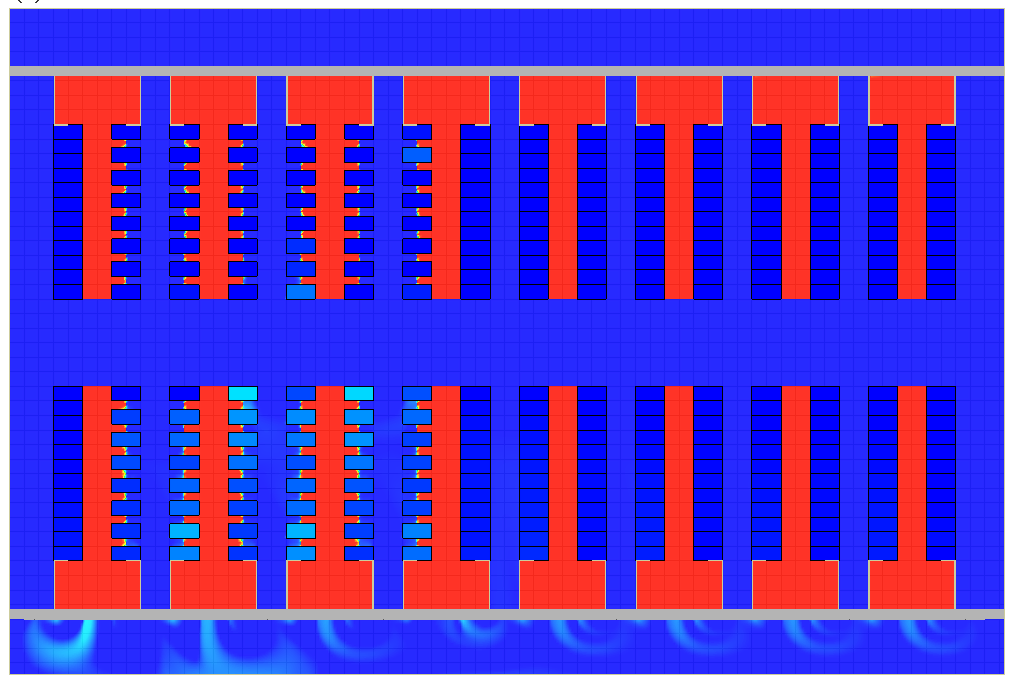
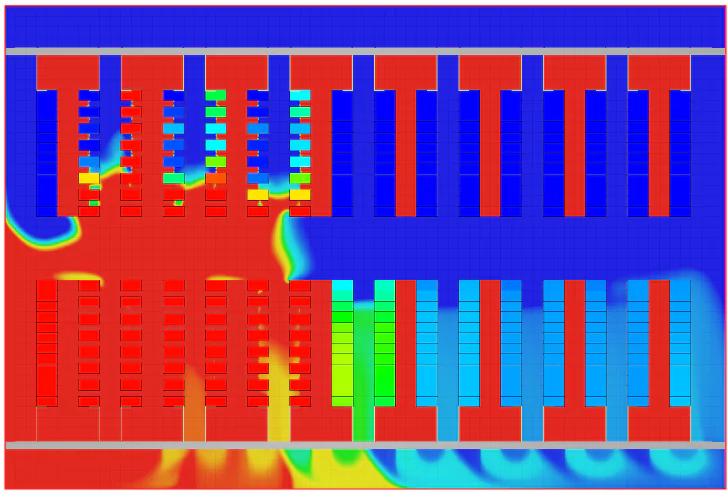
The backup configurations — N+1, 2N redundancy, automatic circuit switchover — are tested under simulated conditions, without mobilising the equipment or disrupting operations. The digital twin becomes an internal certification tool for service continuity and secures changes (extension, new chiller, space reallocation).
Identifying the energy-efficiency levers
By cross-referencing in-situ temperature readings, IT load profiles and AHU utilisation rates, the digital twin identifies oversized equipment, unwanted recirculation and invisible thermal losses. EOLIOS draws concrete optimisation directions from this — flow redeployment, ventilation rebalancing, setpoint adjustment, hot-spot elimination — for a measurable improvement in PUE.