
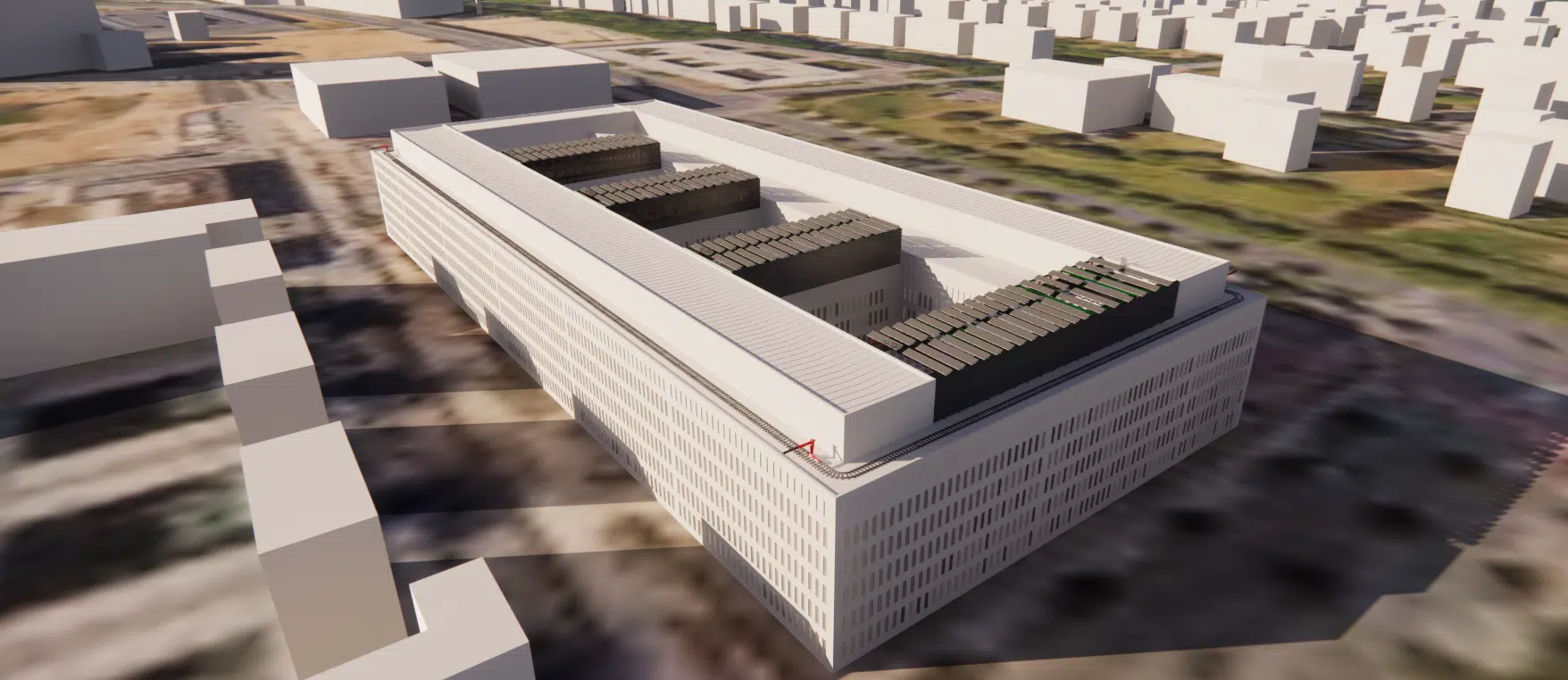
EOLIOS Ingénierie brought its technical expertise to understanding and modelling the external thermal and airflow exchanges of an office building in Luxembourg.
The aim of such a project is the mastery of the specific airflow phenomena induced by the presence of numerous beams and recirculation zones, as well as the assessment of the various optimisation criteria to achieve the highest potential inside the building.
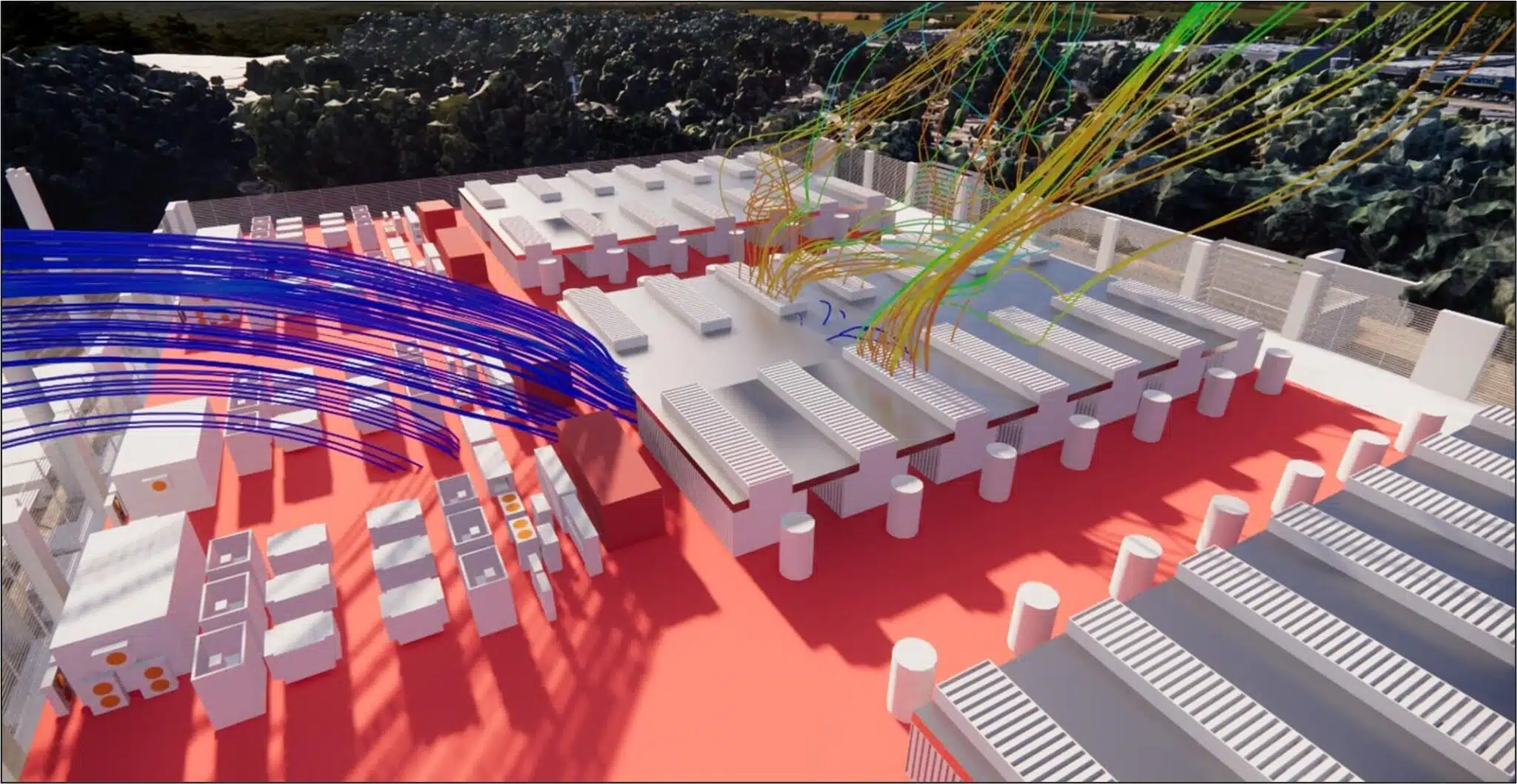
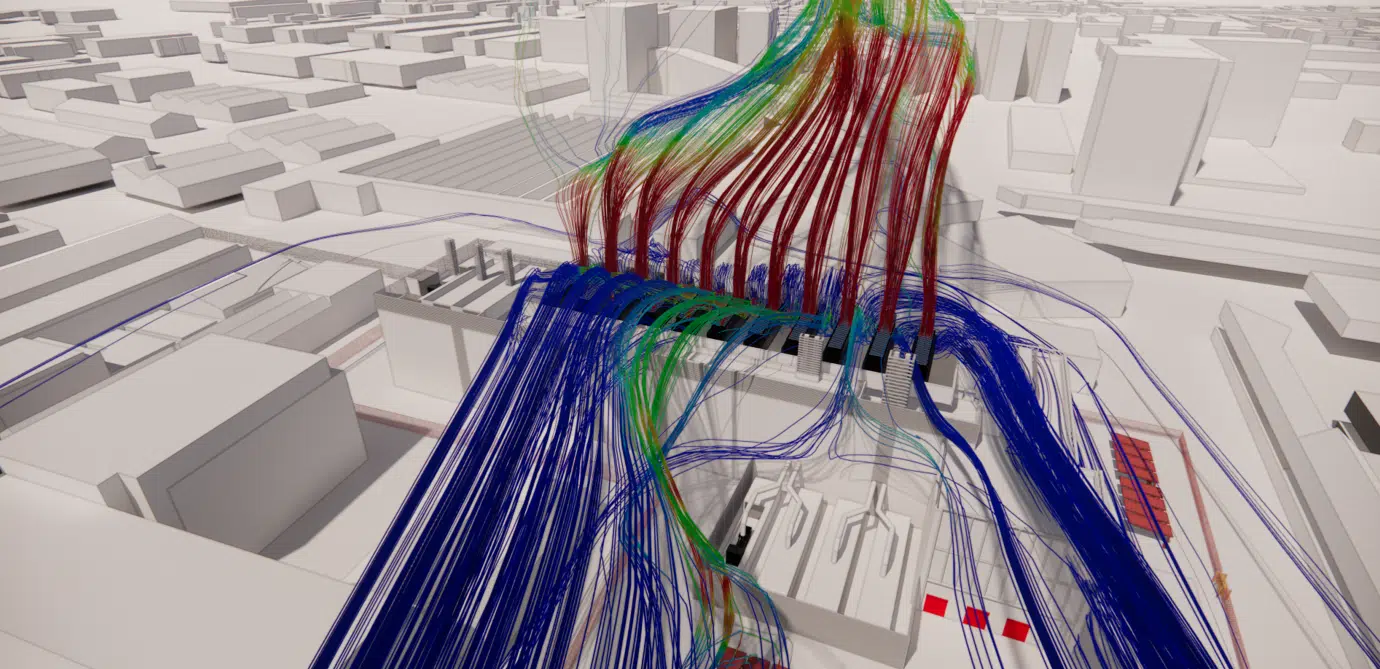
The CFD studies made it possible to visualise the various airflow phenomena for different wind orientations, which allowed the optimisation of the geometry to obtain the best possible efficiency from the systems.
The essentials. External CFD study of an office building in Luxembourg fitted with air coolers, in heat-wave conditions. The thermal-plume simulation reveals a recirculation: with insufficient fresh air near the systems enclosed by gangways, three fans re-ingest their own hot discharge. In zone B, the temperature rise stays limited to +3 °C (38 °C) thanks to a different machine alignment. Airflow obstructions (wind-breaks, solar panels) and deflectors were modelled to optimise the geometry.
An air cooler is a device that cools the air by passing it through a cooling system comprising evaporators, condensers and fans. The cooled air is then distributed into the space through ducts. Air coolers are generally used to cool large indoor spaces, such as factories, shops or hotels; in our case, it is a large office centre.
A heat exchanger that dissipates the heat of a heat-transfer fluid into the ambient air using fans, with no water consumption. Its performance drops if the air it draws in is already warmed by a nearby discharge.
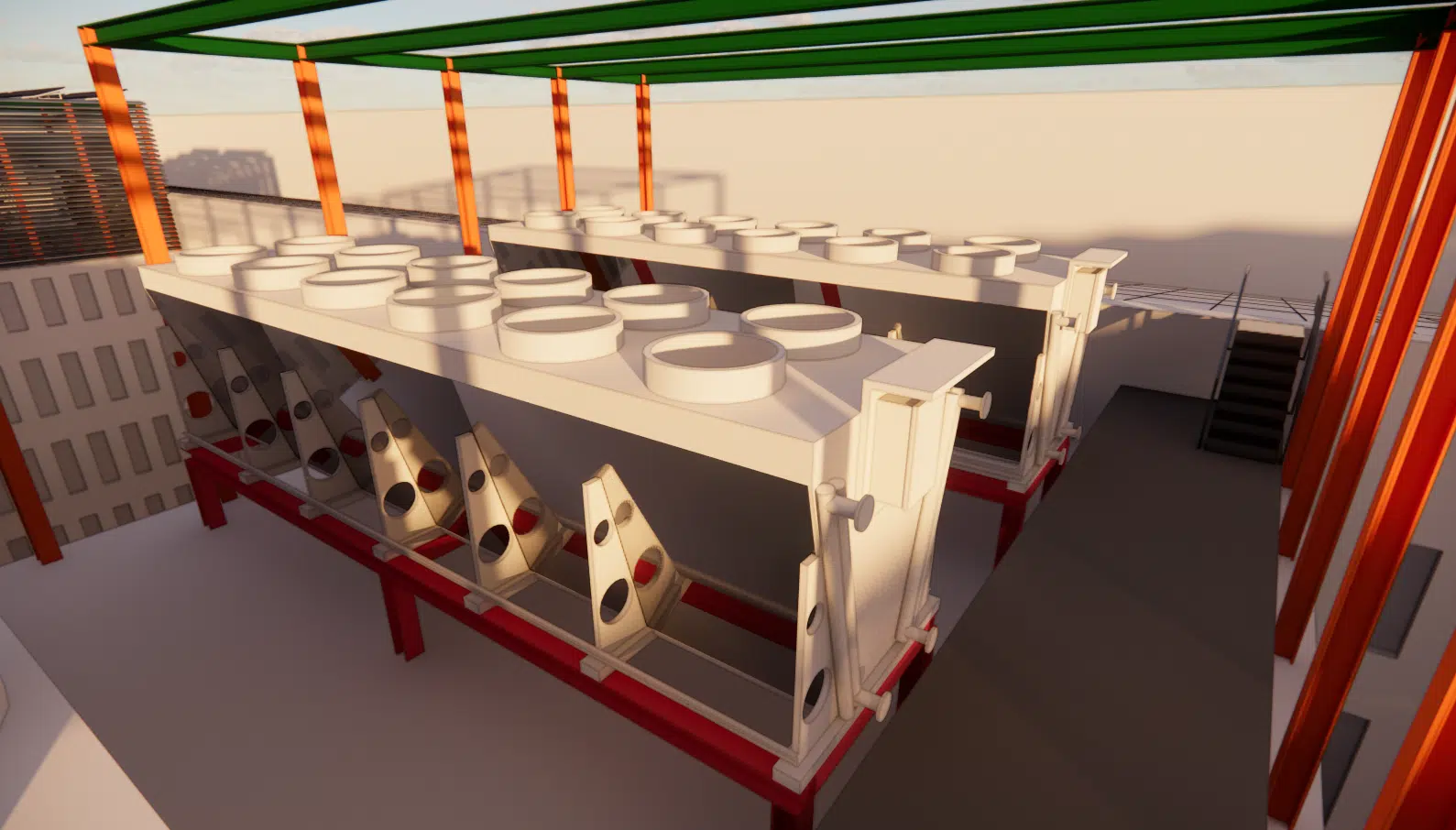
A metal-louvre wind-break is a device designed to reduce the noise and vibrations generated by the wind. It is generally designed to be installed outside walls or windows and comprises a hollow metal frame with a metal mesh wrapped around it. The airflow obstruction created by the louvres was modelled in order to account for their impact on the air's trajectory.
An aeraulic shadow created by an obstacle (wind-break louvres, solar panels) that deflects or slows the airflow and alters the trajectory of the flows around the systems.
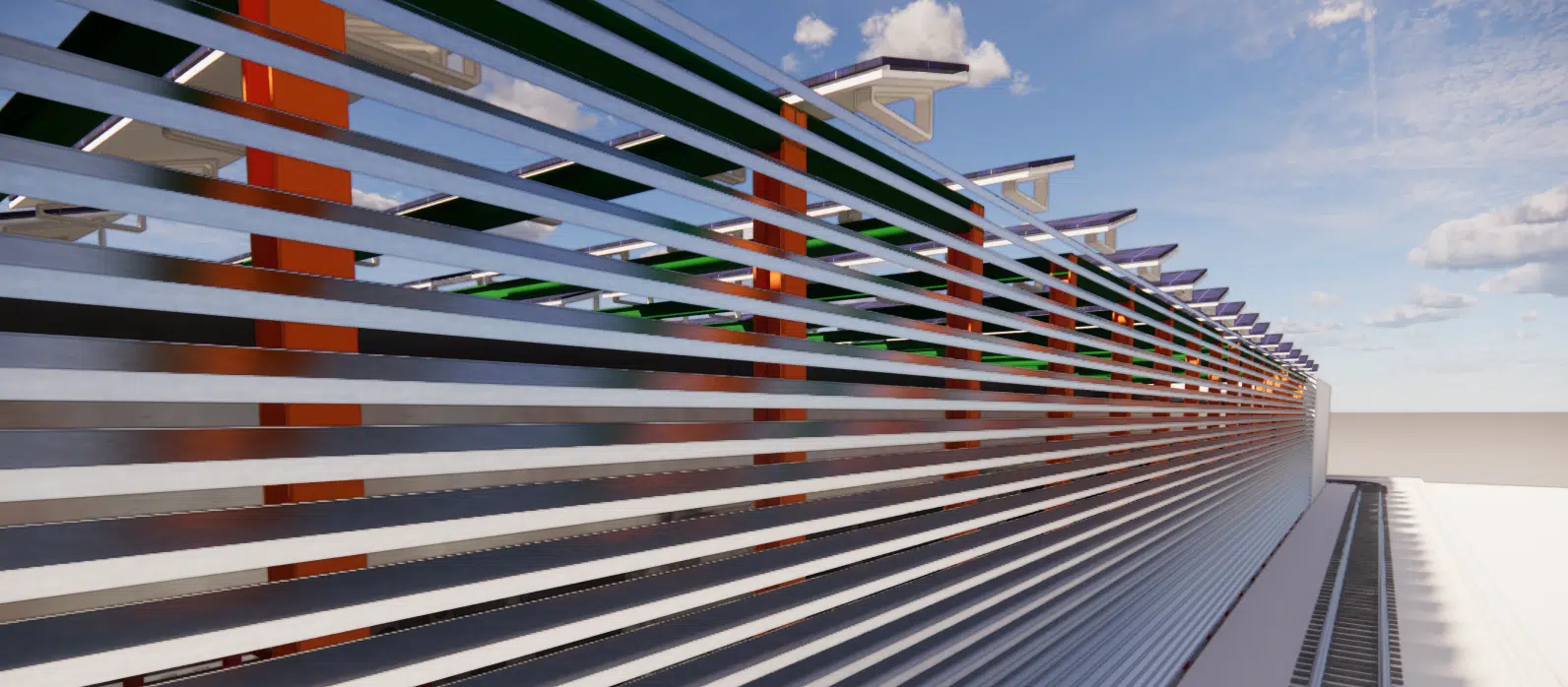
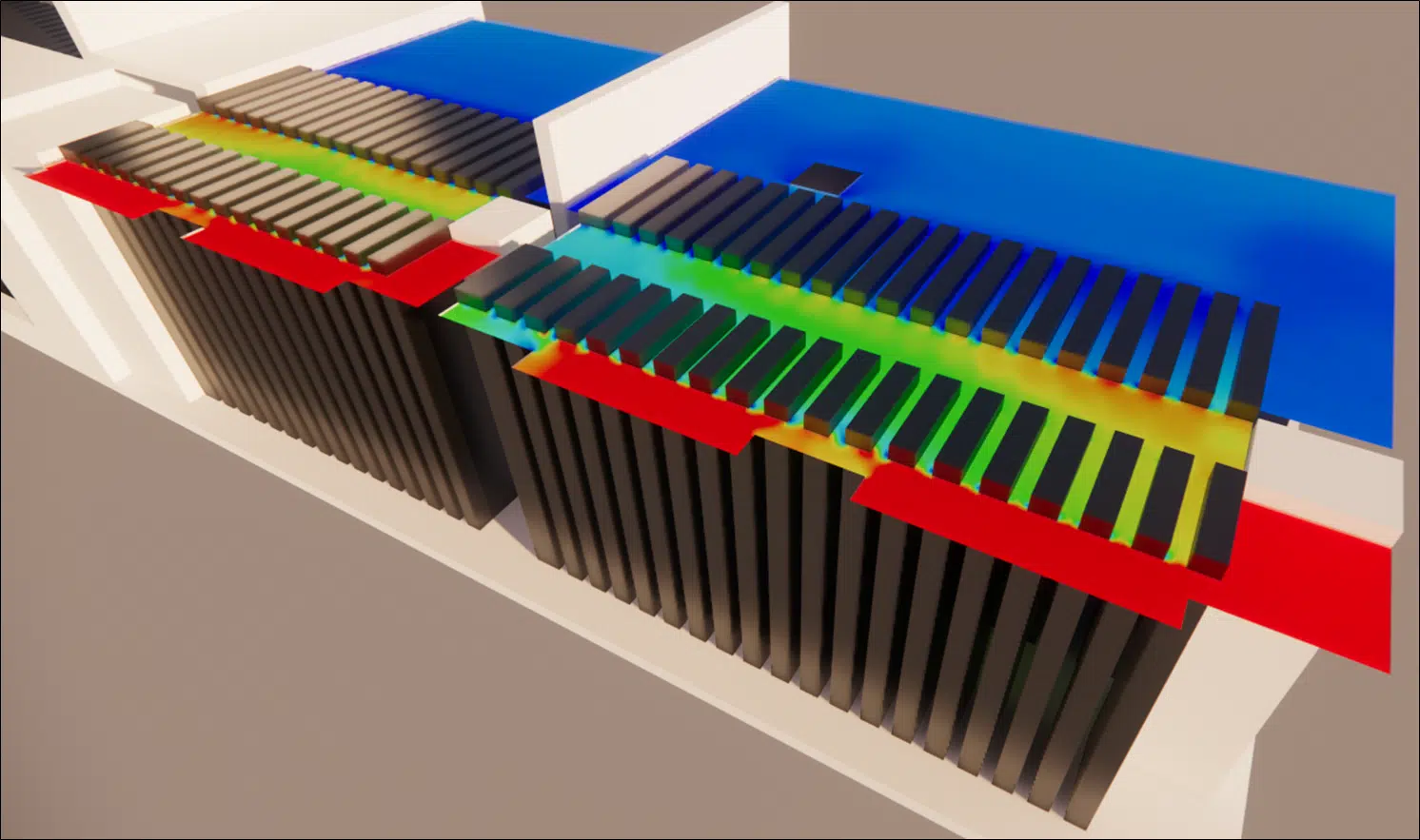
Partition panels are installed to avoid the recirculation effects that can occur between air coolers. These panels are positioned in the upper part of the systems so as not to obstruct the heat exchangers present on each side of the systems.
These panels run the full length, leaving no vertical air passage between the systems' outlets and inlets.
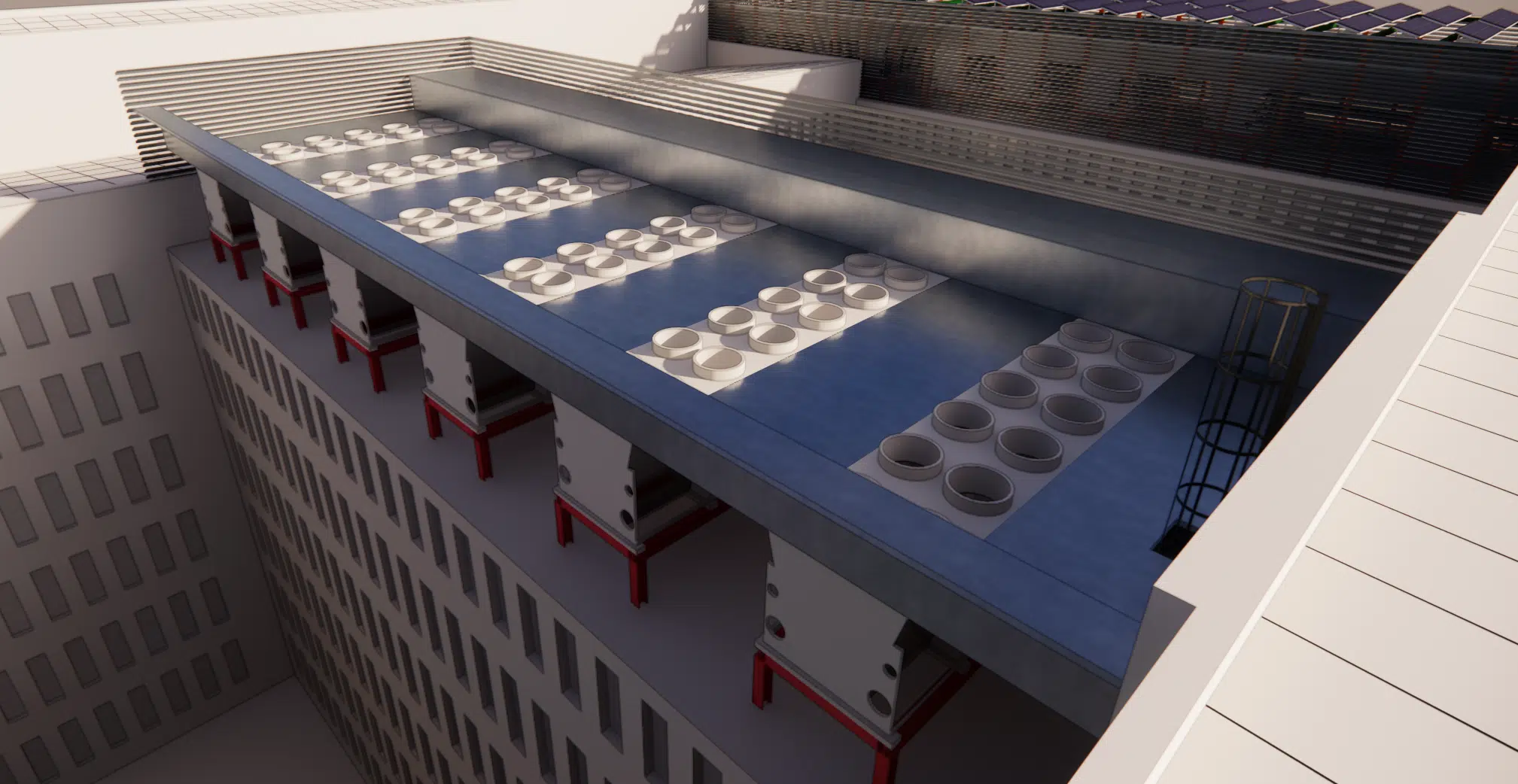
The various airflow obstructions created by the solar panels were modelled in order to account for their impact on the air's trajectory.
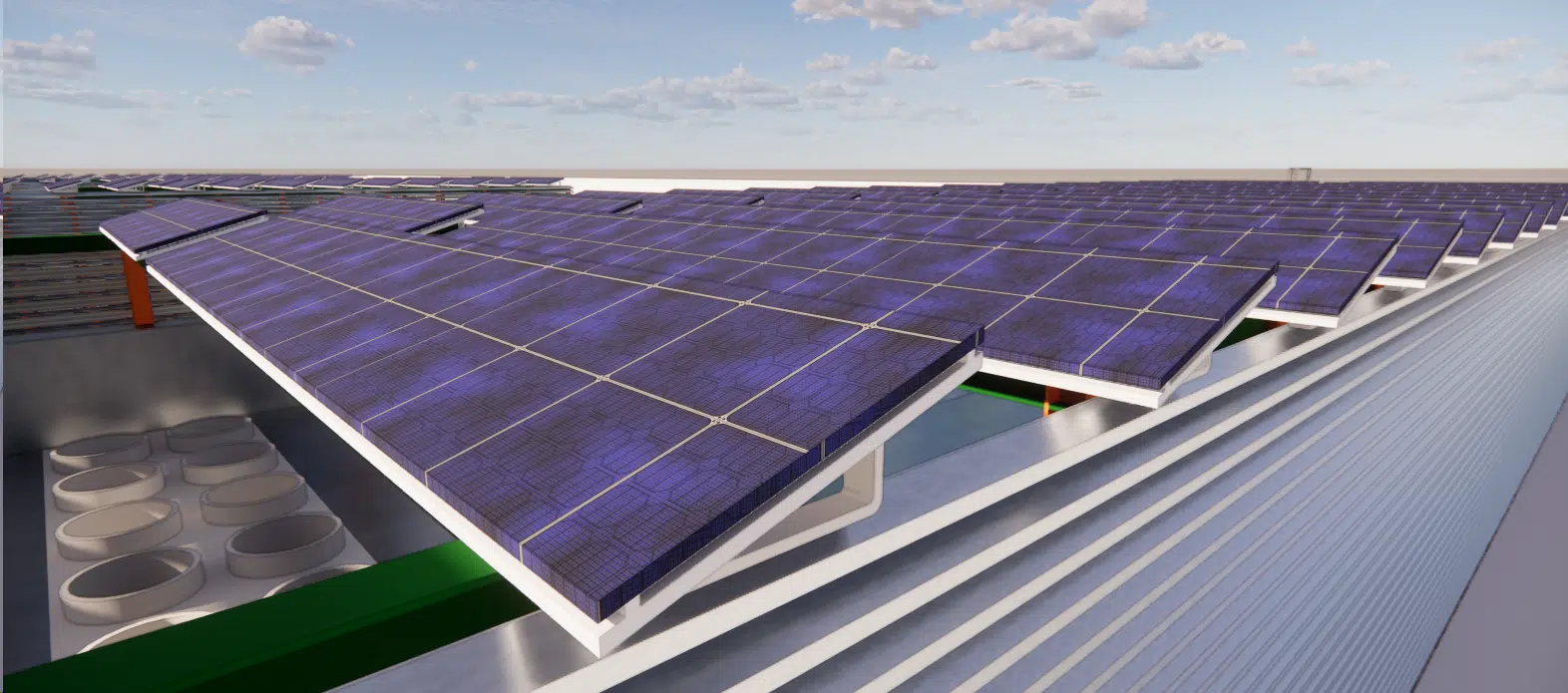
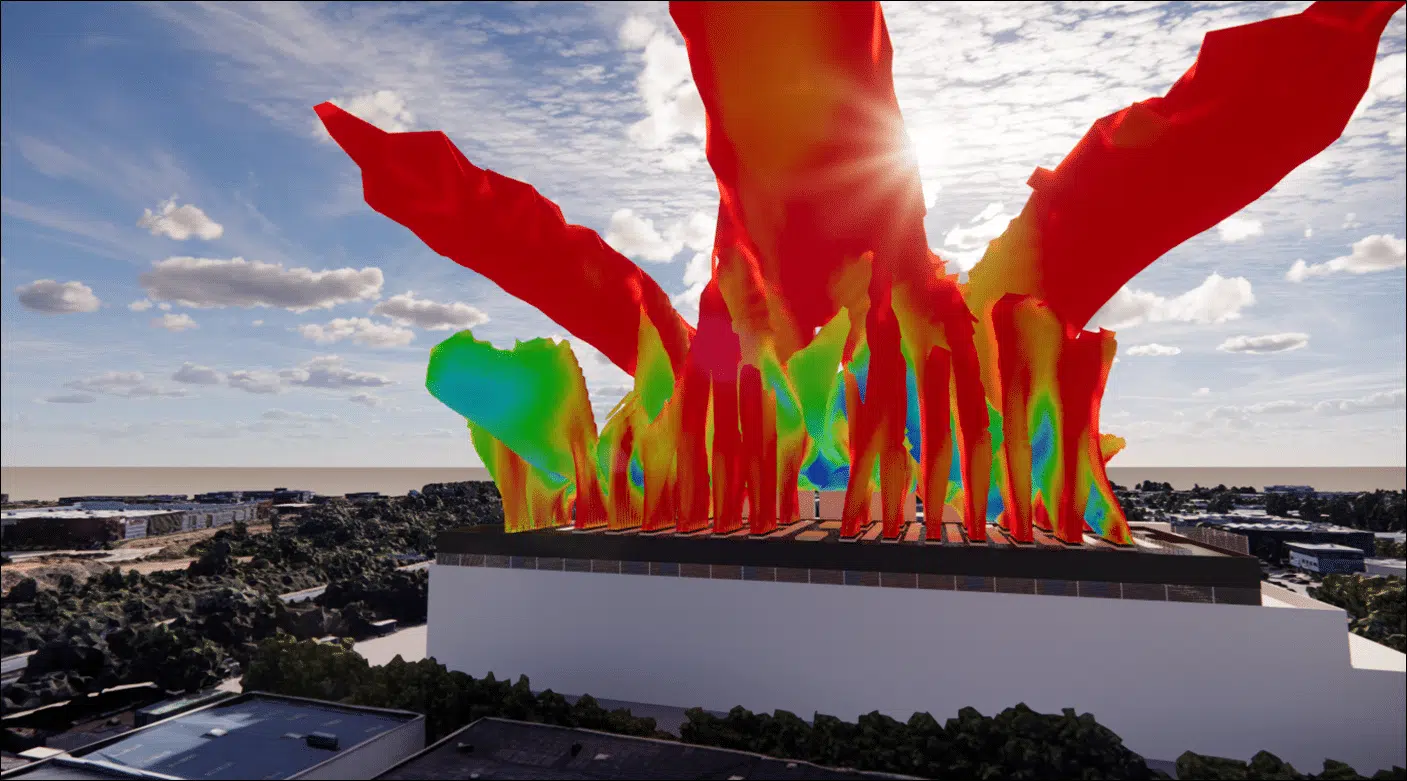
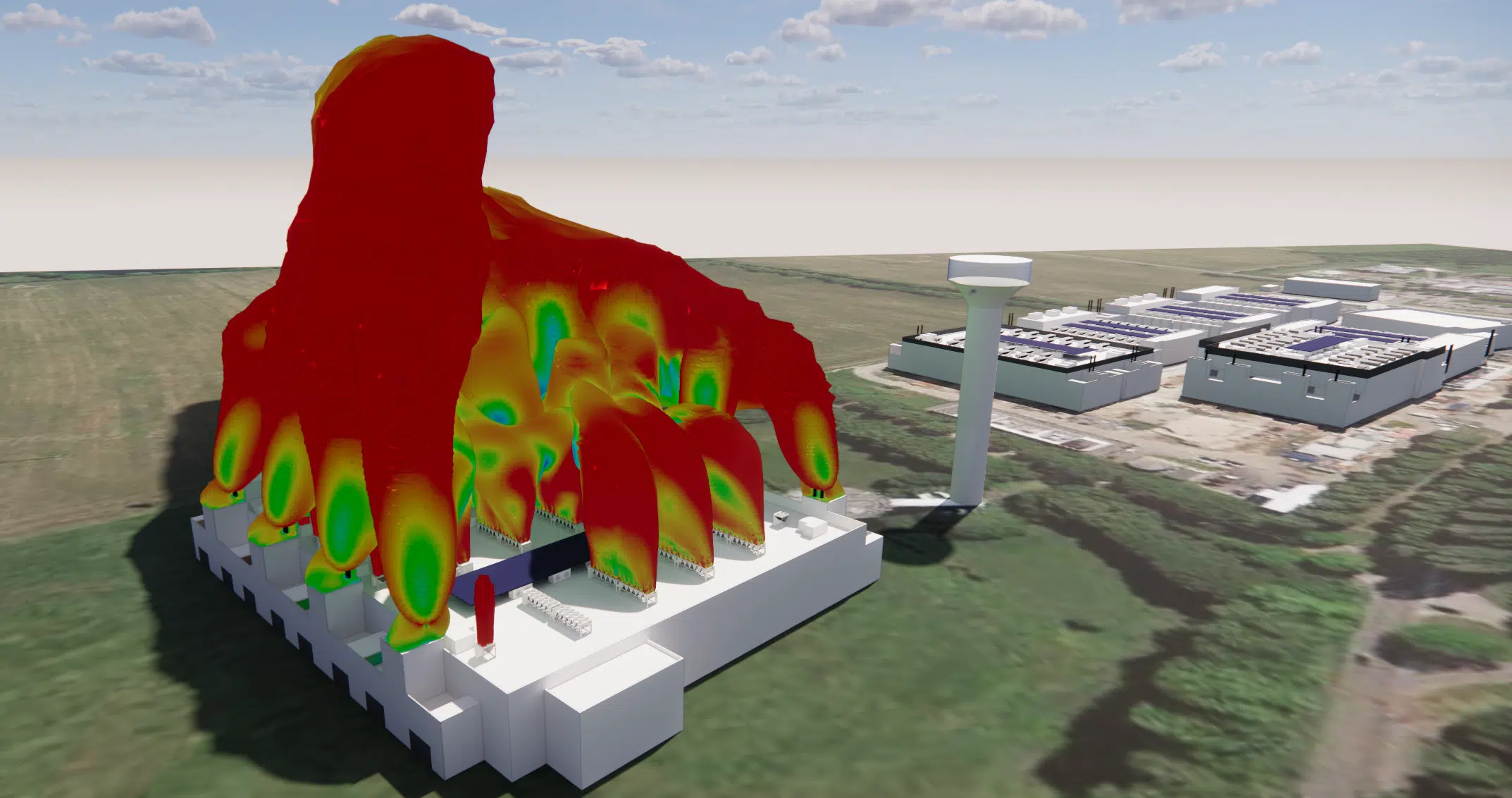
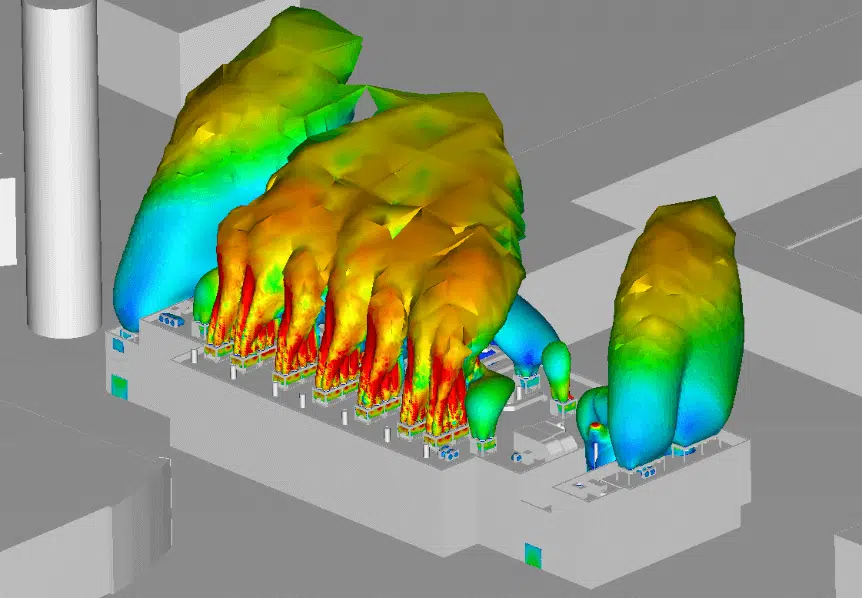
The study of the thermal plumes makes it possible to examine the risks of disturbance of certain systems by the heat rejected by other systems.
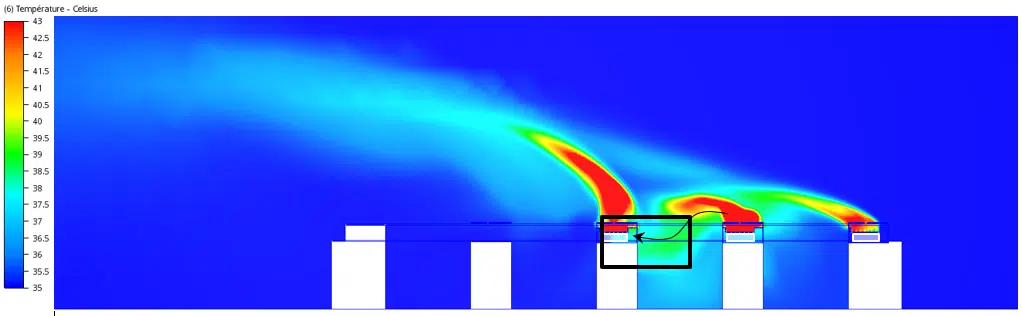
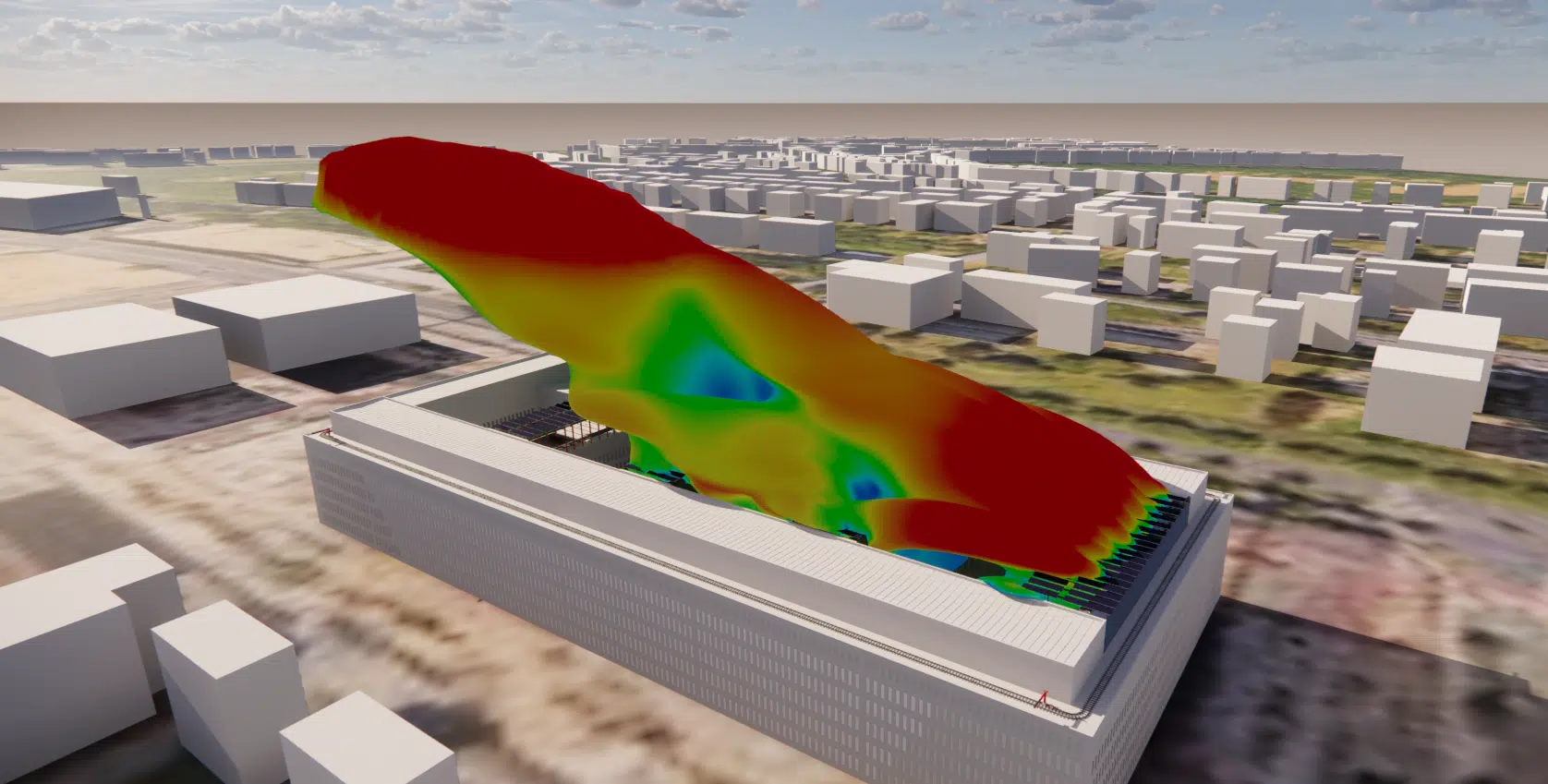
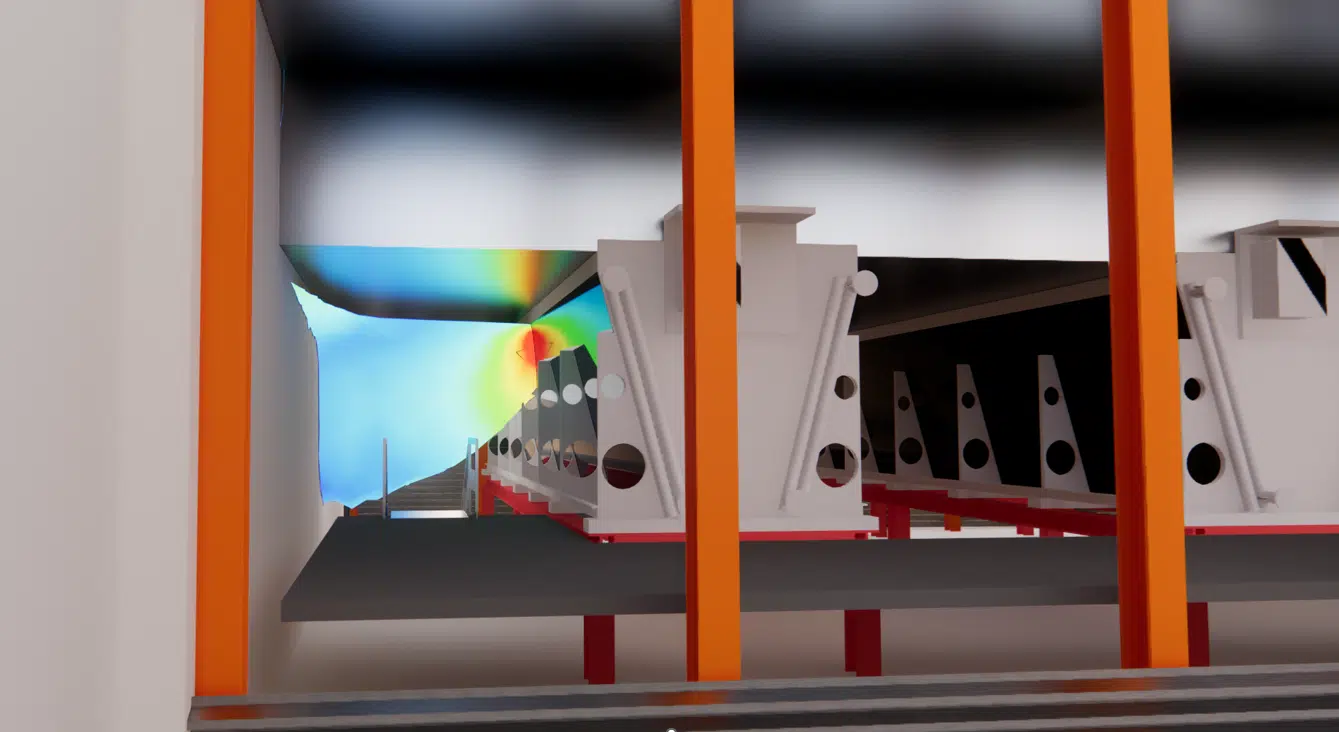
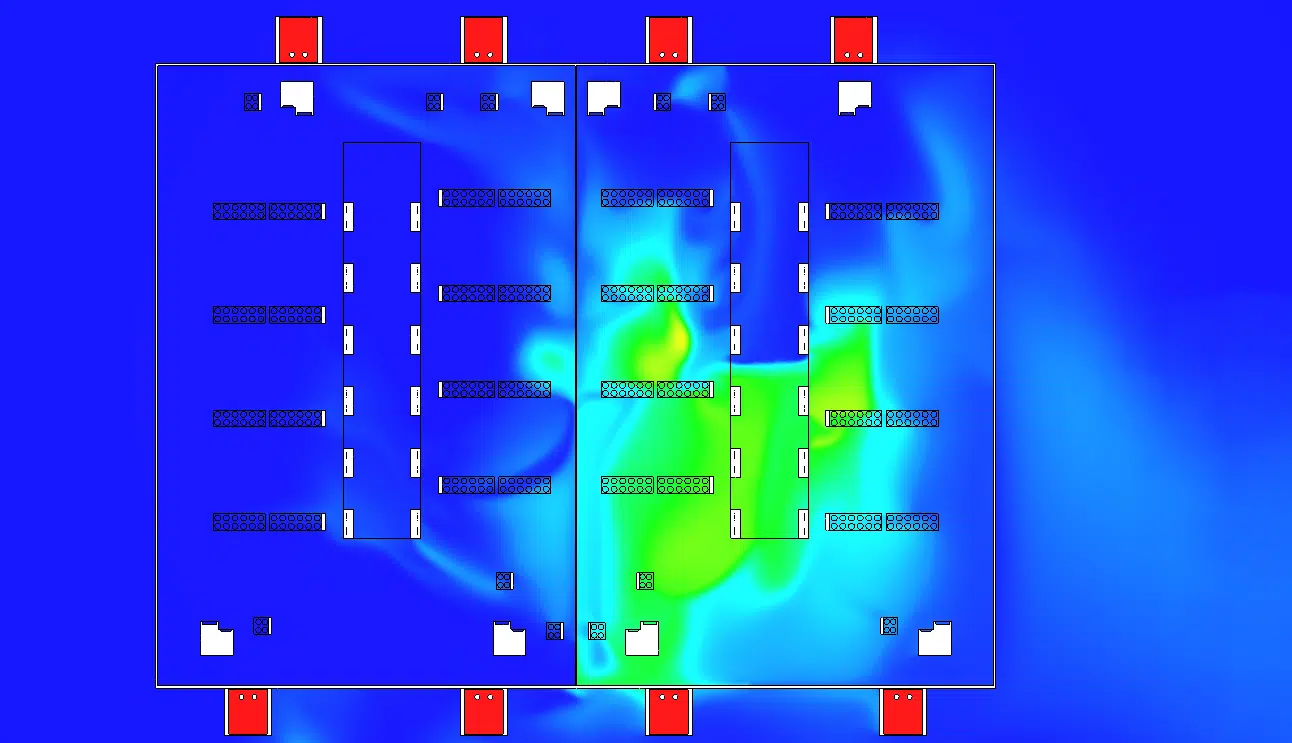
The EOLIOS engineers were able to identify the recirculation described above, which is mainly due to the lack of fresh-air supply near the systems. The presence of fully enclosed gangways does not allow sufficient air renewal. The air drawn in by the systems must therefore be taken from the upper part, corresponding to the heat-release zone. This intake of air from the fans' discharge causes a rise in the temperature of the air drawn in by the 3 fans on the recirculation side.
In addition, the results show a smaller temperature rise in zone B, of around 38 °C, i.e. +3 °C relative to the outside temperature. This temperature rise is less significant owing to the different alignment of the machines in the process zone.
Re-ingestion, by an air cooler, of part of the hot air it has just rejected. It raises the intake temperature and degrades efficiency; controlling it is decisive for the systems' resilience in a heat wave.
Key takeaway. The recirculation comes from a fresh-air deficit: enclosed gangways force the fans to re-ingest their hot air. Widening the fresh-air inlets and breaking this short circuit is the key to preserving efficiency in a heat wave.
Recirculation, airflow obstructions and overheating: answers to the questions asked by operators and design teams.
To model the outdoor thermo-aeraulic exchanges of an office building in Luxembourg fitted with air coolers, in order to assess the overheating risk in a heat wave and optimise the geometry, as on our project DC25 & DC26.
A heat exchanger that cools a heat-transfer fluid by bringing it into contact with the ambient air through fans. Here it equips a large office centre.
Because the enclosed gangways limit the fresh-air supply: the fans draw in, from the upper part, air already warmed by their own discharge, which raises the intake temperature on the recirculation side.
The different alignment of the machines in the process zone limits recirculation there: the temperature rise reaches only about +3 °C (38 °C), versus a stronger rise on the recirculation side.
The airflow obstructions of the metal-louvre wind-breaks and the solar panels, as well as the partition panels and deflectors, to faithfully reproduce the air trajectories and optimise efficiency.
Explore our expertise, projects and technical papers to go further than the FAQ.
 External CFDData Center DC25 & DC26 — External
 External CFDCFD optimisation — Data Center
 External CFDData Center D14 — External
 Internal CFDDC28 — Internal
 HyperscaleExternal & internal CFD — Hyperscale
 External CFDData Center — Paris
 External CFDPressure loss — generator
 External CFDDC23 – External
CFD expertise, delivered projects and technical dossiers: the whole Data Center field in one place.