
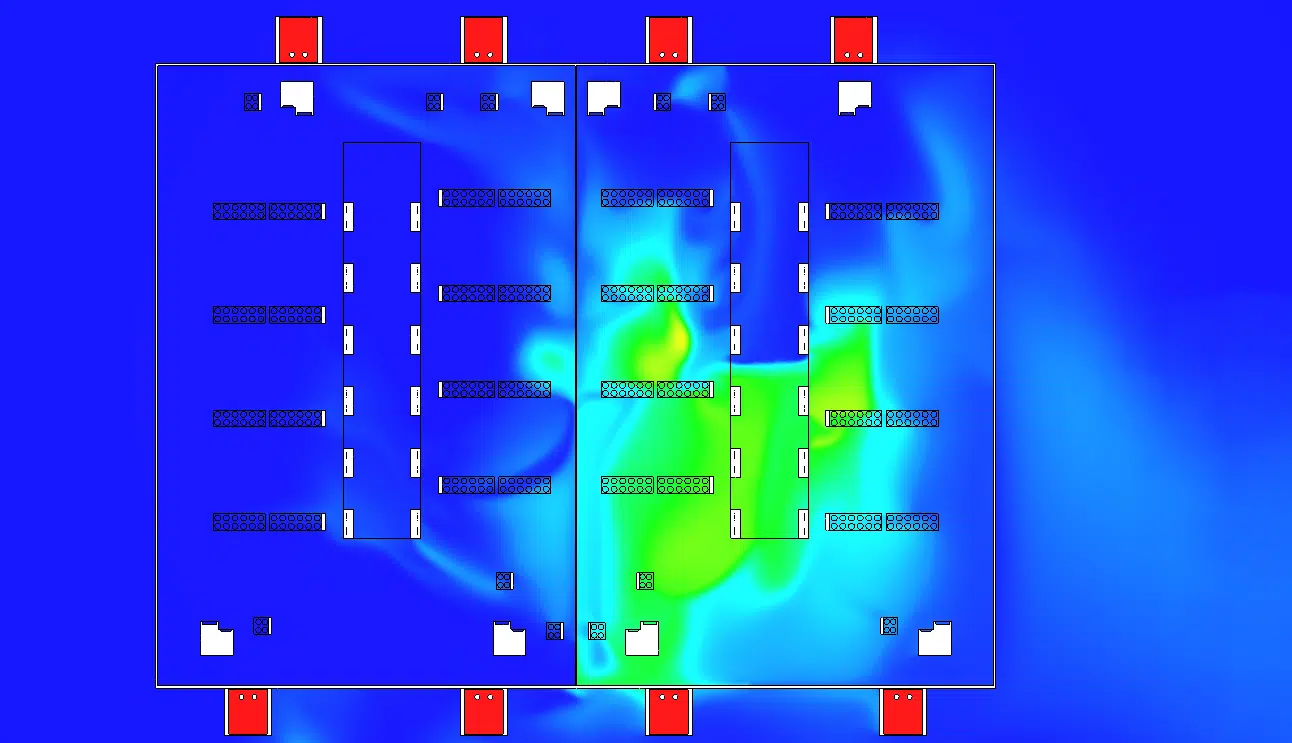
External thermal-airflow study of two data centers: modelling of the thermal plumes and the generator discharge to secure the rooftop cooling.
EOLIOS modelled the thermal and airflow exchanges outside two data centers to verify that the discharge from the generators and the cooling systems neither disturbs the rooftop dry coolers nor contaminates the intake air of the neighbouring offices.
EOLIOS's in-depth study made it possible to complete the risk assessment, optimise the design and reduce the data center's energy consumption, revealing, from the design stage, defects that could be corrected before construction.
The essentials. External CFD study of two data centers: modelling the thermal plumes of the generators and the short-circuiting of the rooftop dry coolers. Under an unfavourable summer wind, the study revealed a strong disturbance of the dry coolers; revising the extraction shafts and the positioning of the air intakes removed the short-circuiting and ruled out the risk of intake-air pollution.
Data centers concentrate a high density of equipment on the roof: dry coolers, discharge stacks, intake and exhaust grilles, substations and back-up generators. In this constrained space, it is far from obvious that fresh air, exhausted hot air and combustion fumes always remain separate.
The main risk is short-circuiting: the re-ingestion, by the dry coolers, of the hot air discharged by neighbouring systems or of the generator plume. This phenomenon causes a loss of cooling power, and therefore a rise in temperature in the data halls that can go as far as equipment failure. To this is added the risk of pollution of the office intake air by the exhaust fumes.
Re-ingestion, by the dry coolers, of part of the hot air discharged nearby. It raises the intake temperature and can degrade cooling; its control governs the site's reliability.
Numerical simulations contribute to a better understanding of thermal-airflow phenomena. The main benefit of CFD is to predict and verify every eventuality in order to develop relevant technical solutions. Thanks to its computing servers, EOLIOS simulates the models in their entirety with great precision, and simultaneously analyses the impact of many phenomena on the external thermal-airflow behaviour of the data center. This study notably made it possible to reveal design defects that could be rectified.
In CFD modelling, the shape of the vertical profile of the wind speeds is paramount. It depends on the degree of roughness of the environment, that is the tendency of buildings, trees and obstacles to slow the wind by opposing its movement. Across the whole thickness of the atmospheric boundary layer, the speed increases as one moves away from the ground.
To reproduce this shear, EOLIOS applies a methodology close to a physical wind tunnel: the urban environment is modelled over a periphery of about 500 m around the site, with a terrain-dependent velocity profile. The impact of the plumes is thus assessed for different wind configurations.
Layer of air near the ground where wind speed increases with height under the effect of terrain friction. Reproducing its profile is essential to correctly assess the plumes' trajectory.
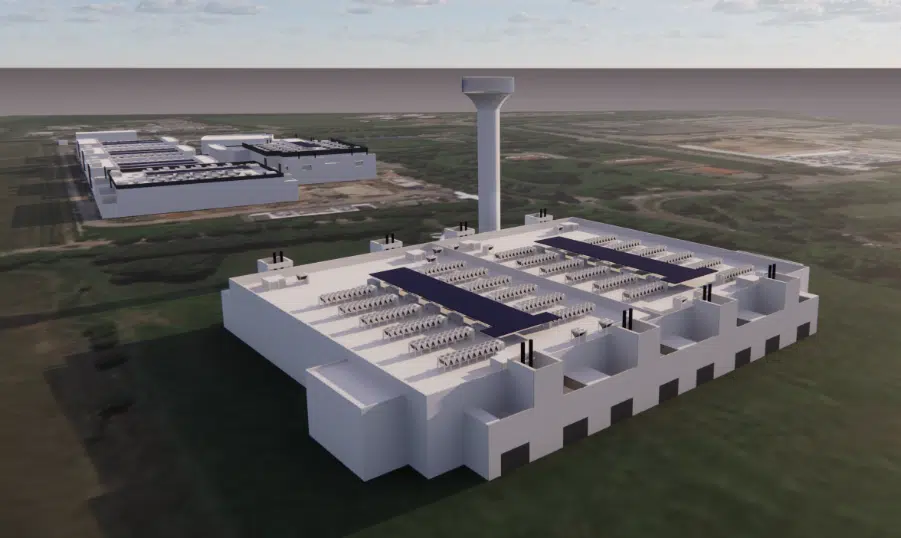
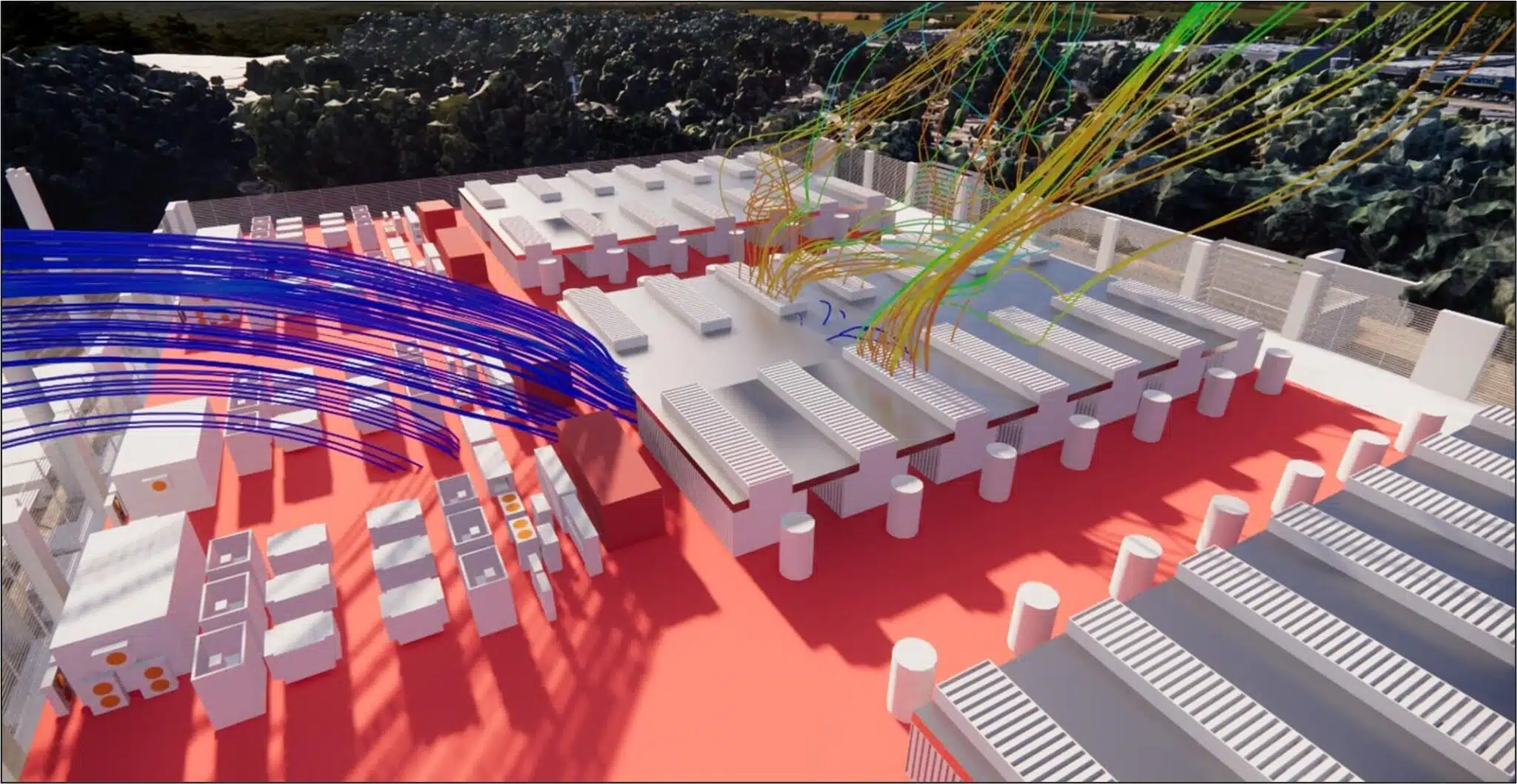
A meteorological study of the site established the prevailing wind conditions and the most unfavourable configuration: that of a wind likely to push the thermal plume of the generators down towards the rooftop systems, combined with a high outdoor temperature.
The digital twin reproduces the simplified geometry of the site and its immediate surroundings to finely analyse the evolution of the plume according to the wind orientations. Several neighbouring buildings and their systems were modelled in order to verify the influence of the thermal discharges of the existing and under-construction buildings.
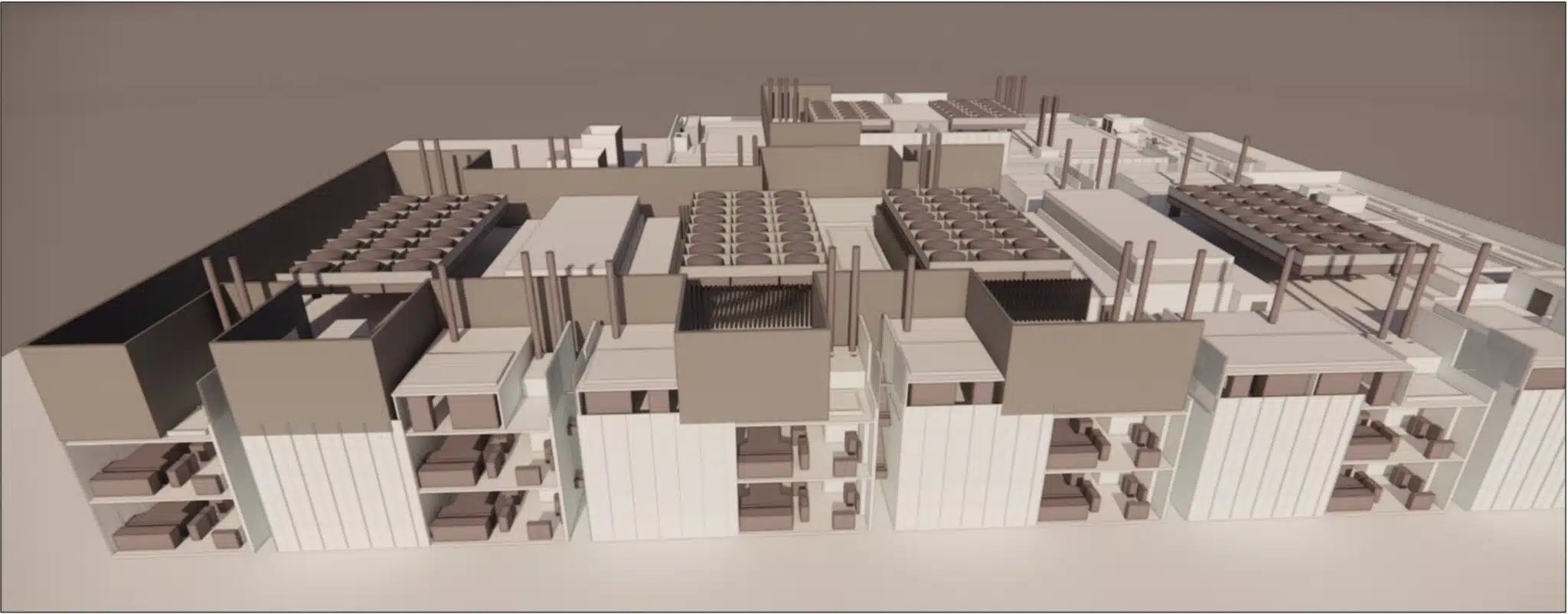
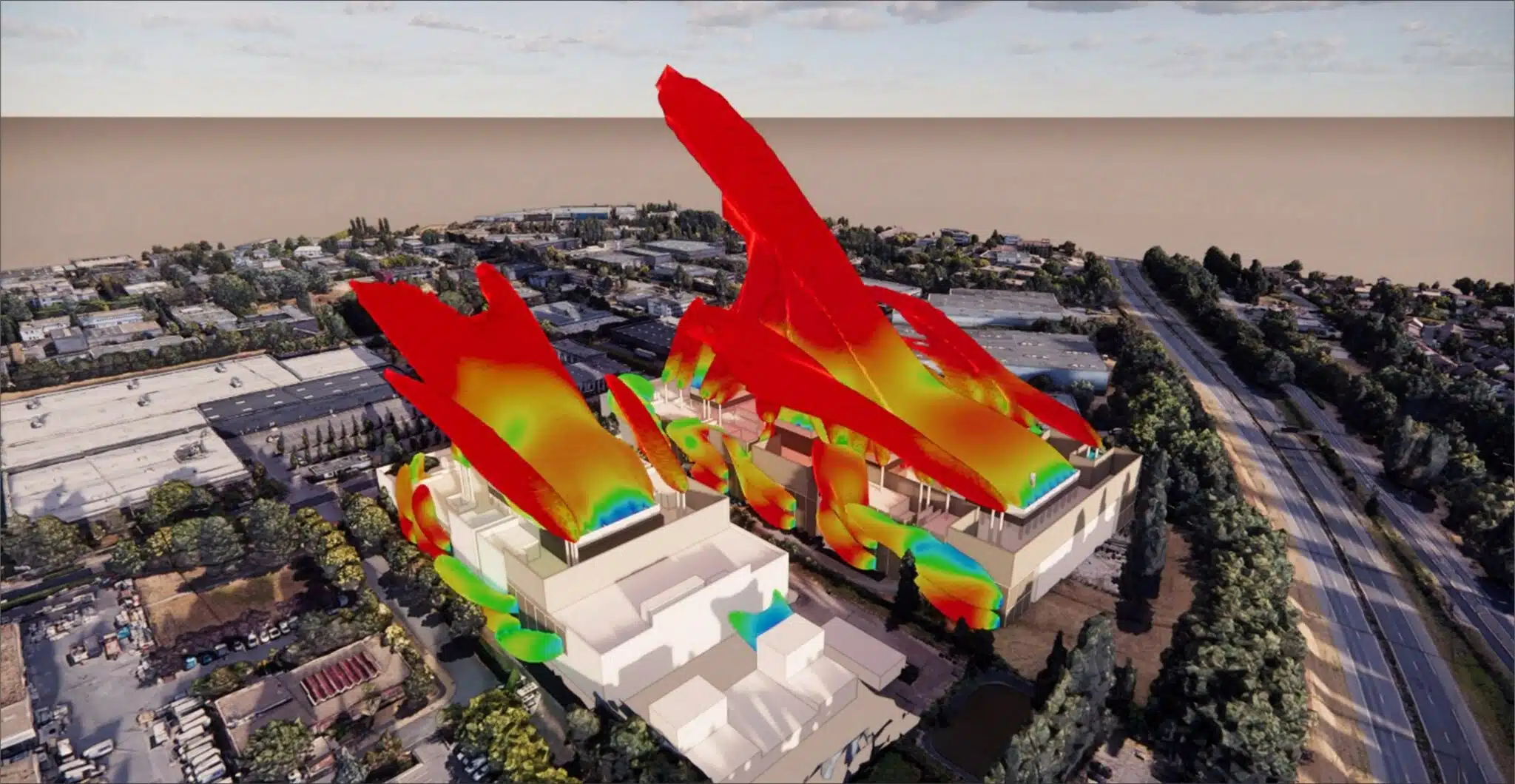
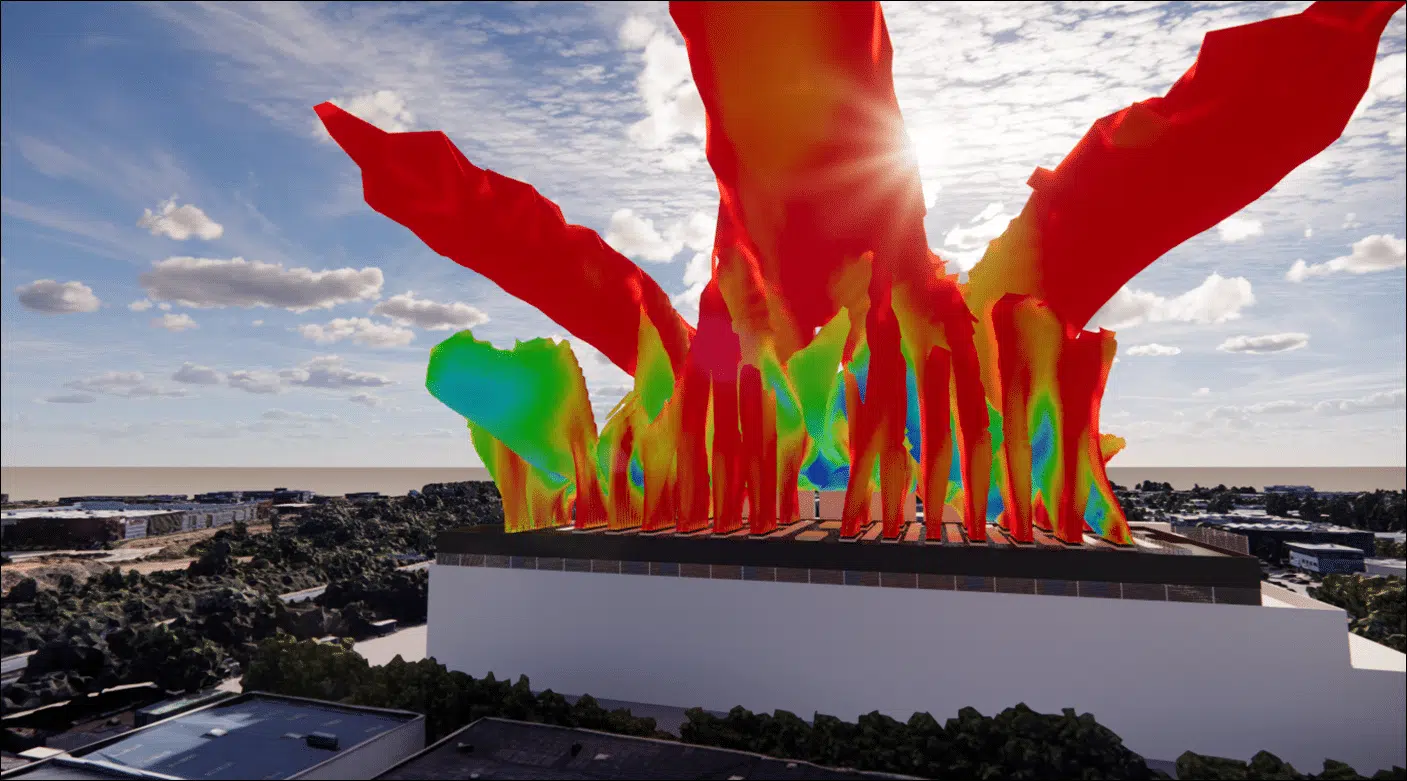
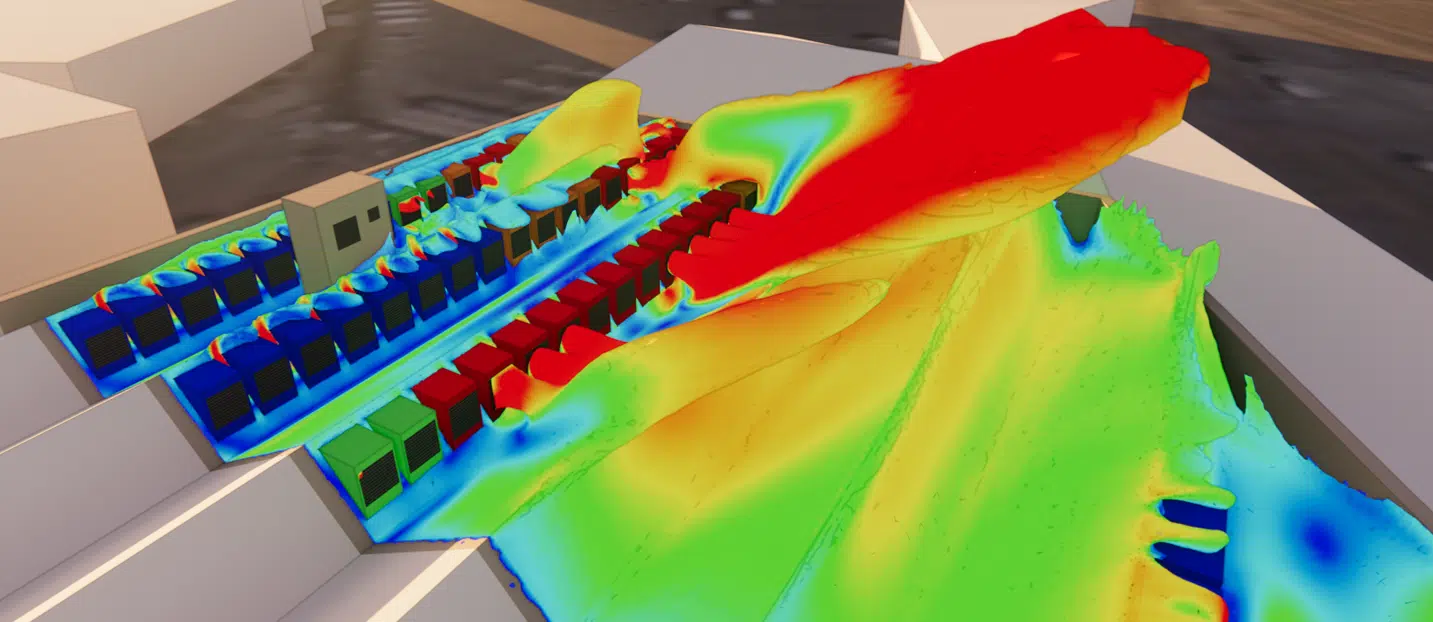
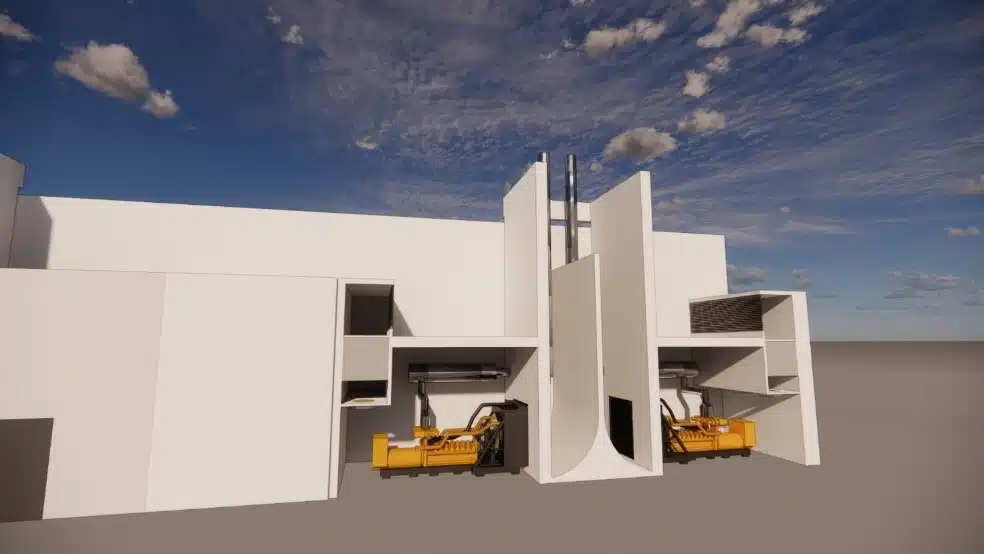
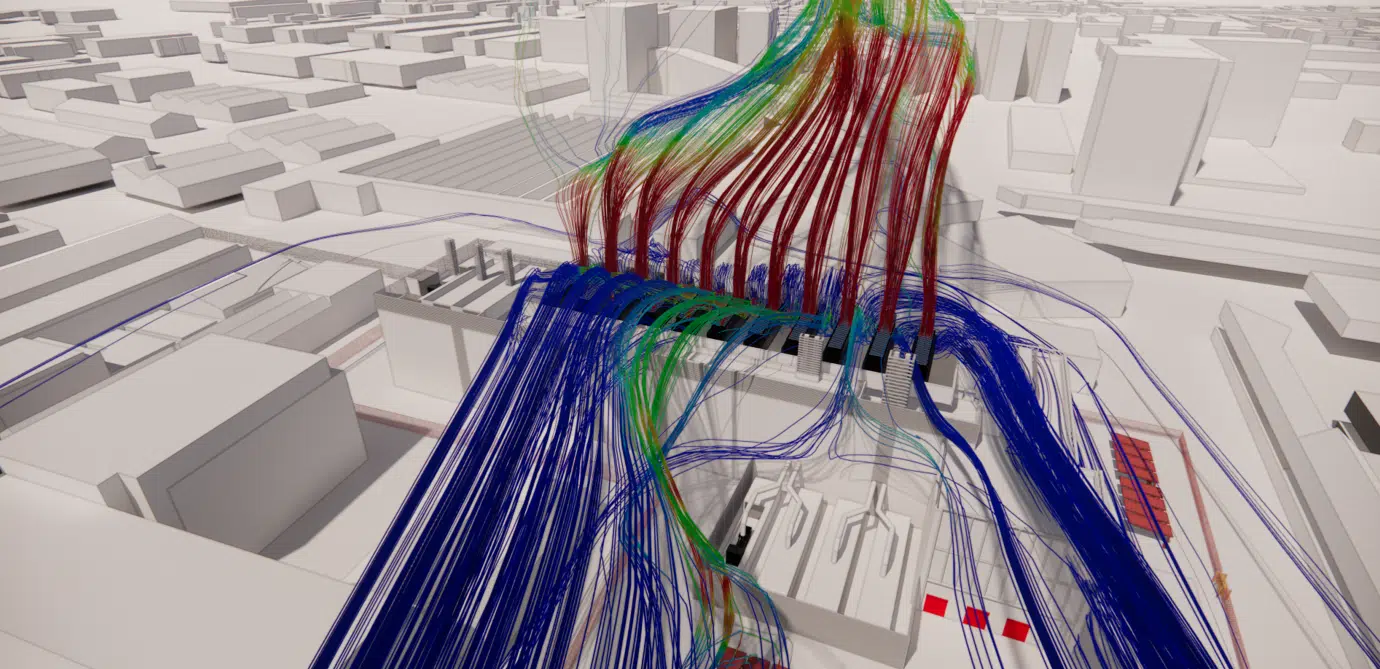
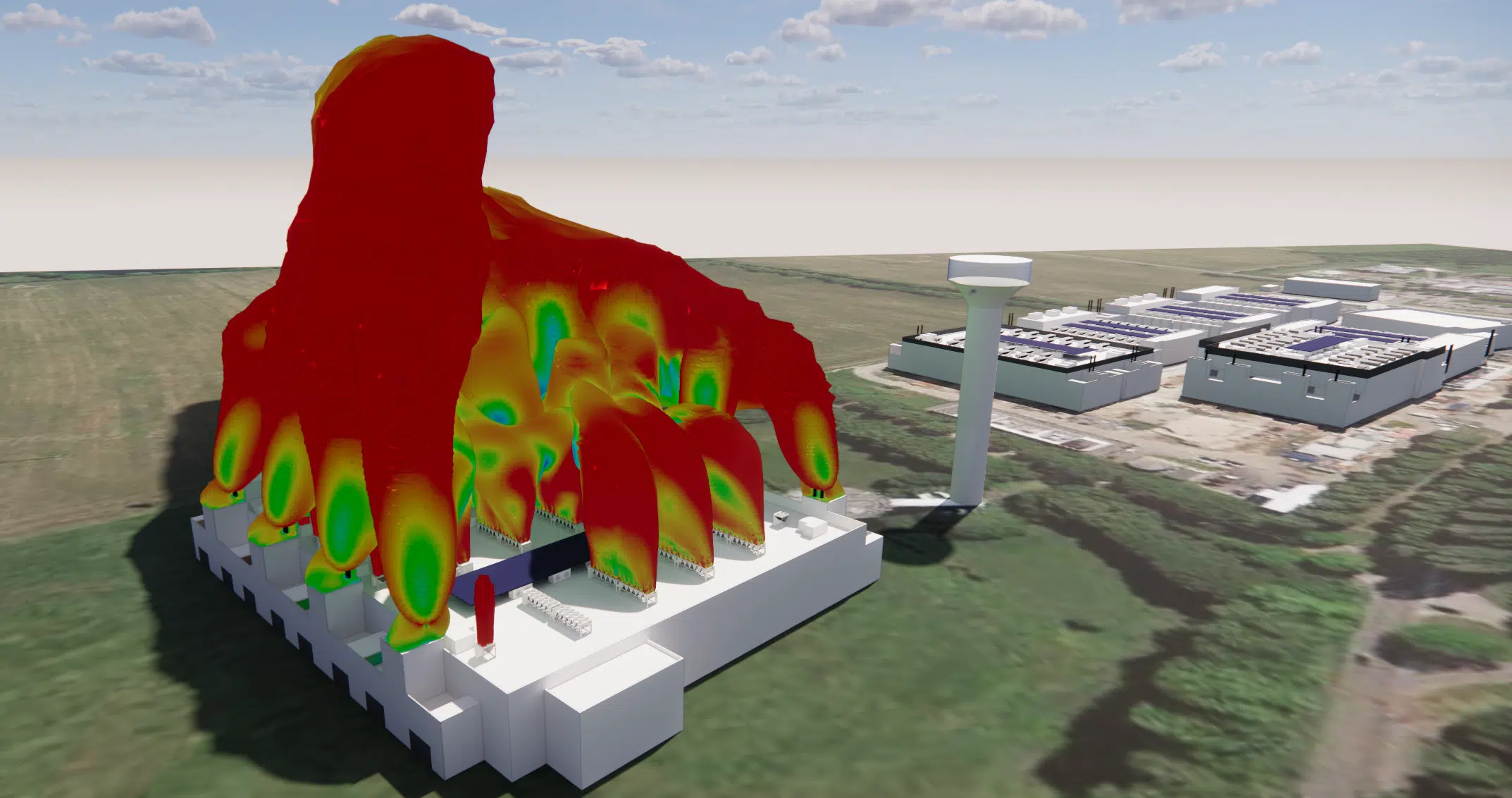
Based on the site's climate studies, for an unfavourable summer wind, the study of the thermal plumes generated by the generators concluded that there would be a very strong disturbance of the dry coolers, and even their potential failure. The design of the airflow extraction shafts could be revised in order to remove the harmful thermal-airflow phenomena at the origin of these issues.
In a second stage, the studies focused on the tracking of the combustion-fume discharge from the engines, depending on the positioning of the air intakes of the office AHUs. The objective being to remove the risk of intake-air pollution, an optimisation of the positioning of the air inlets was carried out.
Finally, the thermal plumes of a data center can influence the local air temperatures over a hundred metres or so. On this basis, several buildings and their systems were modelled in order to verify the influence of the discharges ; the disturbance risk levels could be established in relation to the site's climate studies.
Volume of hot air released by a source (generator, dry cooler) that rises and deforms under buoyancy and wind. Its trajectory governs the risk of re-ingestion by the neighbouring systems.
Thanks to the conclusions of the study, EOLIOS proposed suitable solutions to the design teams to resolve these issues. CFD simulation makes it possible to analyse, predict, verify and correct the errors that may appear in a design. This fast and precise method saves design time and cost, while guaranteeing concrete and reliable results.
By tracking the NOx particles in the exhausted hot air, it was determined that the HVAC equipment remains supplied with clean air for the most unfavourable wind orientations, once the design optimisations have been incorporated.
Key takeaway. Anticipating rooftop short-circuiting and the generator plumes from the design stage avoids cooling-power losses, overheating and air-intake pollution.
Rooftop short-circuiting, generator plumes and fume tracking: answers to the questions asked by operators and design teams.
To verify that the thermal plumes of the generators and the discharge of the cooling systems neither disturb the rooftop dry coolers nor contaminate the offices' intake air, through CFD simulation of the external phenomena, as on our sister project DC15.1 & DC15.2.
The re-ingestion, by the dry coolers, of hot air discharged by neighbouring systems or by the generator plume. It causes a loss of cooling power and a temperature rise in the data halls.
To verify that the exhaust gases do not contaminate the intake air of the office AHUs. By tracking the NOx particles, the positioning of the air inlets could be optimised.
A data center's plumes can change local air temperatures over about a hundred metres, which justifies modelling the neighbouring buildings and their discharges.
It makes it possible to analyse, predict, verify and correct defects before construction. Here, revising the design of the extraction shafts removed the harmful phenomena while saving time and cost.
Explore our expertise, projects and technical papers to go further than the FAQ.
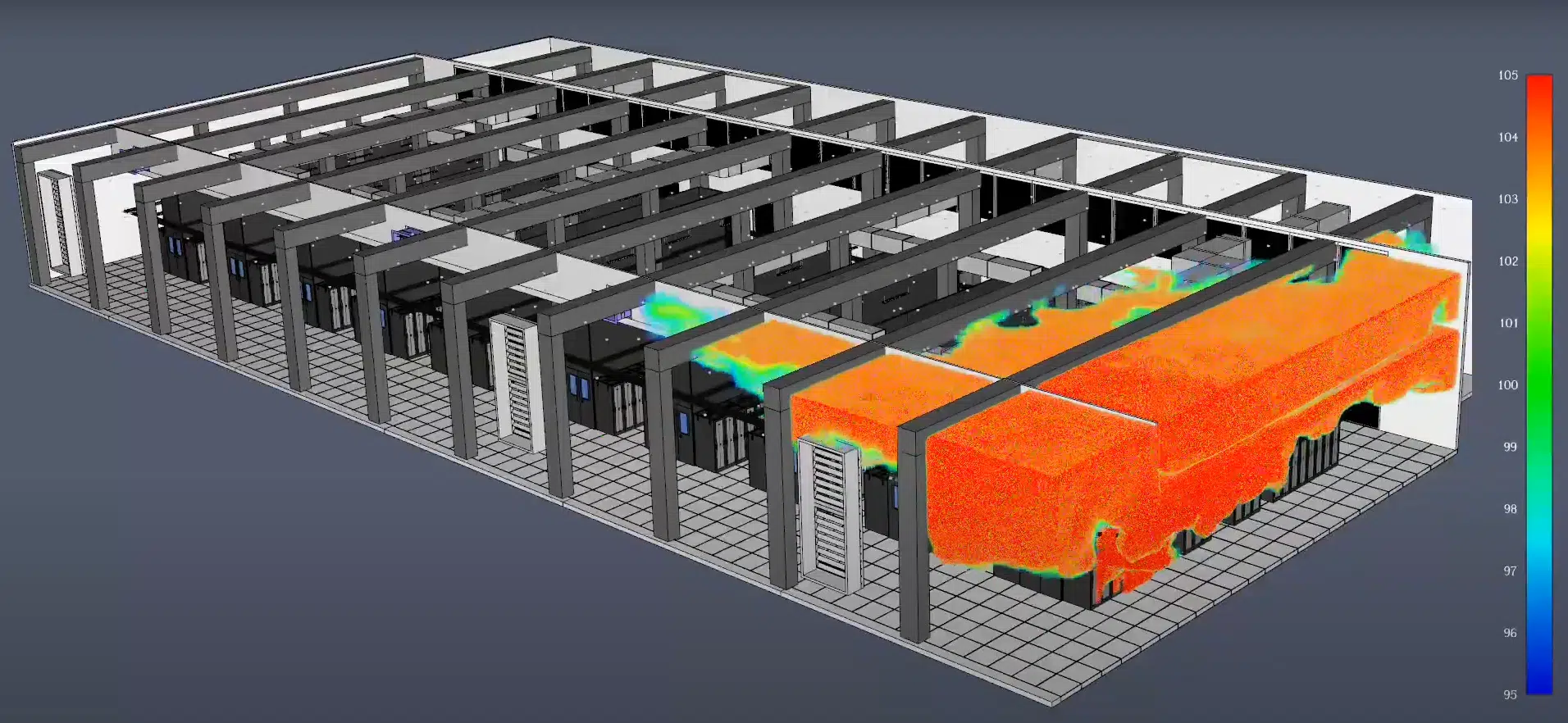
This analysis studied the exhaust plume of a series of back-up generators for two data centers. The objective: to determine whether the exhaust gases would contaminate the supply air of the cooling equipment and of the adjacent office building. By tracking the NOx particles in the exhausted hot air, it was established that the HVAC equipment remains supplied with clean air for the most unfavourable wind orientations.
 Digital twinData center study – Data Hall and UPS rooms
 Smoke controlSmoke-control engineering in a data center
 HyperscaleExternal & internal CFD – Hyperscale Data Center
 OptimisationCFD optimisation – Data Center
 InternalData Center – DC28 – Internal
 Technical roomsTechnical rooms – Data Center
 CoolingCooling optimisation – Data Center
ExternalData Centers – DC15.1 & DC15.2 – External
CoolingCooling optimisation – Data Center
ExternalData Centers – DC15.1 & DC15.2 – External
 ExternalData Center – PA 22 – External
 GeneratorPressure-loss study – Generator – Data center
 ExternalData Center – Paris
 FireData Center – NOVEC gas
 InternalData center – DC17 – Internal
 ExternalData center – D14 – External
 InternalData Center – DC10 – Internal
 InternalData center – DC25 – Internal
ExternalData Center – D14 – External
InternalData center – DC25 – Internal
ExternalData Center – D14 – External
CFD expertise, delivered projects and technical dossiers: the whole Data Center field in one place.
The simplest thing is to talk it through together. Our engineers reply with an initial technical read of your project.