
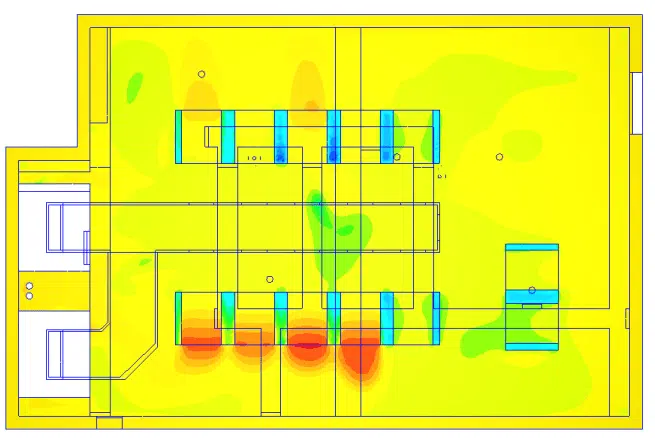
Study of the overheating risks at the server inlet and modelling of the dispersion of 3M™ NOVEC™ 1230 gas in the event of a fire, for the SAMU 95 data hall.
For an existing data center, after an audit, the objectives were to study the overheating risks at the server inlet, to check the overall airflow of the room, then to model the dispersion of 3M™ NOVEC™ 1230 gas in the event of a fire.
The essentials. Climate- and fire-risk study of the SAMU 95 data hall (CHU Pontoise), carried out on a digital twin of about 10 million cells. Under standard conditions, the server-intake temperature stays controlled around 25 °C. In the event of a fire, the dispersion of 3M™ NOVEC™ 1230 gas through the raised-floor and false-ceiling nozzles reaches a concentration above 5 % across all risk zones, in line with the recommendations.
The main challenge in designing a data center is the perpetual continuity of services. Failures, maintenance and fires can occur, but the IT equipment must keep operating without being damaged. It is in this context that EOLIOS brought its expertise to carry out a climate-risk study and a fire-risk study in the SAMU 95 data hall.
The objectives: visualise the server-inlet temperatures, check the overall airflow of the room, then model the dispersion of 3M™ Novec™ 1230 gas in the event of a fire.
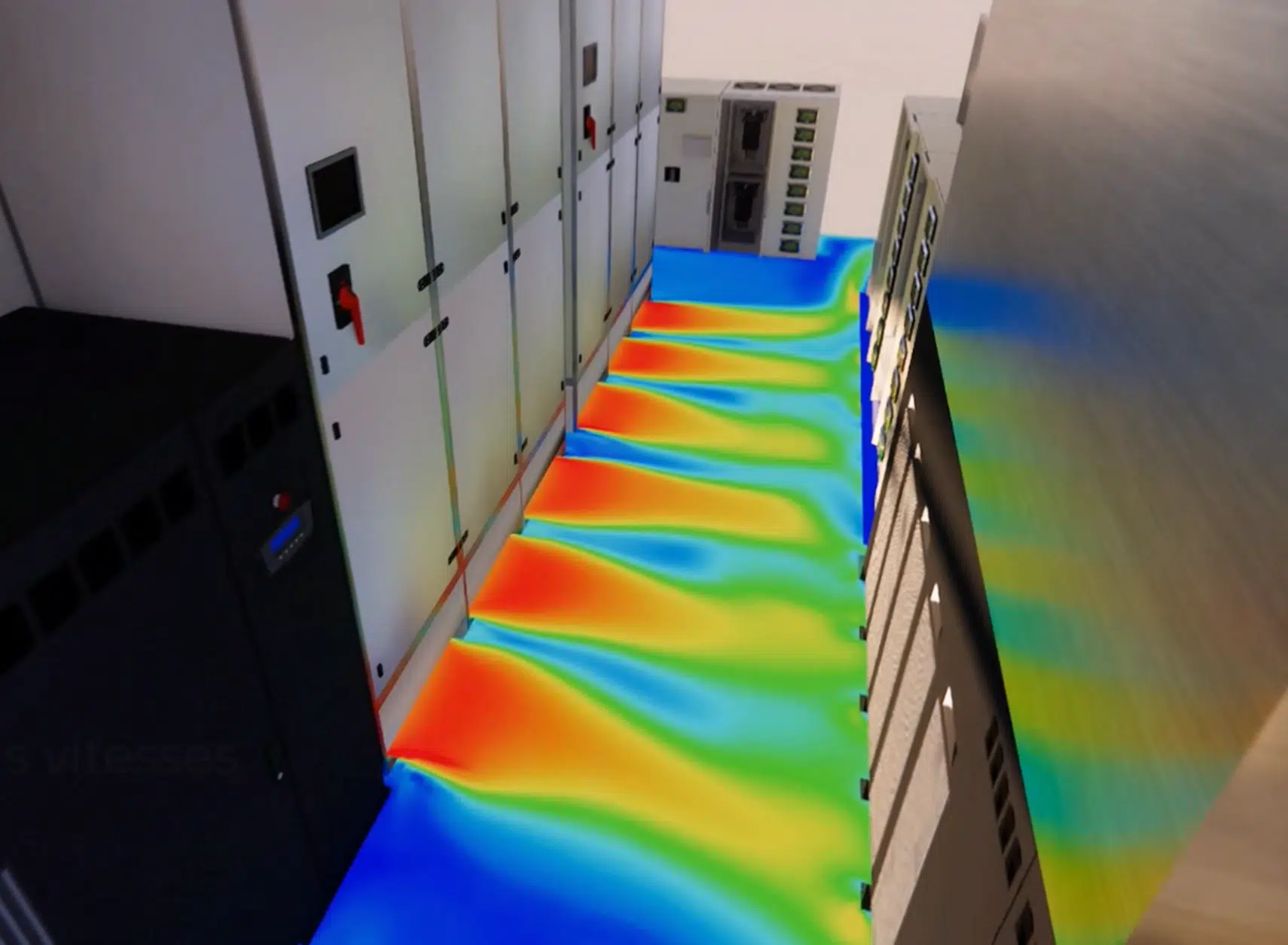
For this study, the entire data center was reproduced using 3D software. All the HVAC systems are taken into account in the model, as are the heat gains through the walls.
The exact layout of the servers is implemented: it considers the flow rate of each server as well as its power. The more precise the digital twin, the closer the results are to reality. The mesh used contains around 10 million elements and is refined in the high-gradient zones.
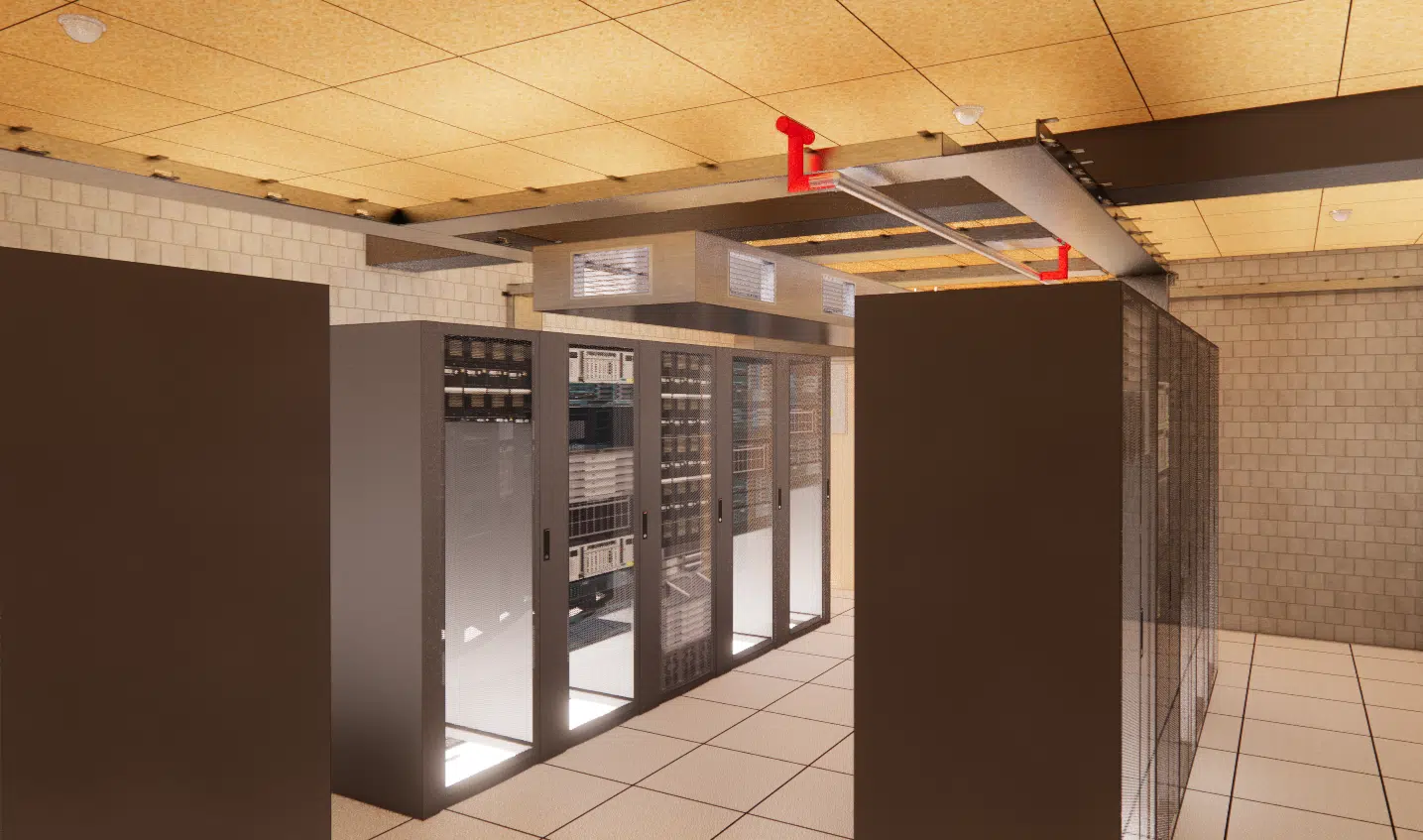
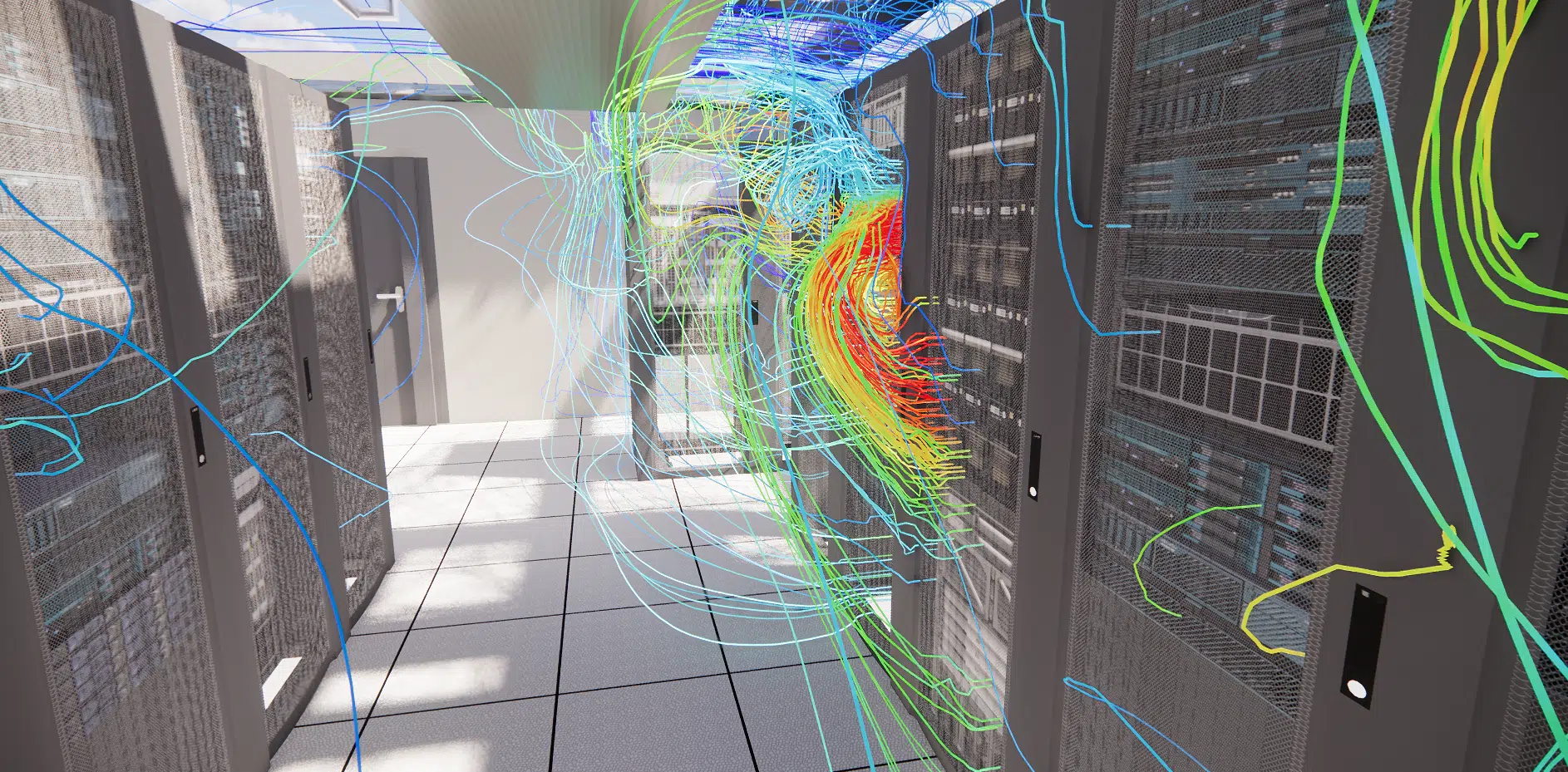
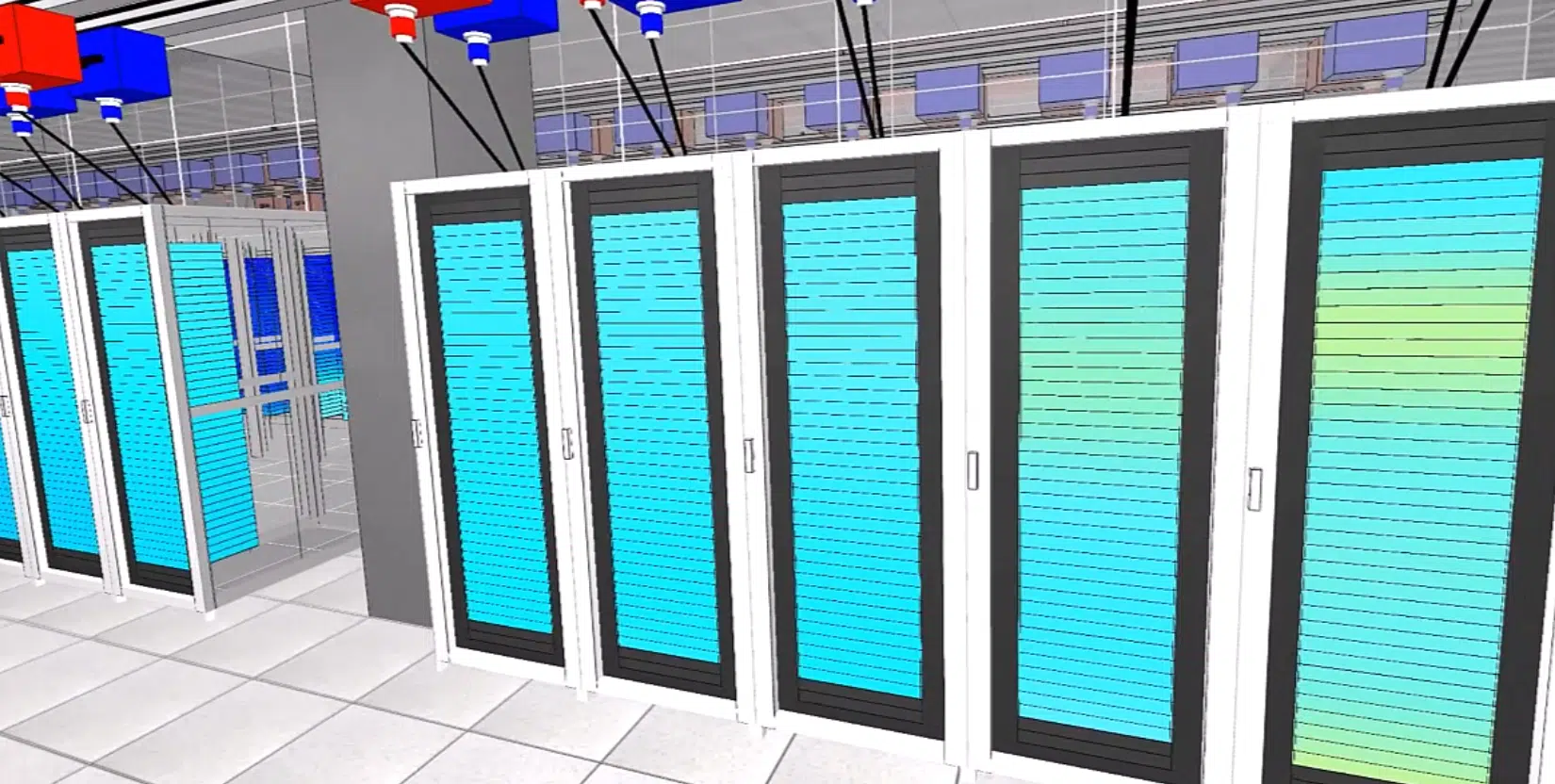
As part of the climate-risk study, the power balance of the recycler reveals no overload. However, the absence of blanking modules in the racks, at the empty server positions, creates an air recirculation.
Under standard conditions, the temperature rise is well controlled: the temperature is around 25 °C at the server intake. Despite the presence of bypass, the climate conditions are met — the recyclers are effective at controlling the temperature, including in hot conditions. The design is deemed to meet expectations.
Key takeaway. adding blanking modules at the empty rack positions would eliminate the parasitic recirculation and further improve the reliability of the thermal control.
A blanking panel installed at the empty server positions of a rack. It prevents hot air from bypassing the equipment and eliminates the parasitic recirculation between hot and cold aisles.
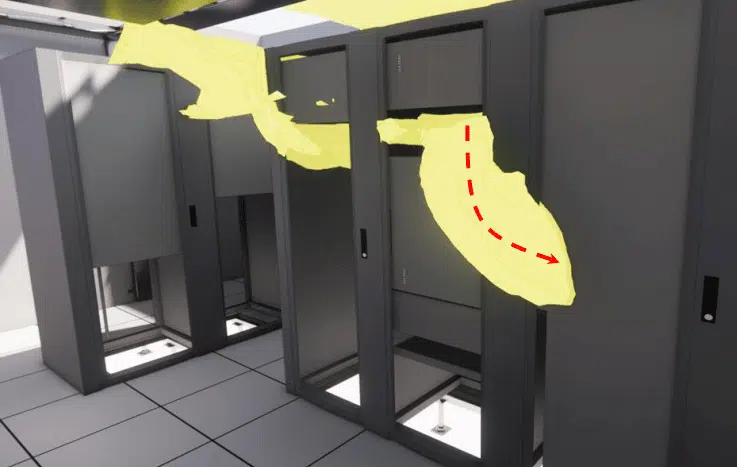
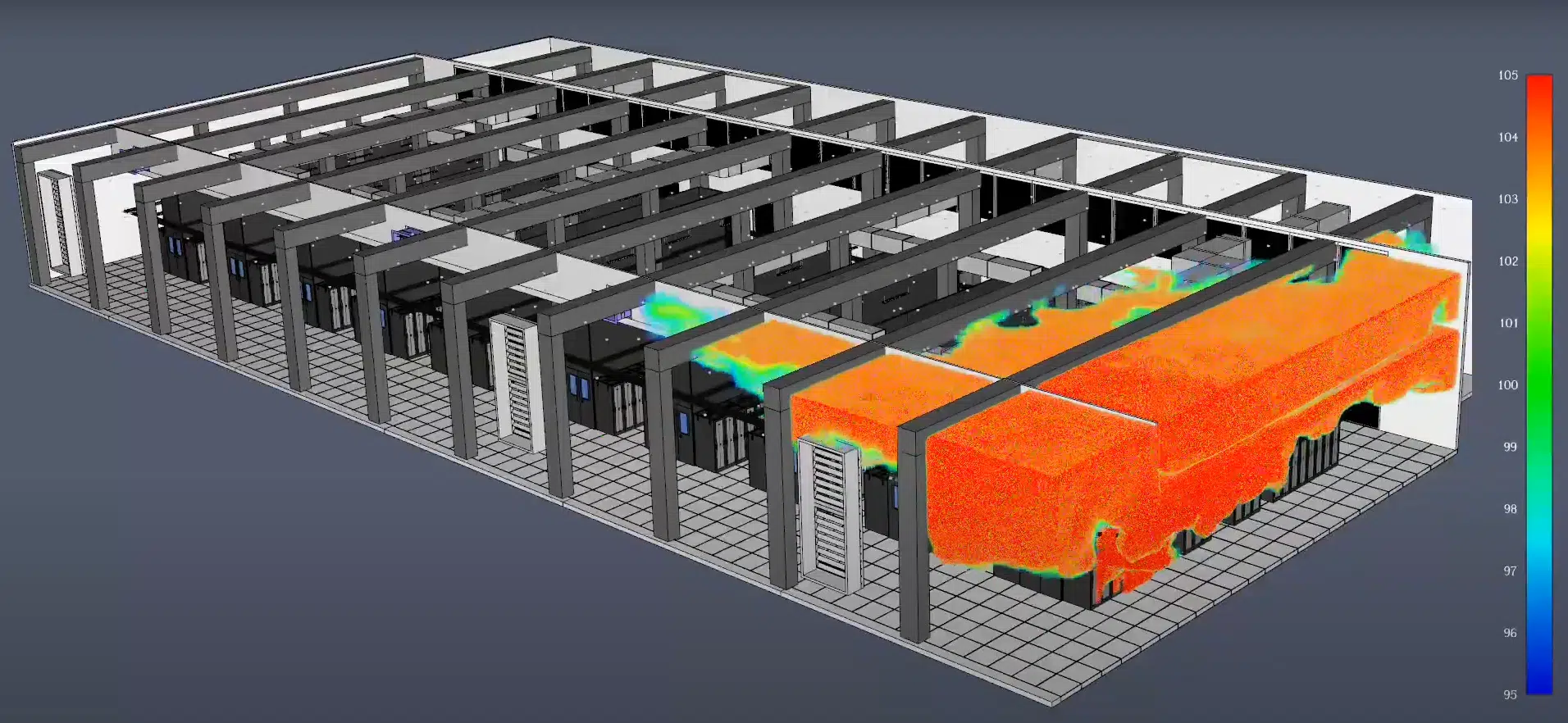
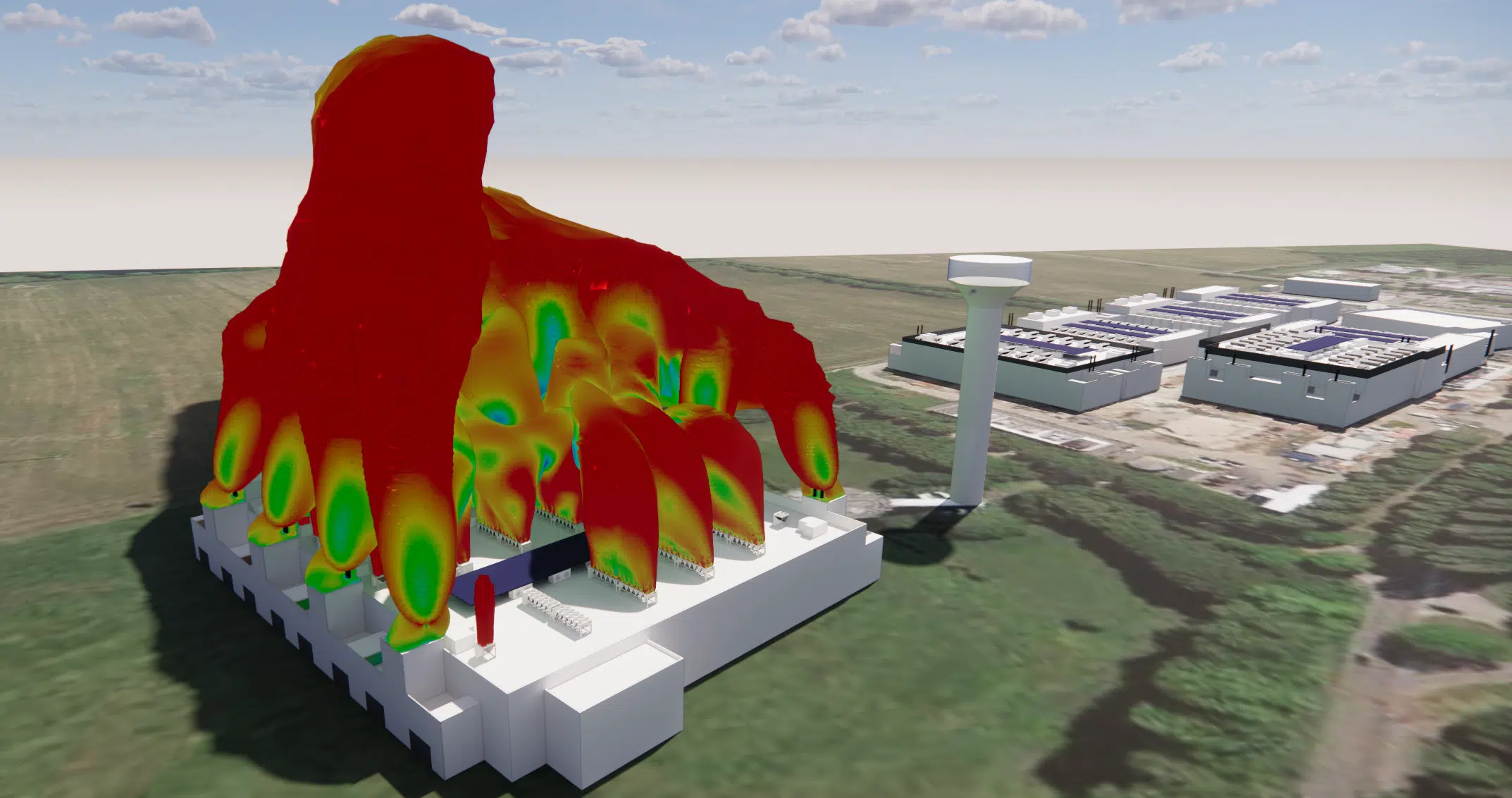
As part of the fire-risk study, all the gas characteristics are implemented in the simulation. The positioning of the 3 raised-floor nozzles makes it possible to quickly prevent any risk in the event of a fire in this zone, while ensuring diffusion through the floor up to the data hall level. The same applies to the false-ceiling nozzles.
The results show that the gas dispersion is in line with expectations: the system manages to disperse enough gas for all the IT equipment and risk zones to reach a concentration above 5% in the ambient air. For this configuration, the system therefore complies with the recommendations.
A gaseous fire-extinguishing agent that puts out fire without water or residue and without harming electronic equipment. Its effectiveness requires quickly reaching, then maintaining, a sufficient concentration in the protected volume.
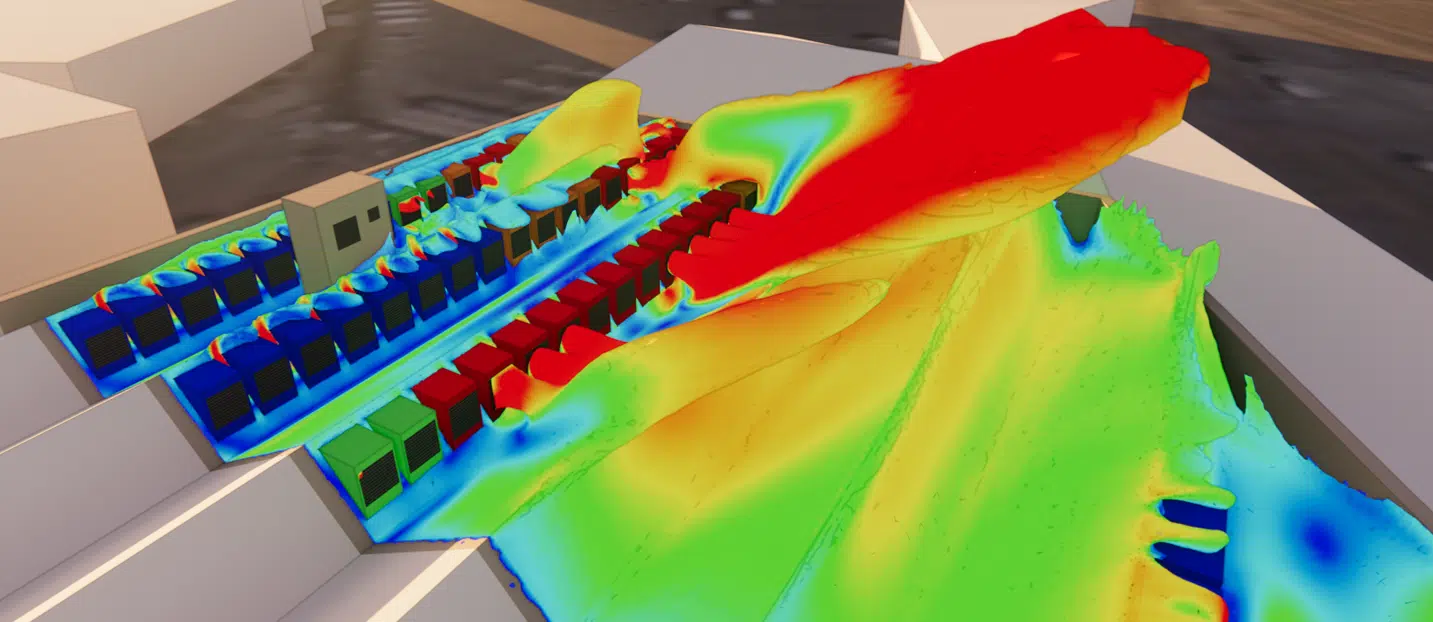
Numerical simulation opens up new perspectives: it makes it possible to predict a large number of scenarios and therefore to control all the contingencies linked to a poor design. For climate risk, multiphysics modelling takes into account all the phenomena behind the loops or hot spots. For fire risk, CFD represents the spatial and temporal evolution of the gas diffusion.
Know-how: fire simulation for data centersClimate risk, digital twin and extinguishing-gas dispersion: the answers to the questions data center operators and designers ask.
Because it represents the spatial and temporal evolution of the gas diffusion and checks that a sufficient extinguishing concentration is reached everywhere, including the risk zones, before commissioning, as on our smoke-control engineering in a data center.
A gaseous extinguishing agent that puts out fire without water or residue and without damaging electronic equipment. Its effectiveness requires quickly reaching, then maintaining, a sufficient concentration in the protected volume.
About 10 million elements, refined in the high-gradient zones. The more faithfully the digital twin reproduces the layout, flow rates and powers of the servers, the closer the results are to reality.
At the empty server positions, the absence of blanking modules creates air recirculation. Adding them removes these bypasses and improves the reliability of the intake-temperature control, measured around 25 °C.
Yes: the climate risk is under control (effective recyclers, no overload) and the NOVEC dispersion reaches more than 5 % concentration across all risk zones, in line with the recommendations.
Explore our expertise, projects and technical papers to go beyond the FAQ.
Modelling of the NOVEC gas dissipation over time and study of the firefighting systems of the SAMU 95 data hall.
 Digital twinData center study – Data Hall and UPS rooms
 Smoke controlSmoke-control engineering in a data center
 HyperscaleExternal & internal CFD – Hyperscale Data Center
 OptimisationCFD optimisation – Data Center
 InternalData Center – DC28 – Internal
 Technical roomsTechnical rooms – Data Center
 CoolingCooling optimisation – Data Center
 ExternalData Centers – DC15.1 & DC15.2 – External
 ExternalData Center – PA 22 – External
 GeneratorPressure-loss study – Generator – Data center
 ExternalData Center – Paris
 InternalData center – DC17 – Internal
 ExternalData center – D14 – External
 ExternalData center – DC25 & DC26 – External
 InternalData Center – DC10 – Internal
 InternalData center – DC25 – Internal
ExternalData Center – DC25 & DC26 – External
InternalData center – DC25 – Internal
ExternalData Center – DC25 & DC26 – External
CFD expertise, delivered projects and technical dossiers: the whole Data Center field in one place.