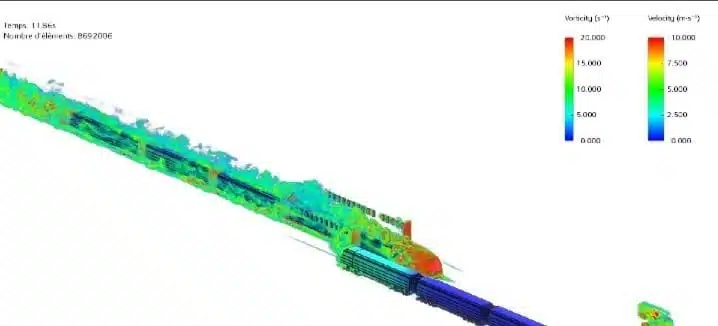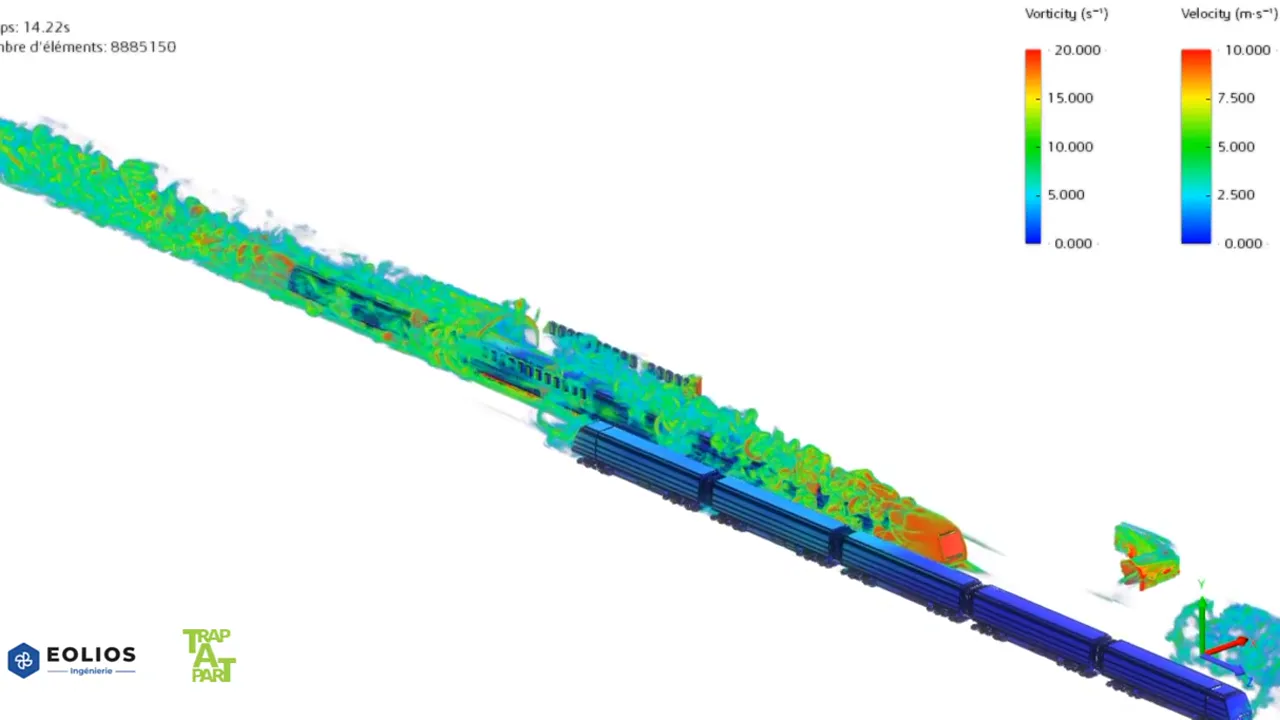
Transient CFD simulation of a train arriving in a Paris station: a section plane coloured by velocity shows the air pushed out ahead of the train, then its movement along the platforms.
Updated on 25 November 2026
In a minute and a half, we see the air of a station set in motion each time a train arrives. These currents carry fine particles to the collectors, or away from them.
Click a passage to play it in the player.
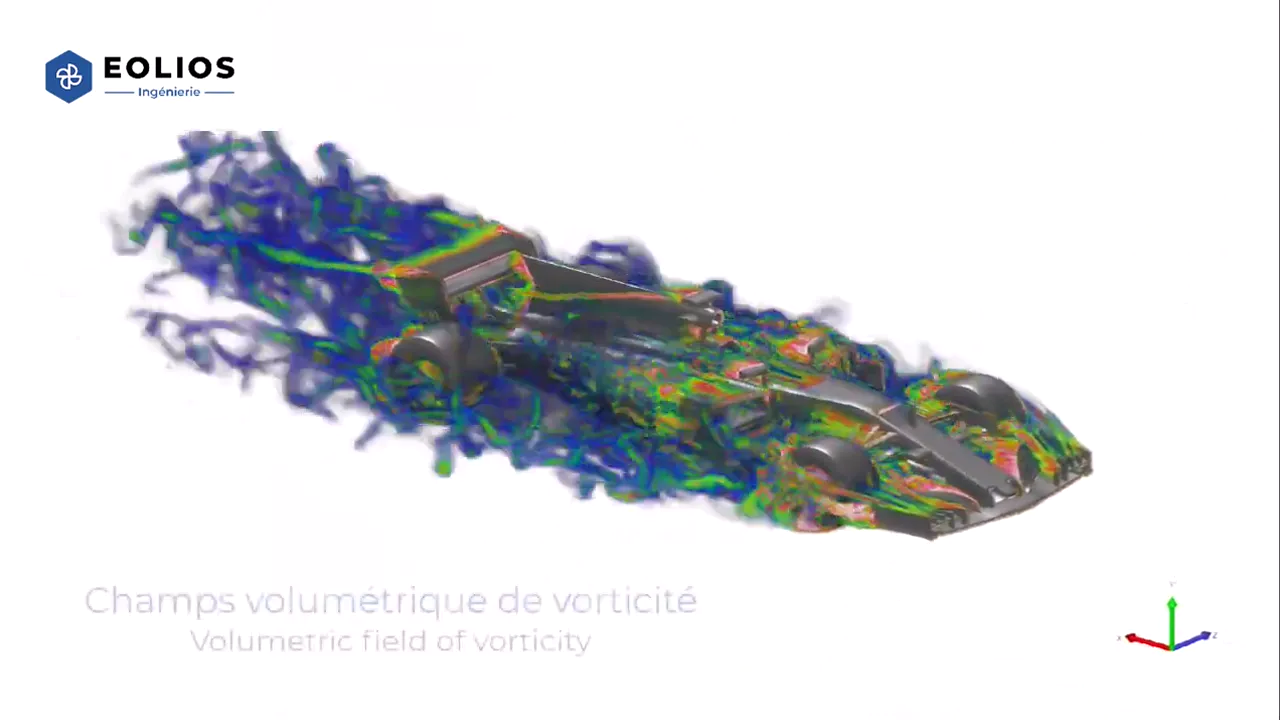
This video comes from the CFD study of fine-particle capture in a metro station in Paris, carried out by EOLIOS. It shows the same train arrival as the vorticity video, but from the angle of air velocities.
A section plane runs through the tunnel and the station. Its colours show the air set in motion: pushed out ahead of the train as it approaches, then spread along the platforms as it enters the station and brakes. These are the air currents felt on the platforms.
The air in underground stations carries more fine particles than outdoor air, because of rolling stock wear and confinement. Passive collectors installed on the platforms have to trap them using natural air currents.
As it enters the tunnel, a train pushes the air ahead of it and draws it in behind it. These movements create strong air currents on the platforms.
EOLIOS measured air velocities and particles as metro trains arrived, then modelled the station and the train in CFD. The simulation makes it possible to analyse air velocities and paths each time a train passes.
View the full study: fine-particle capture in a metro stationThe video shows the air velocities as a train passes. The full study compares these velocities with the measurements taken on the platforms and draws lessons on the effectiveness of the particle collectors.
View the study results: fine-particle capture in a metro stationThe video, the section plane and the role of air currents on the platforms.
A transient CFD simulation of a metro train arriving in a station, with a section plane coloured by air velocity in the tunnel and on the platforms.
They represent air velocity: blue for almost still air, then green and red for increasingly fast air.
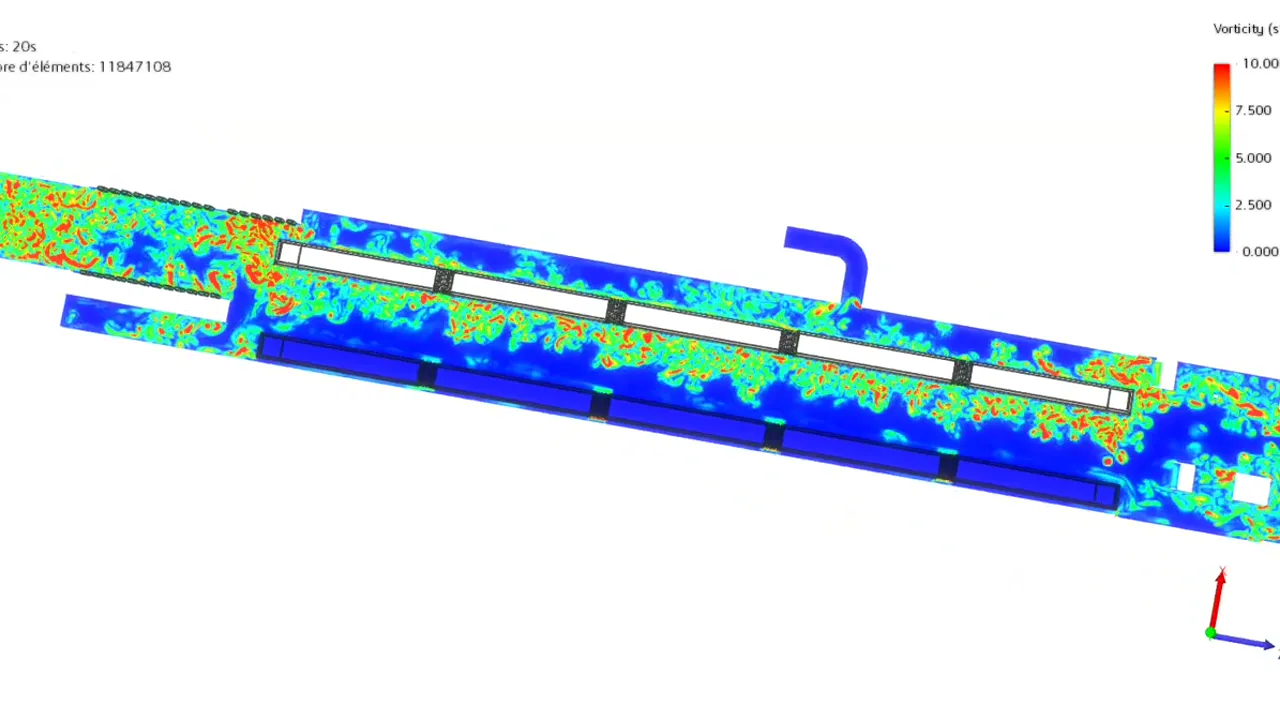
Both show the same train arrival. This one represents air velocity on a section, the other the rotation of the air throughout the volume.
They put fine particles back into suspension and carry them across the platforms. Their strength and path determine what the collectors can trap.
The comparison with on-site measurements and the analysis of particle capture are presented in the full metro station study.
Explore our expertise, projects and technical papers to go further than the FAQ.
CFD expertise, delivered projects and technical dossiers: the whole Air & Wind field in one place.
The simplest thing is to talk it through together. Our engineers reply with an initial technical read.