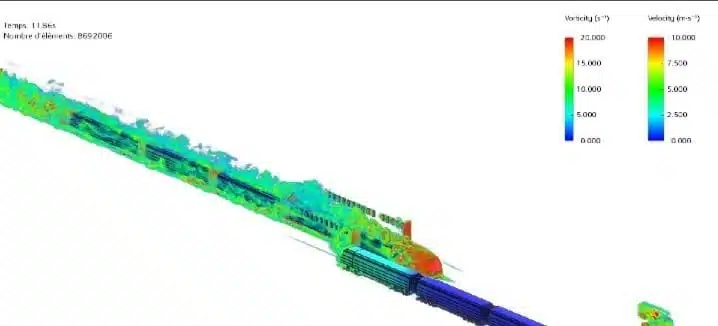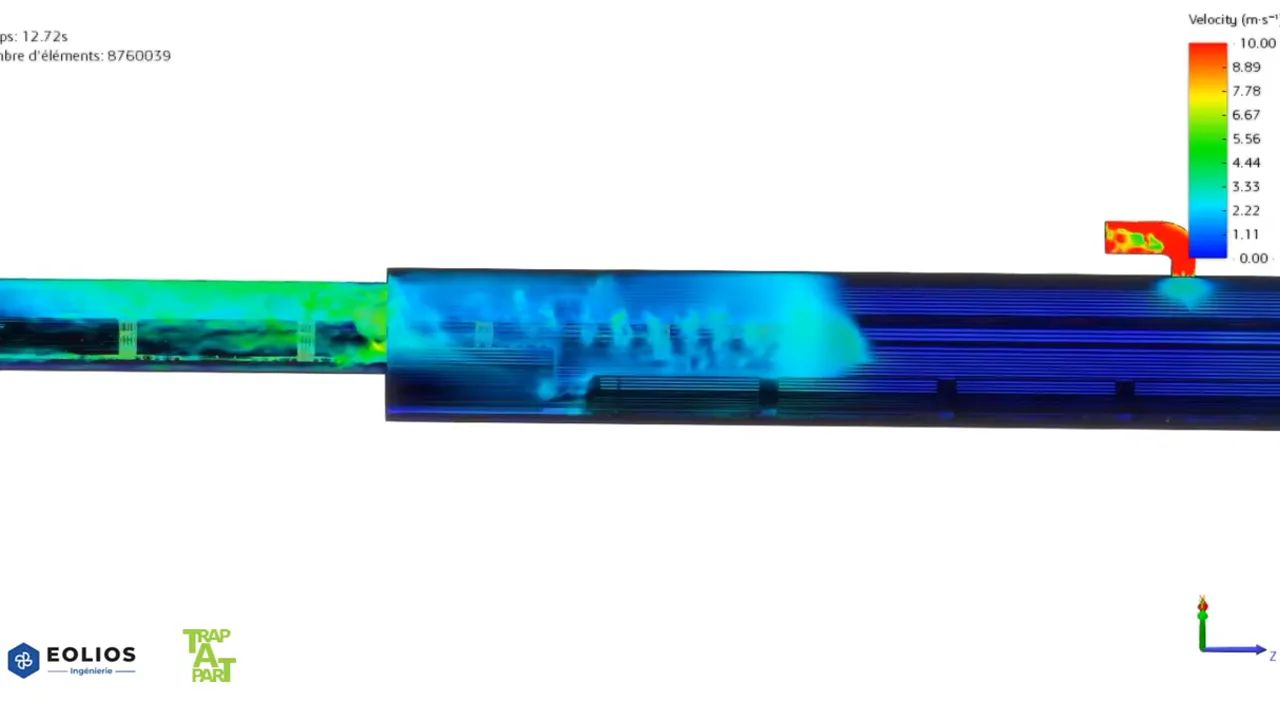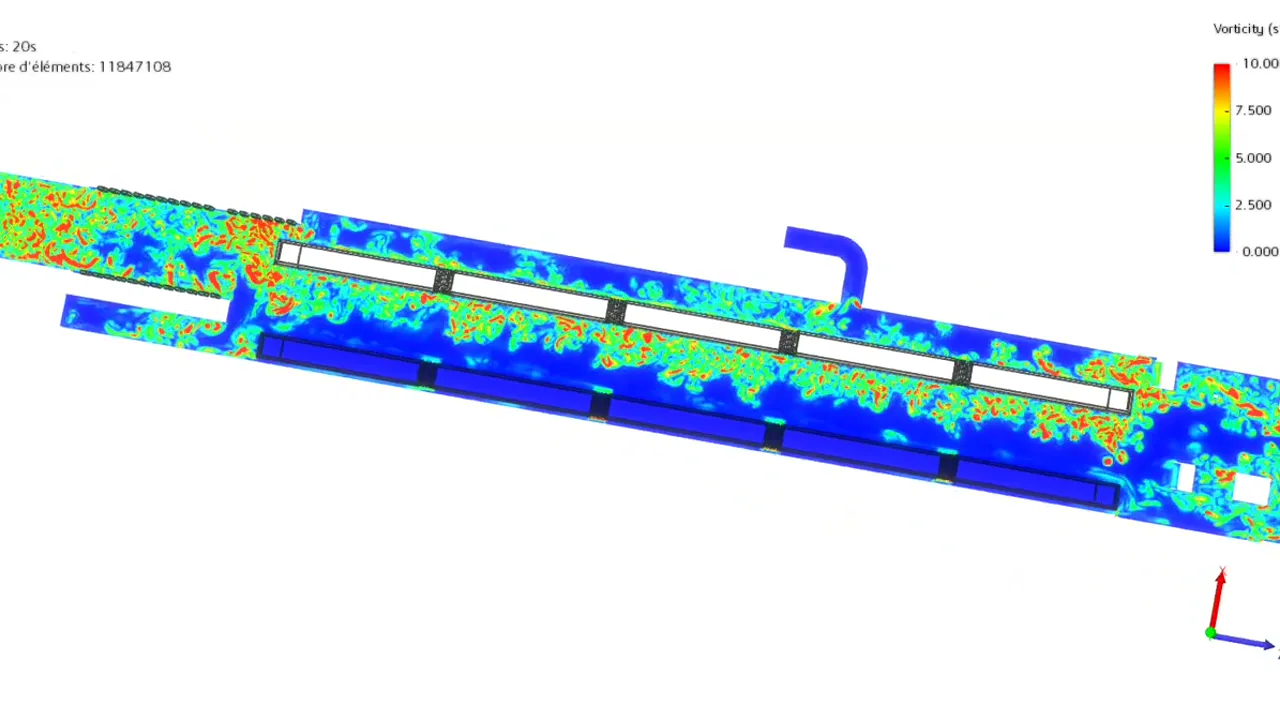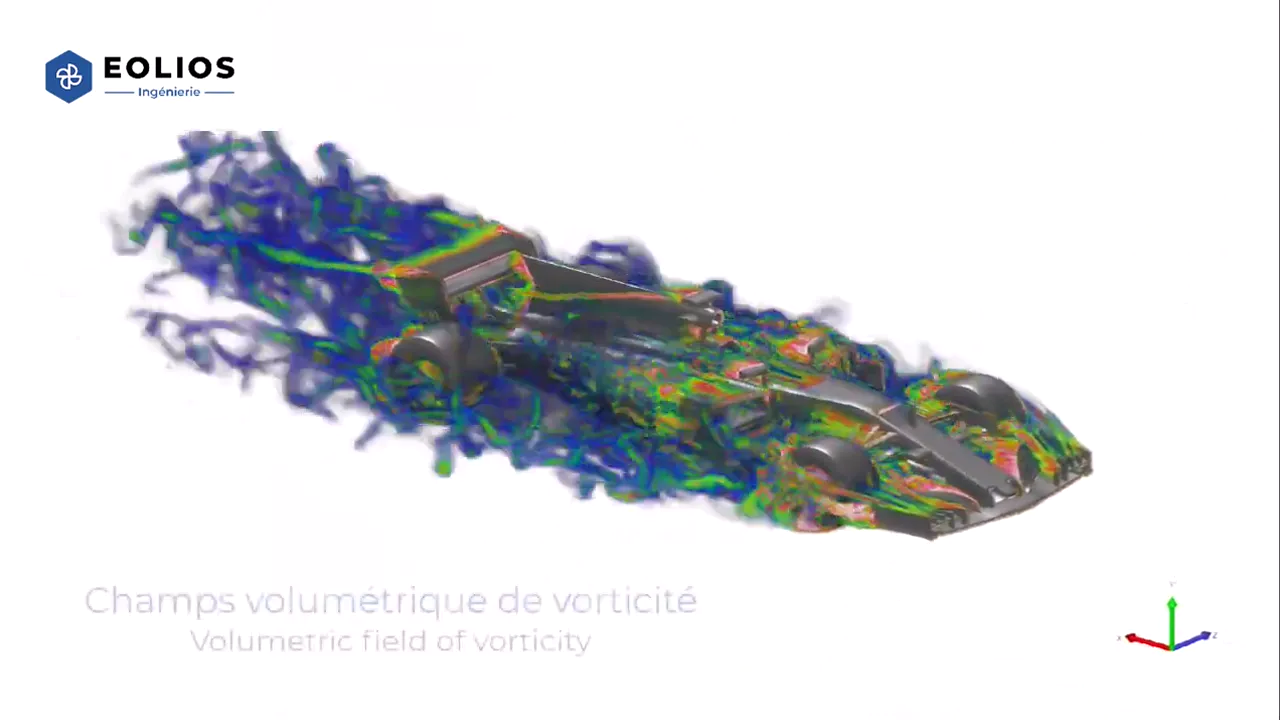
Transient CFD simulation of a metro train arriving in a Paris station: the areas of high vorticity follow the train through the tunnel and then spread over the platforms.
Updated on 25 November 2026
A minute and a half to see how an arriving train stirs the air of an entire station. These vortices put fine particles back into suspension, which is why it is worth knowing them when positioning capture devices.
Click a passage to play it in the player.
This video comes from the CFD study of fine-particle capture in a metro station in Paris, carried out by EOLIOS. The station and the train were modelled to follow the air movements created by an arriving train.
The video represents vorticity, that is, the rotation of the air. The coloured areas mark the vortices: we see them form around the train in the tunnel, then spread along the platforms as it stops. This is the visible sign of the piston effect.
In underground railway spaces, fine particles from the wear of wheels, rails and brakes build up because of confinement. Passive collectors installed on the platforms have to trap them using air movements alone.
A measure of the rotation of air at a given point. High vorticity indicates a vortex, which stirs the air and puts settled particles back into suspension.
To check their effectiveness, EOLIOS carried out an on-site audit, measuring air velocity and particles as metro trains arrived, then built a CFD model of the station and the train to analyse air velocities and paths.
View the full study: fine-particle capture in a metro stationThe video shows the rotation of the air created by the train. The full study presents the on-site measurements, the analysis of velocities according to the direction of travel and what it concludes for capturing particles on the platforms.
View the study results: fine-particle capture in a metro stationThe video, vorticity and the link with fine-particle capture.
A transient CFD simulation of a metro train entering a station, represented by the vorticity of the air: the vortices created in the tunnel and then along the platforms.
They indicate the intensity of the air rotation: warm colours correspond to the strongest vortices, blue to calm areas.
A train arrives in a few seconds and constantly changes the flow. Only a simulation that follows the air moment by moment can reproduce this phenomenon.
The vortices put settled particles back into suspension and move them across the platforms. Knowing where the air is disturbed helps place the collectors where they will be effective.
The on-site measurements and the analysis of air currents on the platforms are presented in the full metro station study.
Explore our expertise, projects and technical papers to go further than the FAQ.
CFD expertise, delivered projects and technical dossiers: the whole Air & Wind field in one place.
The simplest thing is to talk it through together. Our engineers reply with an initial technical read.