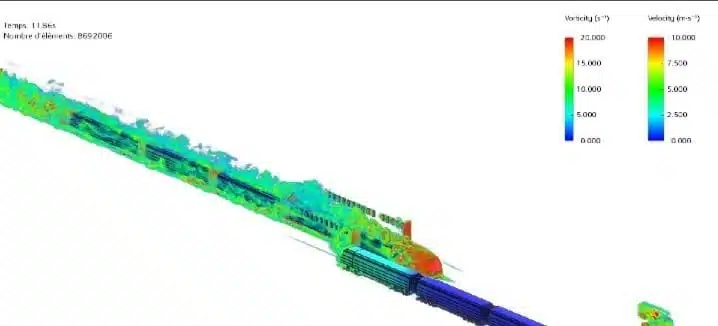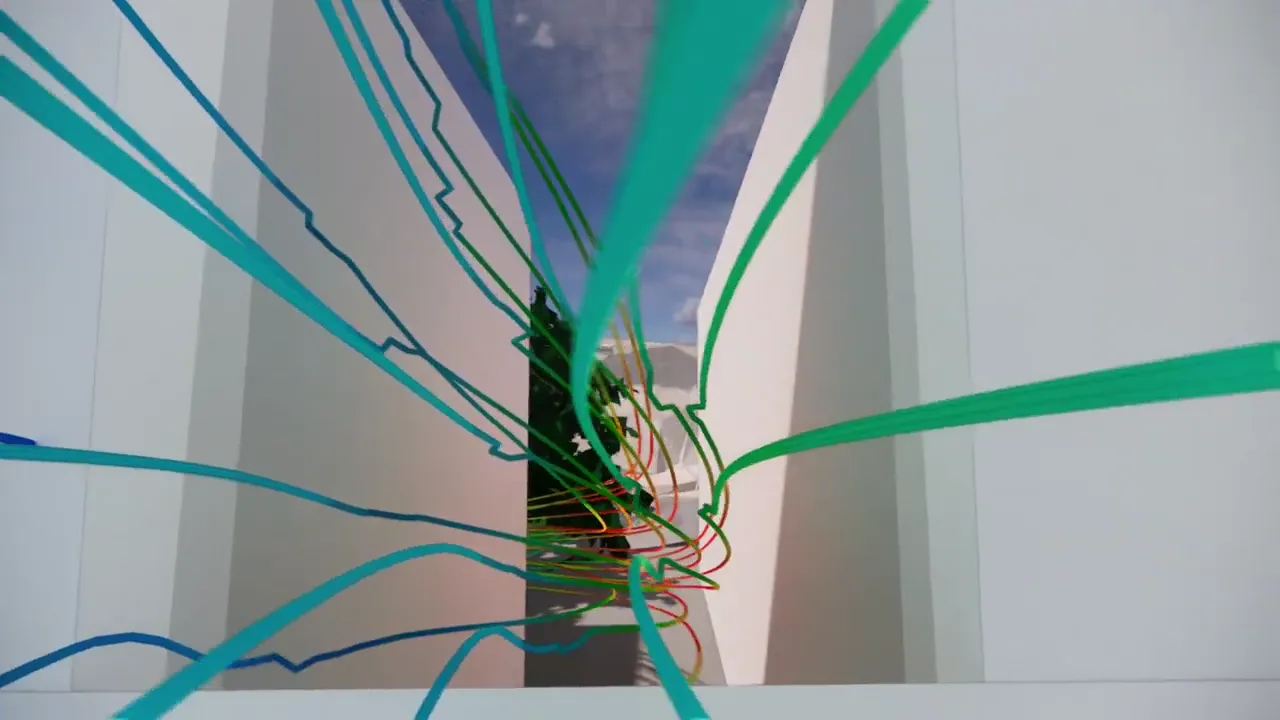
Transient CFD simulation of a train entering a station: the air vortices it creates appear in the tunnel and then spread along the platforms.
Updated on 25 November 2026
In one minute, we understand how a passing train sets the air of a station in motion. These vortices are what put fine particles back into suspension and spread them over the platforms.
Click a passage to play it in the player.
This video illustrates our expertise in air quality in metro stations. It shows a transient CFD simulation of a train entering a station, and the vorticity it generates in the air of the tunnel and the platforms.
The colours show the intensity of the vortices: blue is calm air, green and red are highly disturbed areas. We see the air pushed out and then drawn in by the train, which is the piston effect, and the vortices spreading along the station.
In metro stations, braking and passing trains produce fine particles and put them back into suspension. Ventilation must take into account these highly variable air movements, which a steady-state approach cannot describe.
As a train approaches, air is pushed out ahead of it and then drawn in behind it, in the tunnel and the station. These movements create vortices and pressure variations.
EOLIOS transient CFD simulations reproduce the vorticity and pressure variations induced by trains. They are used to position fans, size ducts and choose a capture strategy as close as possible to the sources.
View the full study: air quality in metro stationsThe video isolates one phenomenon, the piston effect. The expertise page presents the whole approach, from measuring pollutants to simulation and ventilation recommendations.
View the study results: air quality in metro stationsThe video, vorticity and the role of the piston effect in air quality.
A transient CFD simulation of a metro train entering a station, with the air vortices it creates in the tunnel and then along the platforms.
It is a measure of the rotation of air. High vorticity indicates vortices, which stir the air and put particles back into suspension.
A train passes in a few seconds and constantly changes the flow. The air has to be followed moment by moment, which a steady-state simulation cannot do.
It spreads the fine particles produced by braking and rolling. Understanding it helps place ventilation and capture where they are effective.
The complete approach, from measuring pollutants to ventilation recommendations, is presented on the air quality in metro stations page.
Explore our expertise, projects and technical papers to go further than the FAQ.
CFD expertise, delivered projects and technical dossiers: the whole Air & Wind field in one place.
A station, a tunnel or an underground car park to clean up, a ventilation system to size? Our engineers reply with an initial technical read.