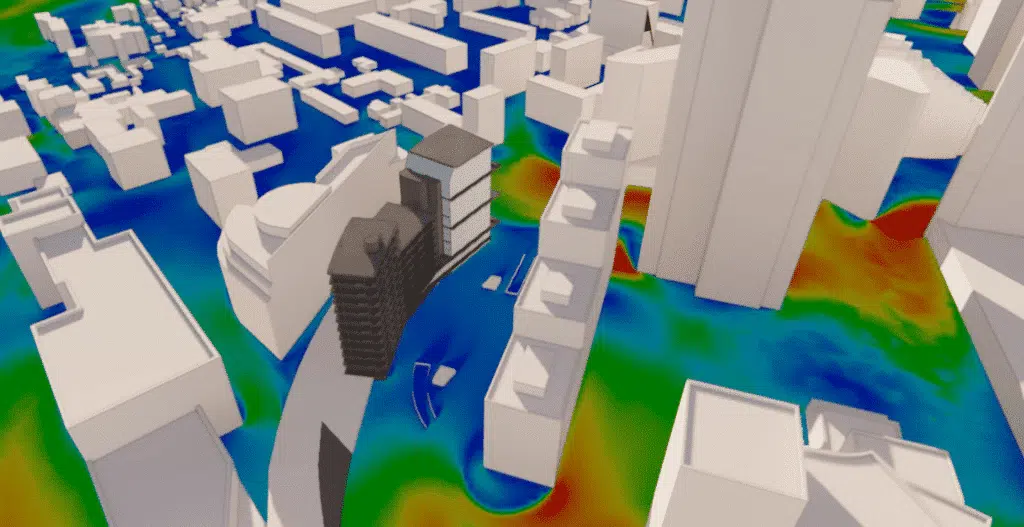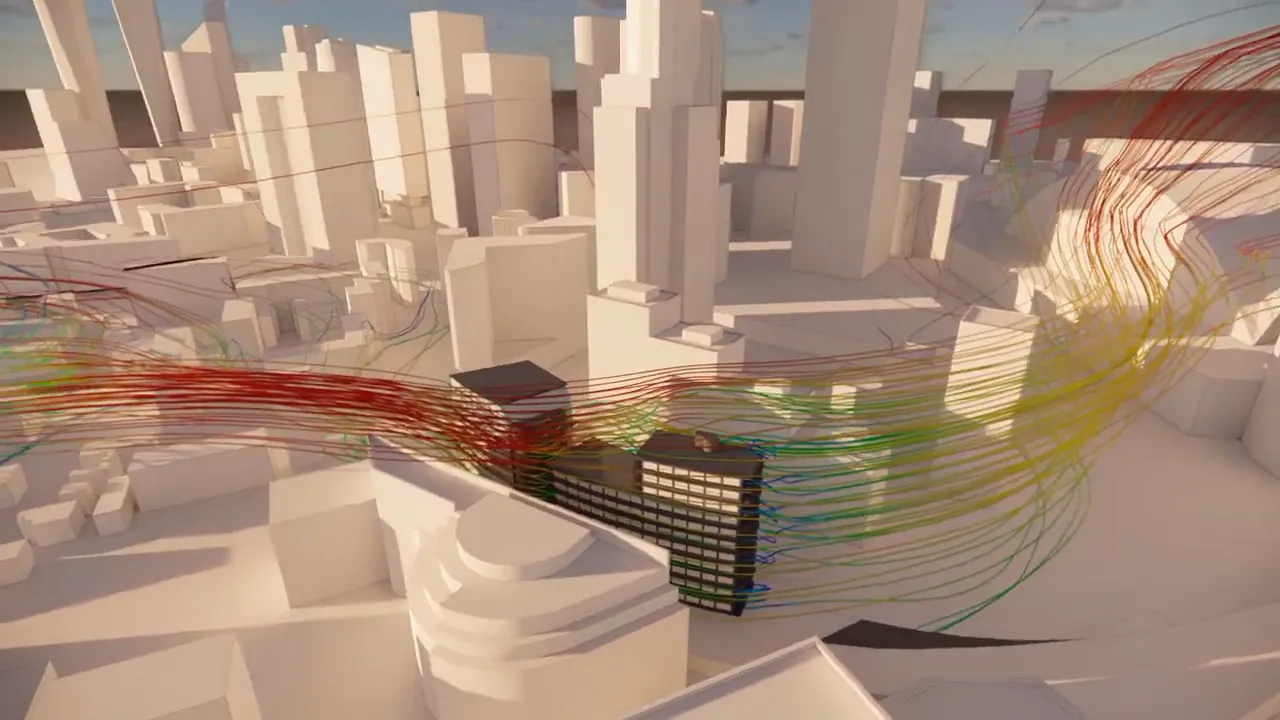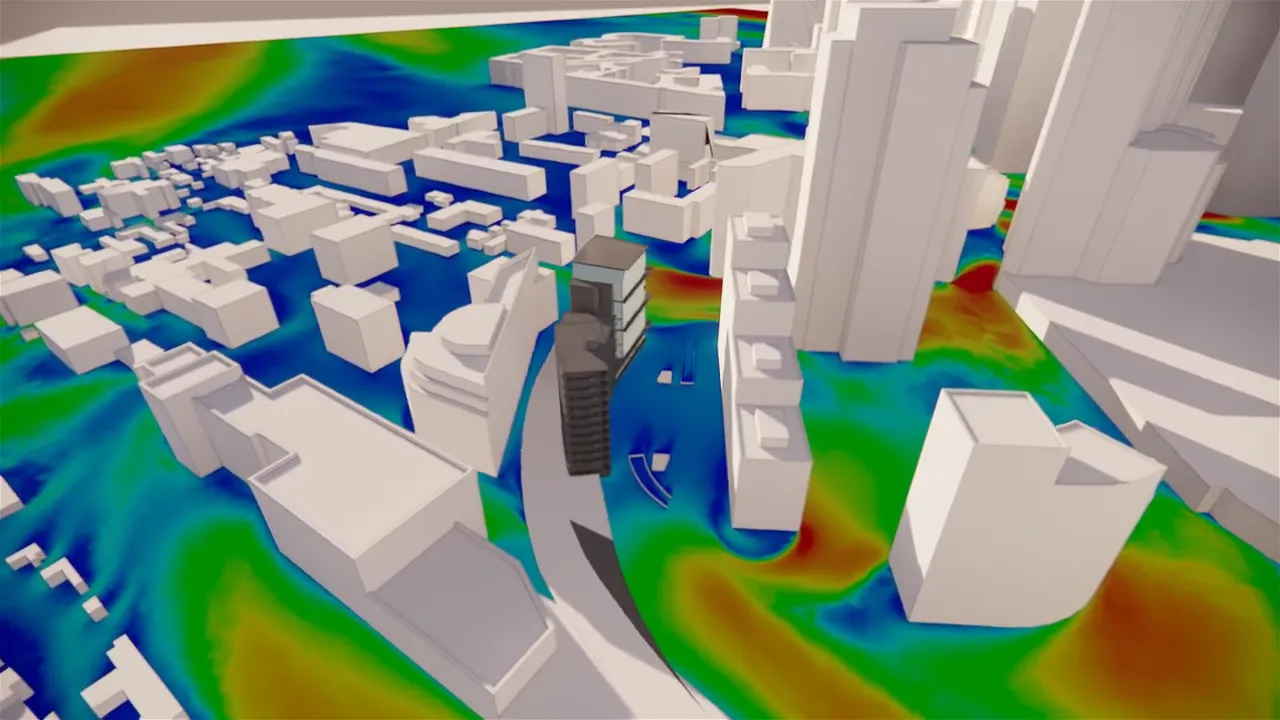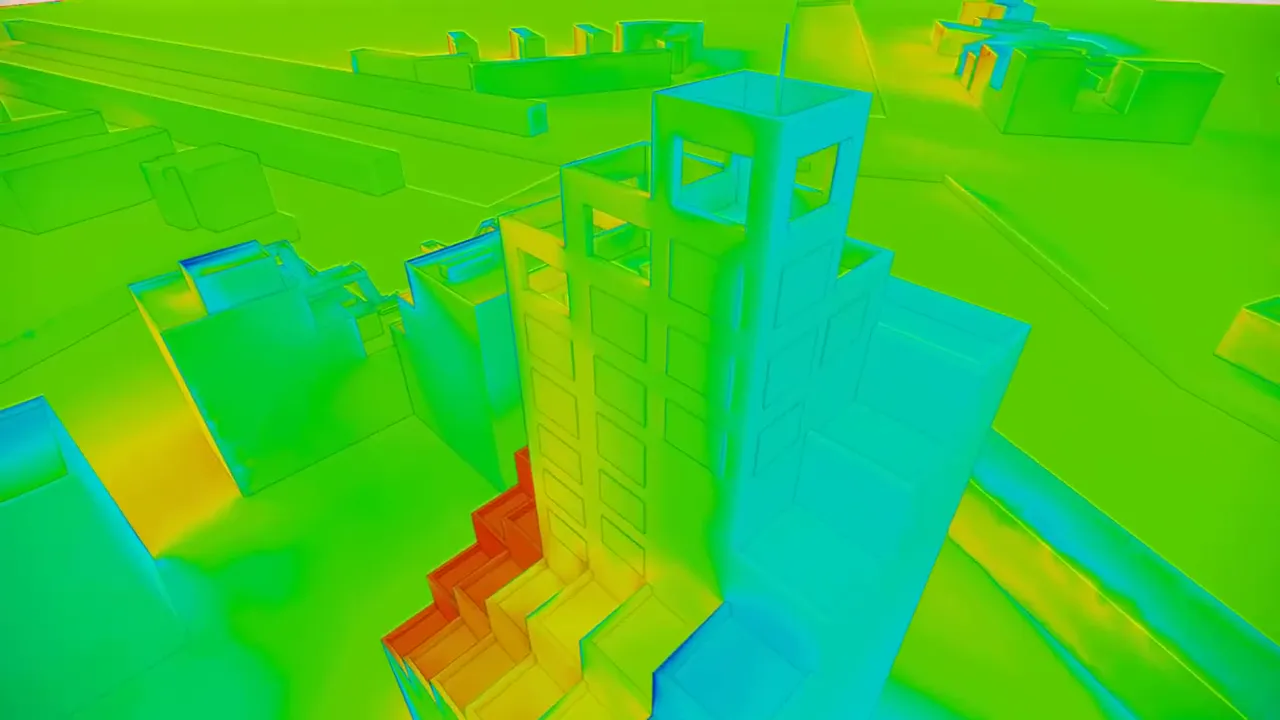
Flyover of the realistic 3D model of the La Défense district, built to study the wind around a planned building: from the streets of Courbevoie to the CNIT and the Grande Arche.
Updated on 25 November 2026
In just over a minute, we understand why the wind at La Défense is unlike any other: the density and height of the buildings mean the whole district has to be modelled to study a single project.
Click a passage to play it in the player.
This video presents the realistic 3D model of the La Défense district built by EOLIOS for a CFD wind study around a planned building. It does not yet show any calculation results: this is the environment that served as the basis for the simulations.
The camera flies over Courbevoie, follows the ring road, passes between the towers and then reaches the CNIT and the Grande Arche. We get a sense of the building density the wind has to cross: each building is an obstacle that shelters, deflects or accelerates it.
EOLIOS carried out a CFD study of the La Défense district to check the feasibility of wind energy systems on a planned building, suggest ways to optimise them and assess how the prevailing winds behave on the site.
A building or obstacle that shelters the structures behind it from the wind. In dense urban areas, wind shadows completely redraw the velocity map.
The high density of buildings creates many wind shadows. A large part of the buildings near the project was therefore modelled, with a higher level of detail to capture these effects.
View the full study: wind study at La DéfenseThis video stops at the model. The air velocities and paths calculated around the building, for two wind directions, are presented in the full study, along with what they mean for the wind energy systems.
View the study results: wind study at La DéfenseThe 3D model, its role in the study and the link with urban wind power.
A flyover of the realistic 3D model of La Défense and Courbevoie, built for a CFD wind study. It does not yet include any calculation results.
The wind reaching a building depends on all the buildings around it. At La Défense, the neighbouring towers shelter, deflect or accelerate the air.
To check whether wind turbines installed on the planned building would receive enough wind to generate electricity, and how to optimise their layout.
A digital model that reproduces the geometry of the buildings with their real appearance. It helps viewers find their way around and serves as the basis for the calculation model.
The air velocities and paths around the building, and what they mean for wind power, are presented in the full La Défense wind study.
Explore our expertise, projects and technical papers to go further than the FAQ.
CFD expertise, delivered projects and technical dossiers: the whole Air & Wind field in one place.
The simplest thing is to talk it through together. Our engineers reply with an initial technical read.