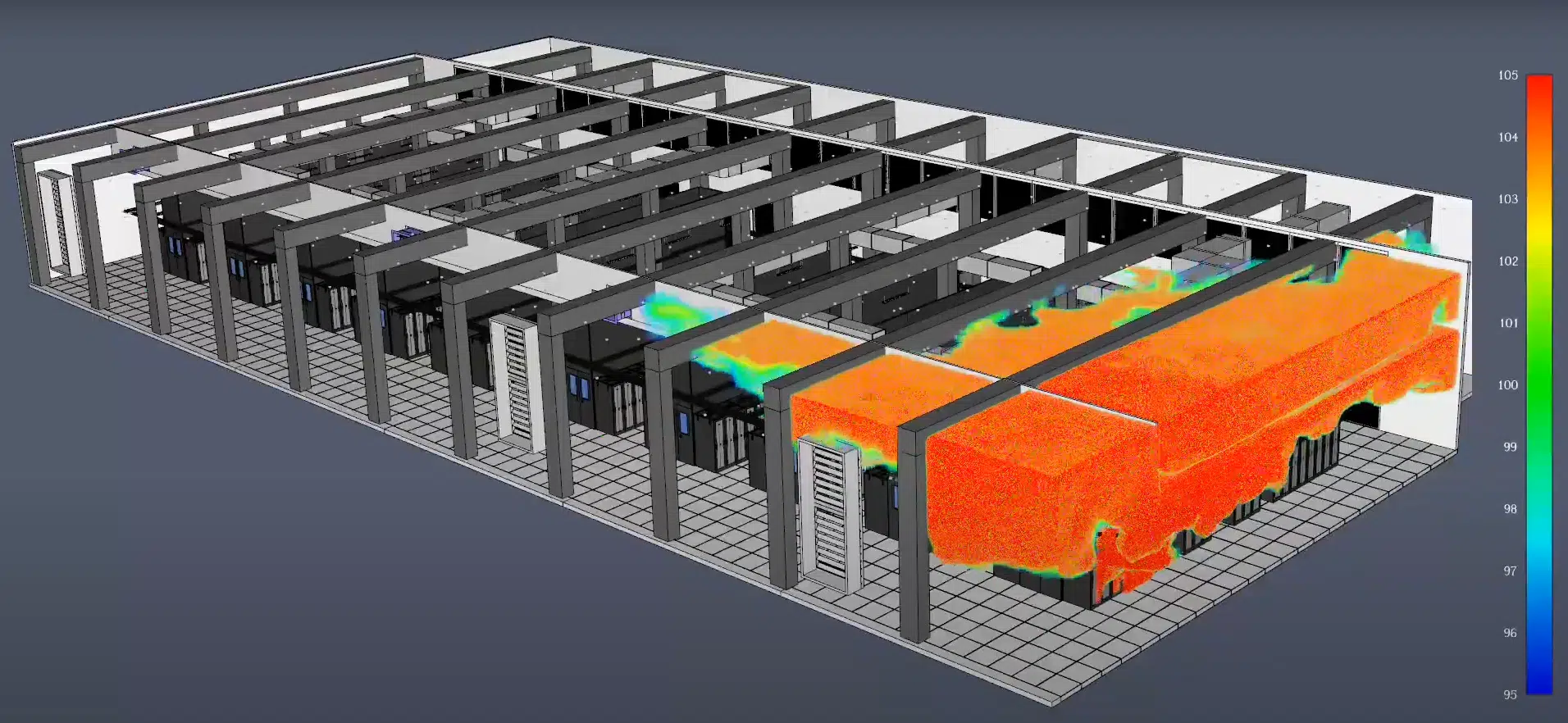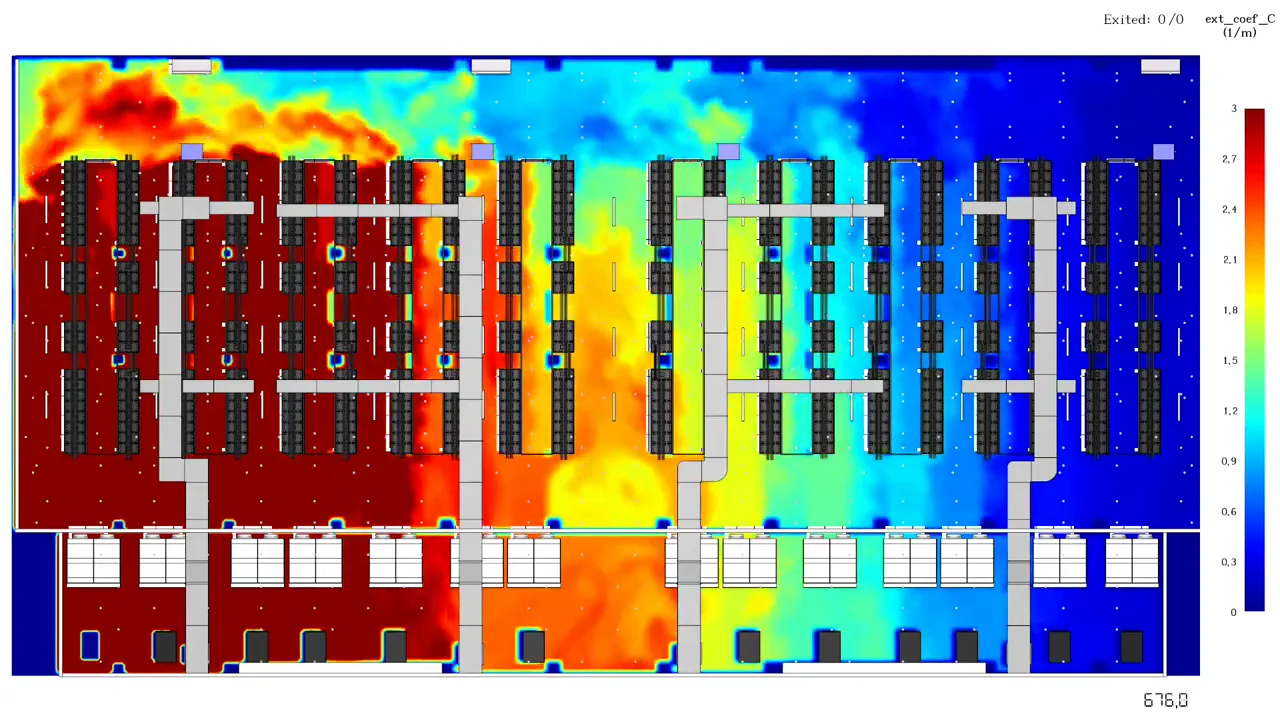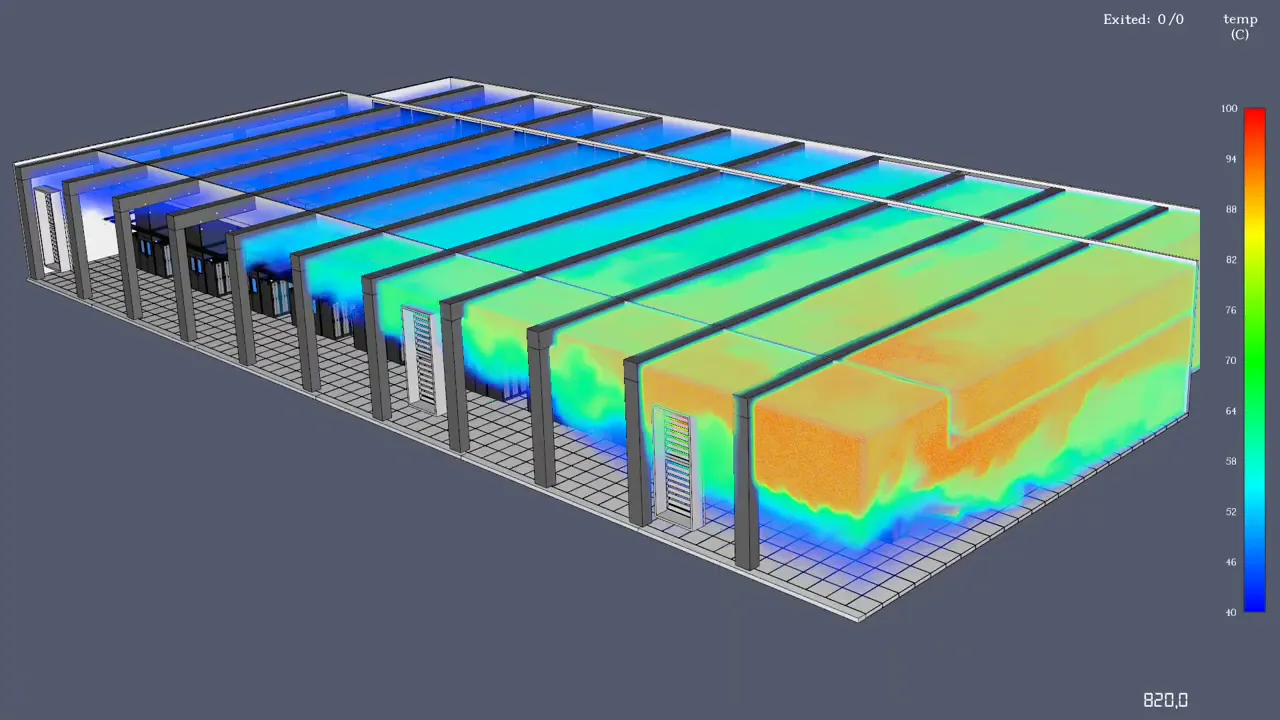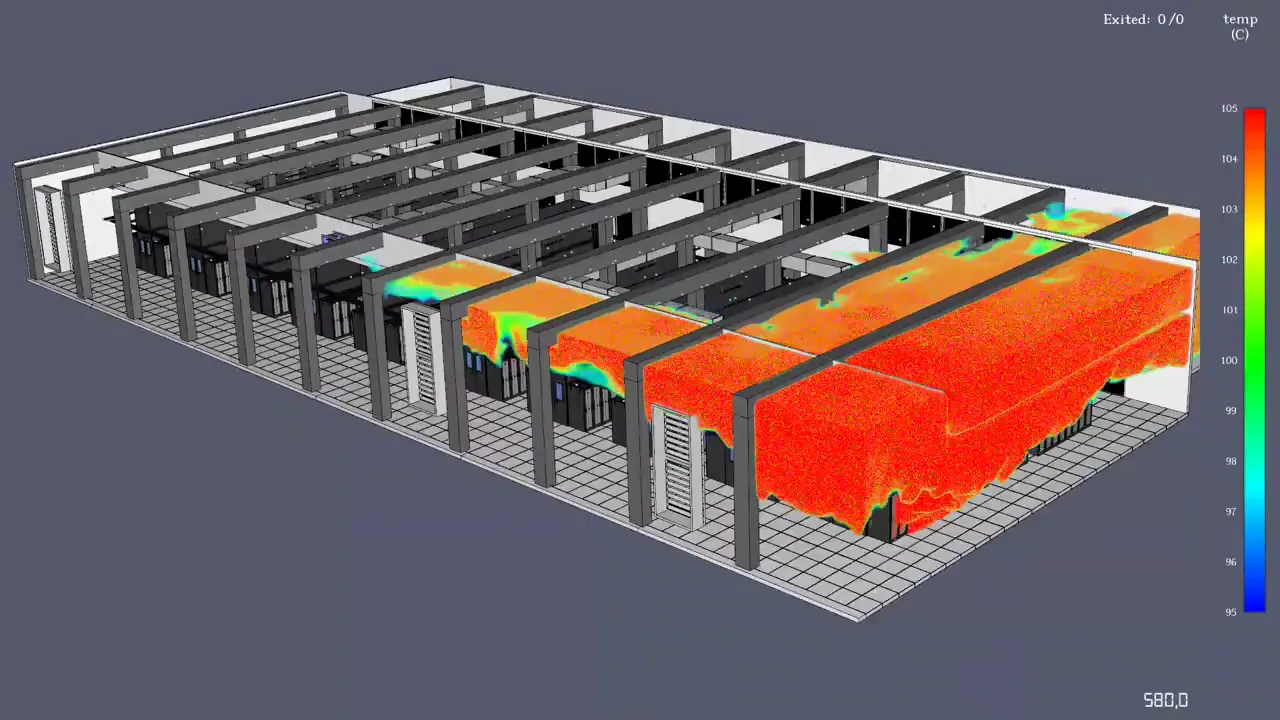
Simulation of an IT rack fire in a high-density data hall: we follow the heat as it rises, spreads under the ceiling and then dissipates, without the fire spreading to the neighbouring racks.
Updated on 25 November 2026
Two and a half minutes to follow a rack fire in a data hall: the heat rises, builds up in the upper part then comes back down, and the fire stays confined to the original rack. These simulations are used to check that conditions remain tenable for firefighters and to assess the effect of smoke control.
Click a passage to play it in the player.
This video is taken from the smoke control study of a high-density data center in Warsaw. It shows a simulation carried out with FDS (Fire Dynamics Simulator): the hall is seen in perspective, rack aisles included, and a coloured section displays the air temperature over time.
The scenario shown is a contained fire: a single rack burns, with no spread to the neighbouring racks. We see the heat leave the fire, rise towards the ceiling and form a hot layer that extends through the hall, before gradually dissipating. The video condenses several tens of minutes of simulation.
EOLIOS studied the fire safety of a high-density data hall in Warsaw. The building is not permanently occupied, but it must guarantee tenable conditions for firefighters (visibility, temperature, radiation), including when smoke control is only triggered after the emergency services arrive.
A scenario in which the fire remains confined to a single IT rack. The study compared it with a spread scenario, in which the fire reaches the neighbouring racks, to cover the most unfavourable situations.
The hall was modelled with its aisles, racks and ventilation, then several fire positions were simulated over several tens of minutes. The fire's power is based on published data on the ignition of IT racks. The video shows one of these calculations.
View the full study: smoke control engineering in a data centerThis sequence illustrates the scenario of a fire that remains contained. Together with the other scenarios, it was used to check the conditions for emergency intervention, the role of the sprinklers and the effect of smoke control. The details of the scenarios and the conclusions are presented in the full study.
View the study results: smoke control engineering in a data centerThe video, the contained fire scenario and the link with the smoke control study.
An FDS simulation of a rack fire in a high-density data hall. A coloured section displays the air temperature: the heat leaves the fire, builds up under the ceiling, then comes back down, with the fire confined to a single rack.
Air heated by the fire is lighter than the ambient air: it rises and spreads under the ceiling, forming a hot layer. As long as this layer stays high, the air is cooler and visibility better near the floor.
To observe the delayed effects of the fire: its growth, the phase following sprinkler activation and the effect of smoke control triggered during the fire. The video condenses this duration into two and a half minutes.
They represent the air temperature in the section: from blue for the coolest air to red for the hottest. The legend is displayed on the right of the image.
The scenarios studied, the tenability conditions and the role of smoke control are detailed in the full smoke control study of this data center.
Explore our expertise, projects and technical papers to go further than the FAQ.
CFD expertise, delivered projects and technical dossiers: the whole Data Center field in one place.
The simplest thing is to talk it through together. Our engineers reply with an initial technical read.