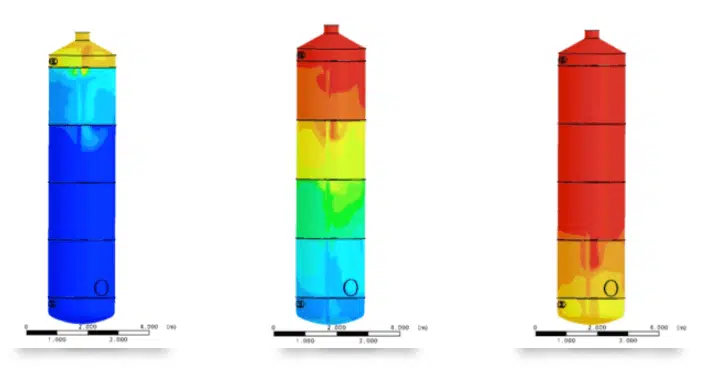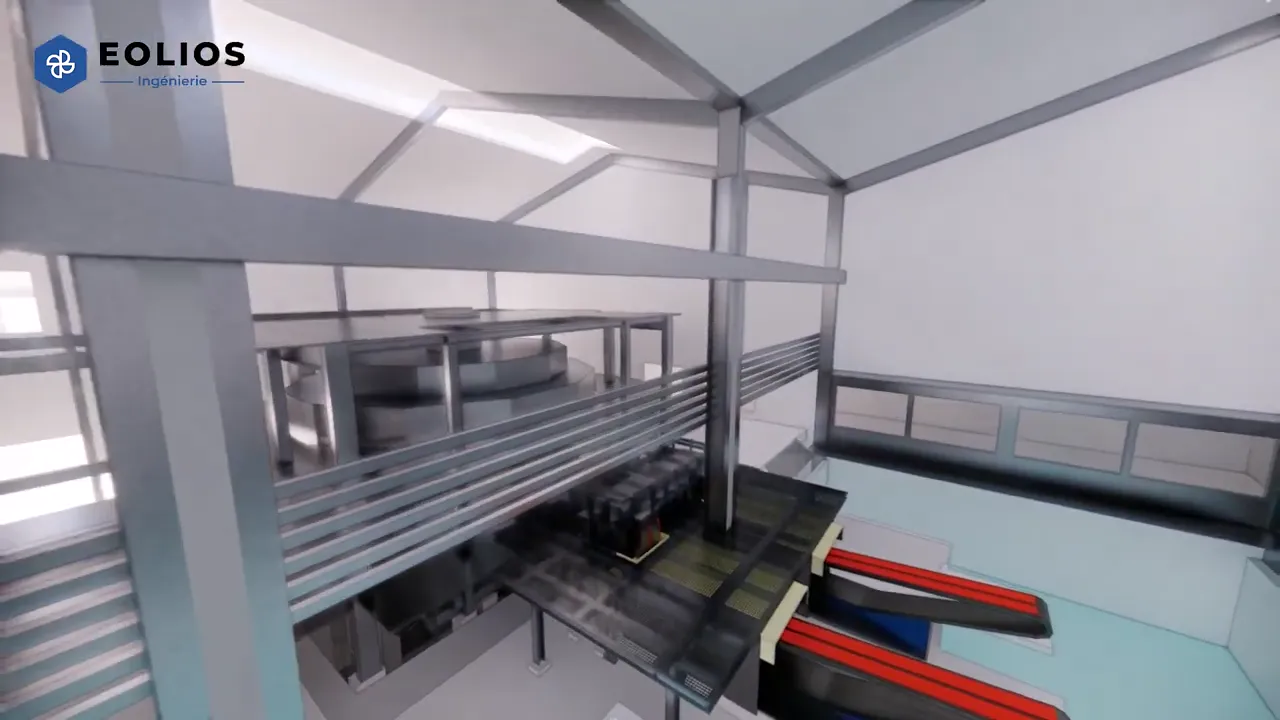
Transient CFD simulation of a thermal storage tank while charging: hot water enters at the top, stacks up in layers and pushes the cold water down to the bottom.
Updated on 25 November 2026
In less than two minutes, we see the thermocline form and then move down as charging progresses. The thinner and sharper it stays, the larger the tank's truly usable volume.
Click a passage to play it in the player.
This video comes from the stratification study of a thermal storage tank carried out by EOLIOS. The tank stores the heat produced by a heat pump that recovers waste heat, so that it can be released when the demand arises.
Four views run in parallel. On the left, a vertical section coloured by temperature shows the hot water filling the tank from the top. The following views present temperature isosurfaces, including a 3D view that closely tracks the hot water front through the tank's internal partitions.
A heat pump that recovers waste heat from a process does not necessarily produce at the moment it is needed. The storage tank absorbs this mismatch: it stores the hot water during charging and releases it afterwards.
The transition layer between the hot water at the top of the tank and the cold water at the bottom. A thin, stable thermocline is the sign of good stratification.
For the heat pump to keep a good efficiency, the tank must return cold water drawn from the bottom, which requires clear stratification. EOLIOS rebuilt the tank's geometry and simulated it in transient mode to track how the temperature evolves over the cycle.
View the full study: stratification of a thermal storage tankThe video shows one charge of the tank. The full study explains which mechanisms degrade stratification and which internal design levers were tested to make use of the whole usable volume.
View the study results: stratification of a thermal storage tankThe video, how to read the colours and the principle of stratification.
A transient CFD simulation of a thermal storage tank being charged: hot water enters at the top and gradually fills the tank, shown in section and as temperature isosurfaces.
Hot water is less dense than cold water: it stays above. As long as the inlets and outlets do not mix the tank, the two bodies of water remain separate.
A steady-state simulation only describes a frozen state. Here, the aim is to track how the temperature evolves during charging, which only the transient mode allows.
They represent water temperature: blue for cold water, red for the hottest water. The area where the colours change rapidly is the thermocline.
The mechanisms that degrade stratification and the solutions tested are presented in the full storage tank study.
Explore our expertise, projects and technical papers to go further than the FAQ.
CFD expertise, delivered projects and technical dossiers: the whole Industrial process field in one place.
The simplest thing is to talk it through together. Our engineers reply with an initial technical read.