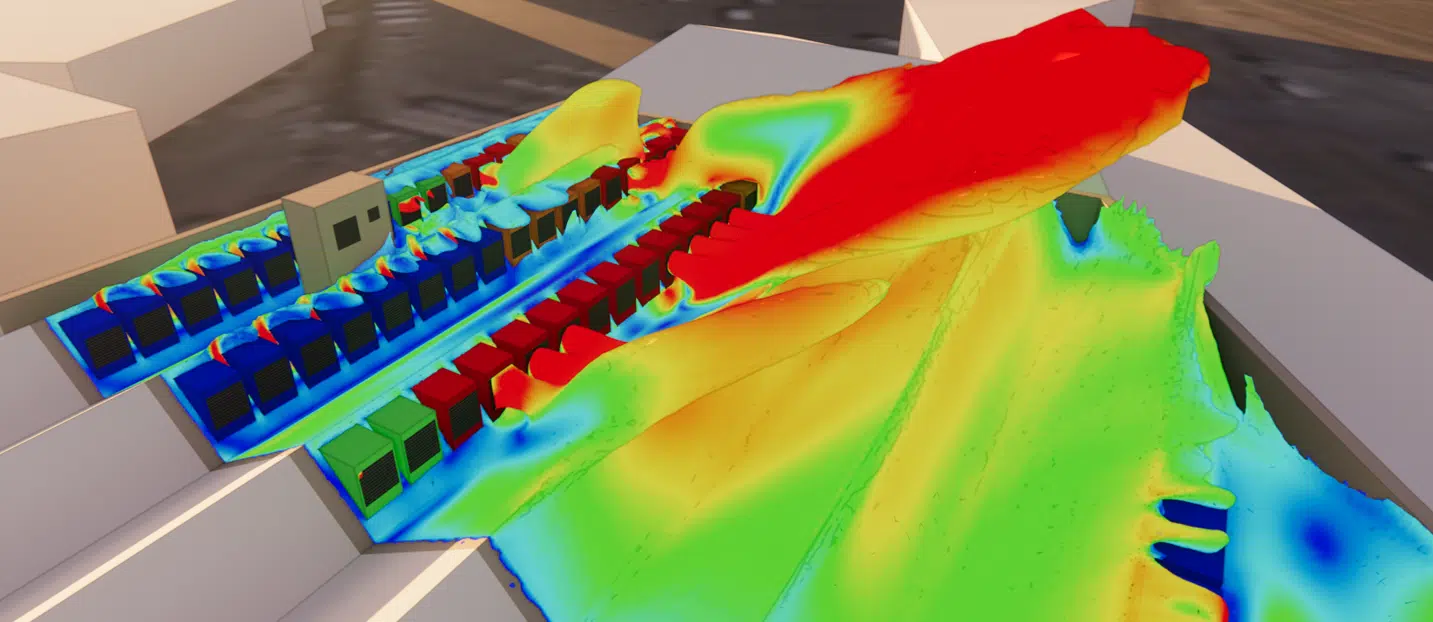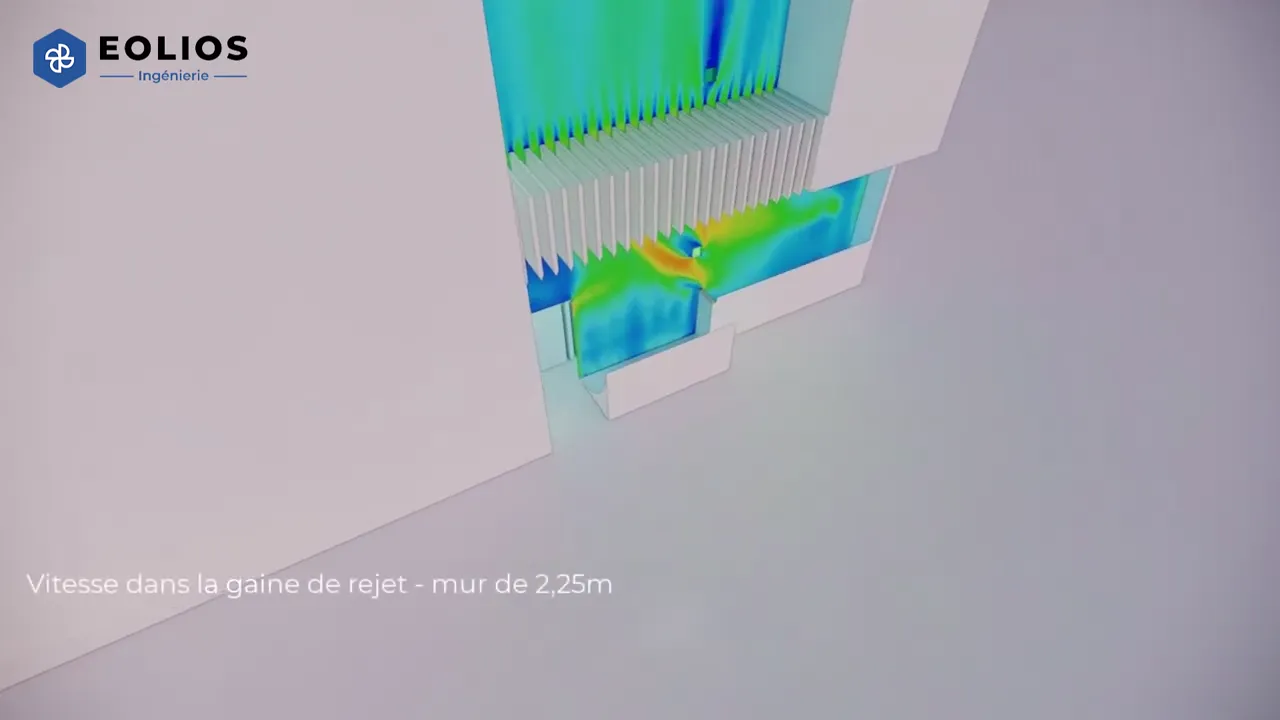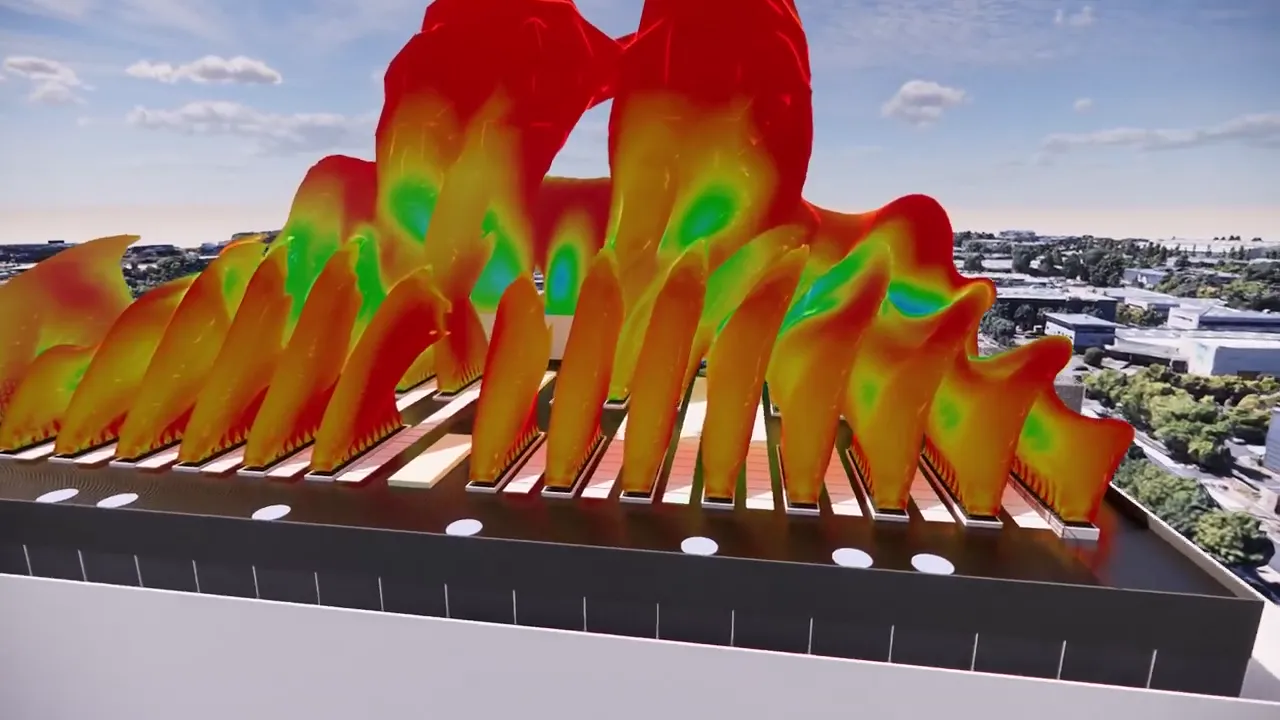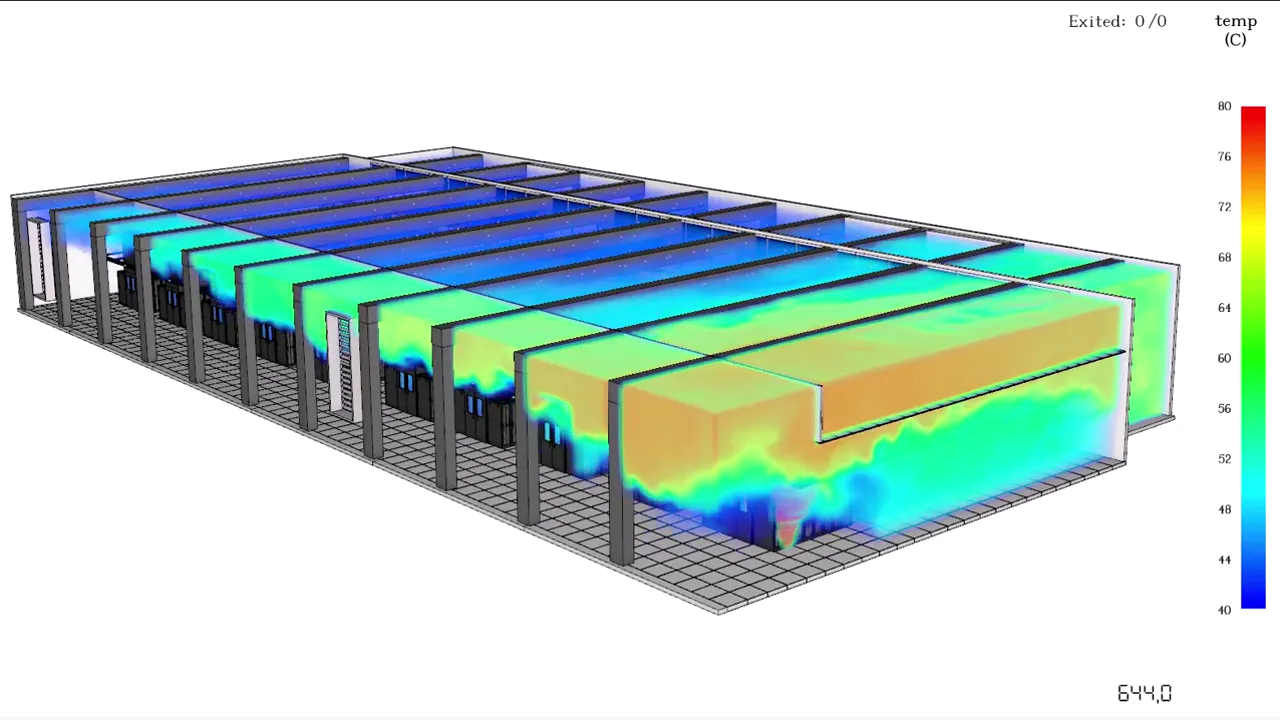
CFD simulation of a data center whose cooling equipment is on the roof: we see the wind pushing their hot air back towards the fresh air intakes, then the new design studied to limit this recirculation.
Updated on 25 November 2026
Less than two minutes to understand air recirculation on a roof: the wind pushes the hot air from the dry coolers back towards the fresh air intakes, which draw in air that is already warm. In hot weather, this phenomenon caused cascading shutdowns. The video also shows the new design studied to avoid it.
Click a passage to play it in the player.
This video is taken from the cooling study of a data center in Vénissieux. Its dry coolers, installed on the roof, discharge the heat from the IT rooms. The video strings together several visualisations of the calculation, captioned on screen: temperature plane, streamlines coloured by temperature, isosurface and velocity plane.
The first part shows the existing configuration: the streamlines leave the hot discharges and are pushed back down by the wind towards the fresh air supply zones. The second presents the new design studied to limit this recirculation, and the resulting flows.
The data center studied suffered cascading shutdowns of its installations in hot weather. EOLIOS carried out an audit and a 3D model of the building, analysed the site's weather data, then simulated the existing configuration to understand the origin of the problem.
A heat exchanger installed outdoors, often on the roof, which releases the heat from the cooling circuit into the air. Its efficiency depends directly on the temperature of the air it draws in.
The simulation of the existing configuration revealed the mechanism at fault, shown in the first part of the video. Several modifications were then tested numerically before being adopted.
View the full study: optimising the cooling of a data centerThe video sums up the approach: understand the recirculation, then check that a new design limits it. That is the value of simulation, which compares configurations before any works. The solutions adopted and their effects on intake temperatures are presented in the full study.
View the study results: optimising the cooling of a data centerThe video, air recirculation on the roof and the link with the study.
A CFD simulation of a data center whose dry coolers are on the roof. The visualisations, captioned on screen, show the discharged hot air pushed back by the wind towards the fresh air intakes, then the new design studied to limit this recirculation.
Depending on its direction, the wind pushes the hot plumes down onto the roof instead of letting them rise. If the fresh air intakes are downwind of the discharges, they draw in air that is already warm.
Because the dry coolers then have less margin: the outside air is already hot, and the additional warming at the intake can be enough to stop the installations working.
On the planes and streamlines coloured by temperature, blue corresponds to the coolest air and red to the hottest. On the velocity plane, the colours represent air speed.
The solutions adopted and their effects on intake temperatures are detailed in the full cooling optimisation study.
Explore our expertise, projects and technical papers to go further than the FAQ.
CFD expertise, delivered projects and technical dossiers: the whole Data Center field in one place.
The simplest thing is to talk it through together. Our engineers reply with an initial technical read.