
Virtualisation: a sharply rising thermal density
The rise of digital infrastructures: virtualisation and AI
Global demand for digital infrastructure is growing exponentially, driven by the rise of the cloud, AI, IoT and data-intensive applications.
In this context, data centers play an essential role: they host the servers, storage equipment and networks that process and distribute information. At the same time, the thermal load of data facilities has risen sharply. The miniaturisation of equipment, the massive virtualisation of servers and the proliferation of AI applications generate a heat output per unit far higher than before: whereas a capacity of 5 kW per rack once sufficed, many servers now exceed 10 kW per rack, and some installations reach up to 45 kW.
In this context of thermal intensification, controlling the airflows and the cooling becomes critical, and a central question arises: “Is the air-conditioning system able to handle 100% of the thermal load, including in degraded conditions?”
Economic and material consequences
Poor heat management can lead to a significant increase in operating costs (energy consumption, corrective maintenance), a reduced lifespan of the IT equipment (electronic components are sensitive to temperature variations and repeated overheating) and an increased risk of sudden hardware failures or service interruptions. These problems can also limit the ability to increase the IT load, blocking expansion projects.
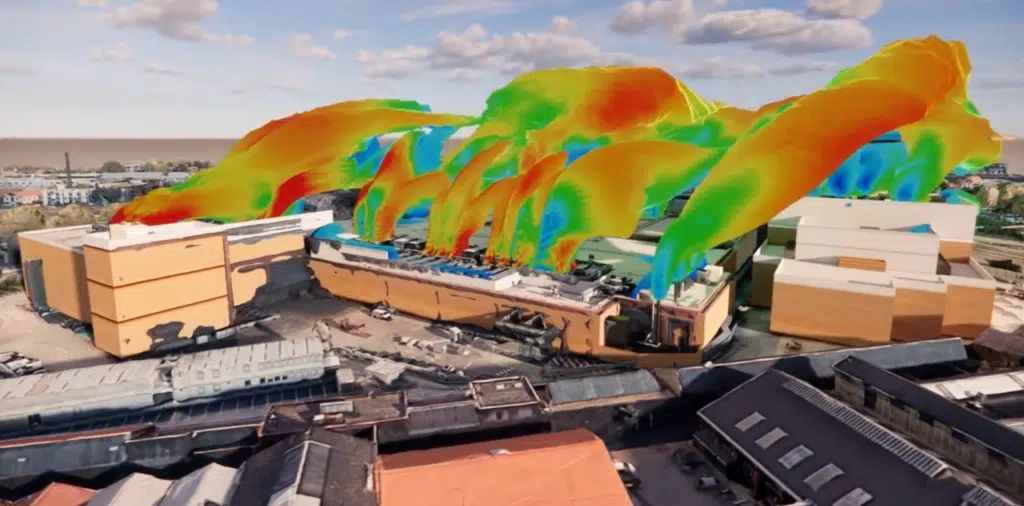
The traditional methods of thermal calculation (simplified formulas, Excel spreadsheets) are not enough to anticipate the behaviour of the systems in critical conditions: cooling failure, power cut, rack maintenance. It is to meet these challenges that CFD numerical simulation (Computational Fluid Dynamics) establishes itself as a strategic tool: it precisely models the airflows, the pressure, the thermal distribution and the cooling configurations, and makes it possible to anticipate the most critical scenarios.
The thermal challenges in data centers
Controlling the temperature results from multiple interactions: building architecture, IT load density, airflow dynamics, cooling technologies and operational changes.
Densification of the IT loads
Modern servers, particularly for AI and high-performance computing (HPC), can dissipate several dozen kilowatts per cabinet. This high density generates a significant thermal load, considerably reducing the margin for error: as the power increases, the risks of hot spots and hot-air recirculation intensify. Densification therefore requires precise sizing, active management of the airflows and rigorous thermal control.
Formation of hot spots
Hot spots are zones where the temperature exceeds the ASHRAE thresholds, due to poor airflow distribution, physical obstacles, rack positioning, badly calibrated units, load variations or layout changes. Even at low load, these imbalances affect the reliability and lifespan of the equipment and increase the risk of sudden failure. Often invisible without specialised tools, they make CFD a key tool to detect, anticipate and prevent them.

Hot-air recirculation
Recirculation is the phenomenon by which the hot air discharged by the servers returns to the cold aisle before being cooled. The temperature at the cabinet inlets rises, cooling efficiency drops and the risk of hot spots grows; it also causes over-consumption of the air-conditioning units. Main causes: poor aisle sealing (no brushes or blanking panels), badly designed containment, or insufficient airflow.
Faced with the risk, many operators choose to over-cool the room: the HVAC units run beyond the actual need, increasing the PUE and the costs. The challenge is to cool exactly what is needed, where it is needed, without waste — hence the importance of rigorous management of the aisle architecture and appropriate sizing of the flows.
Controlling temperature and humidity
A temperature that is too high accelerates the wear of the components and increases the risk of failure; humidity that is too high causes condensation, short circuits and data loss; humidity that is too low promotes static electricity. In high-density environments (AI, HPC), precise management of these parameters becomes even more critical — an imbalance amplifies the risks of overheating, recirculation and failure. Fine control prevents incidents and optimises energy efficiency.
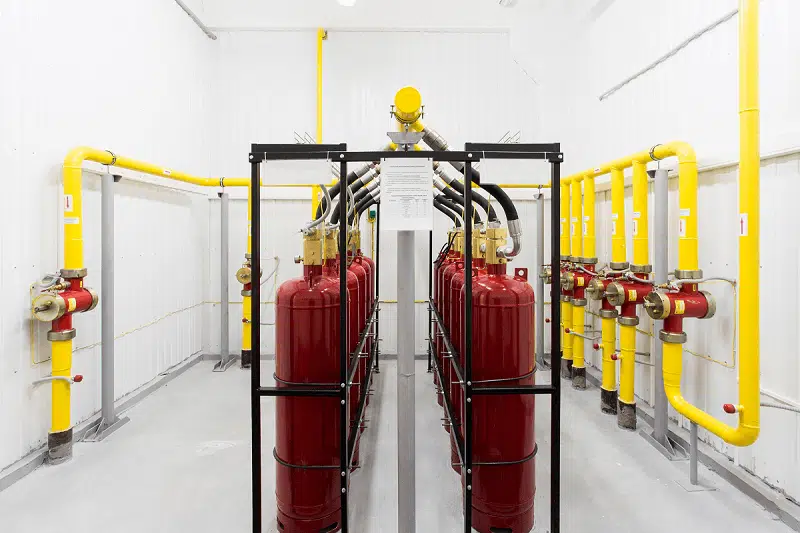
Fire ignitions
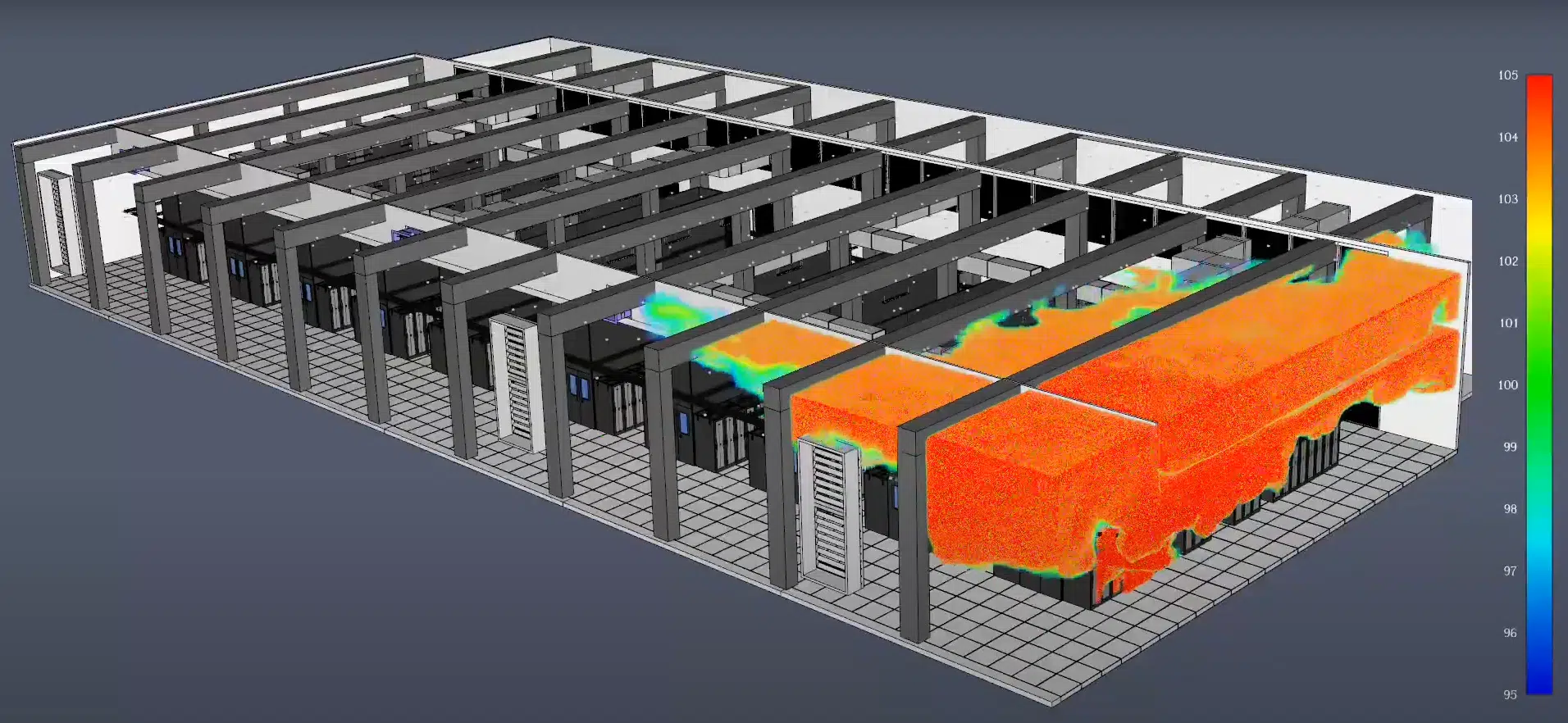
Data centers present specific fire risks linked to the high concentration of electrical equipment and the high-power supplies. A fault, a short circuit or overheating can lead to a fire ignition; the combustion of electronic components generates dense, toxic and corrosive smoke. The rapid build-up of hot smoke degrades visibility, complicates the intervention of the emergency services and raises the ambient temperature within minutes.
CFD simulation makes it possible to analyse and anticipate the building's behaviour in a fire situation: smoke spread, temperature evolution, influence of the airflows (ventilation, smoke control). It assesses the effectiveness of the smoke control, identifies the stagnation zones and checks that the escape routes remain passable — guaranteeing acceptable intervention conditions for the emergency services.
CFD simulation: an indispensable tool
What is CFD simulation?
CFD (Computational Fluid Dynamics) is a numerical-simulation method for modelling the behaviour of fluids and the associated thermal phenomena. Using specialised software, the engineer builds a three-dimensional model of the object studied, defines the boundary conditions, chooses the relevant physical models (convection, conduction, radiation, heat transfer, flow dynamics) and selects a computation method.
An iteration phase follows: on the basis of the results, the model is adjusted to better represent the real phenomena. The aim is to understand, analyse and optimise the thermal and fluid behaviour of a system. The results form a decision-support tool: improving the design, identifying the bottlenecks and optimising the operational performance.
A tool for understanding and visualisation
Thermal management is crucial: a rapid temperature rise due to a cooling failure can cause simultaneous equipment failures. Unlike traditional spot measurements, CFD offers a global, predictive view, making it possible to anticipate problems before they occur.
Visualising the invisible
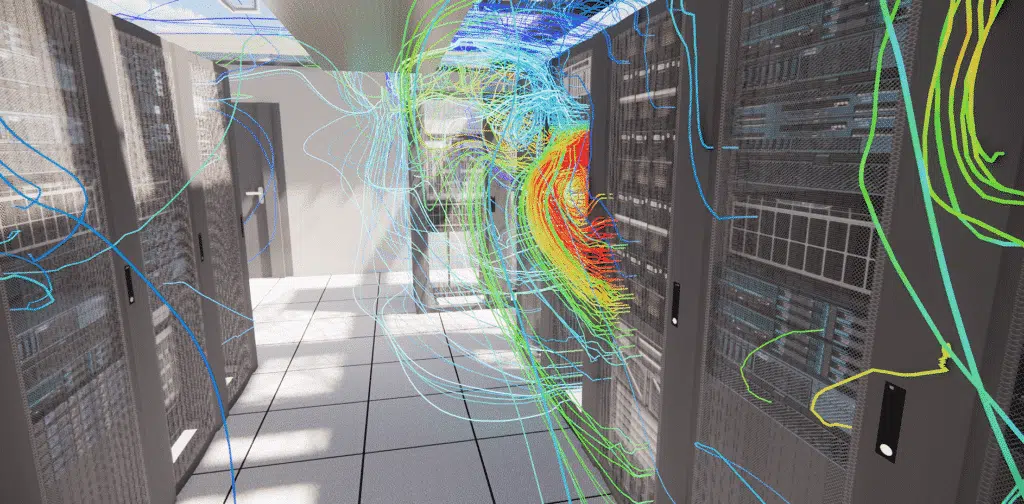
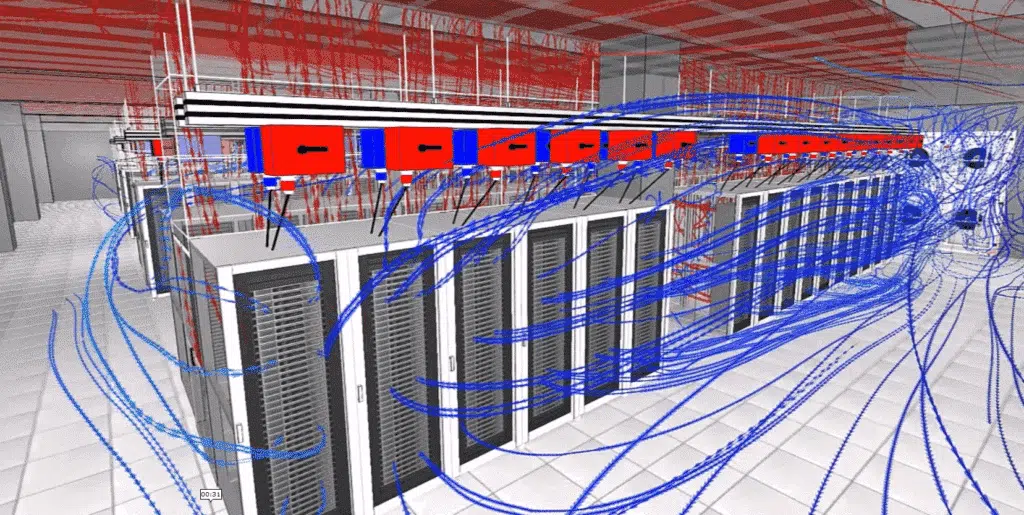
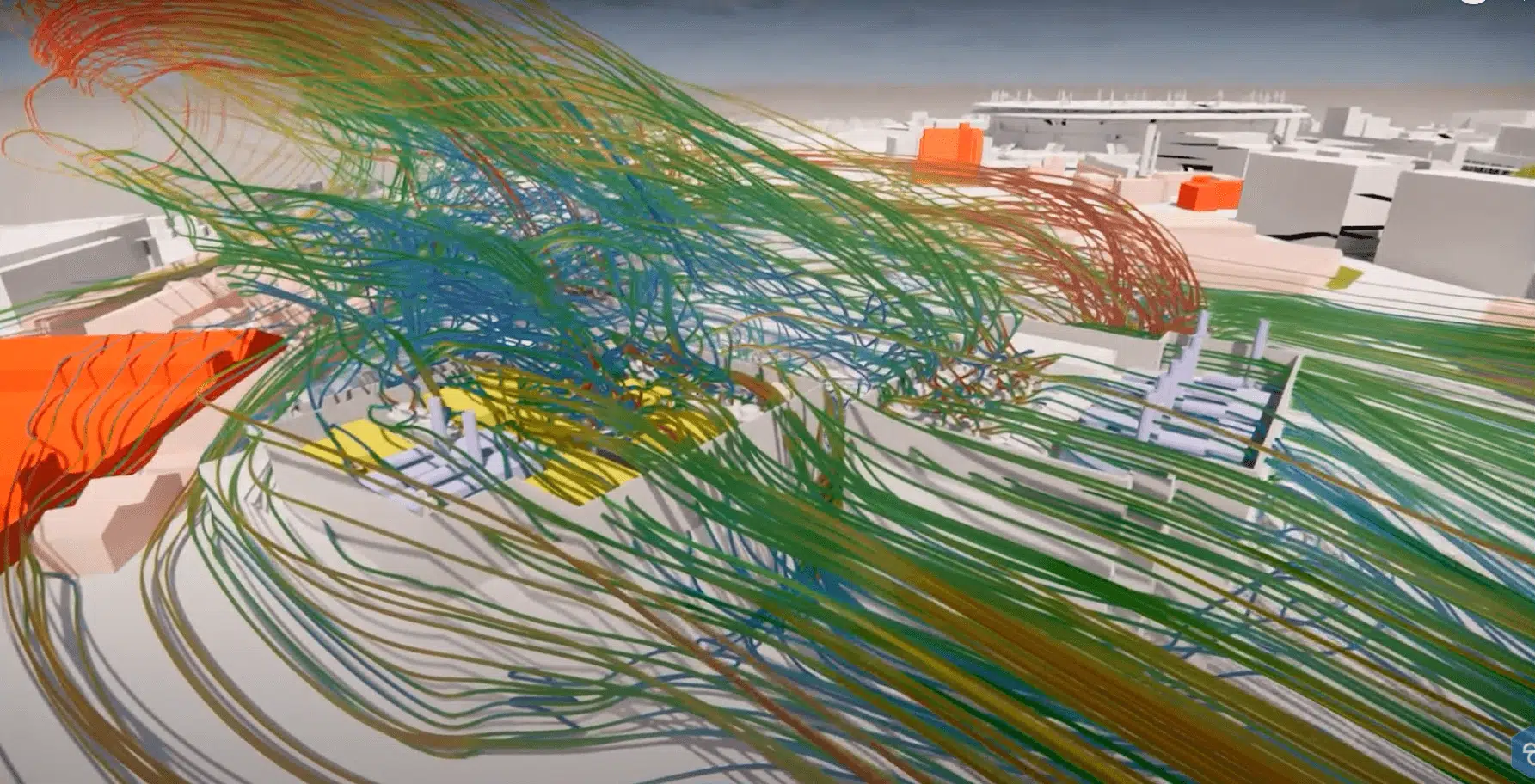
- Makes visible and quantifiable the airflow and thermal phenomena that cannot be observed by eye: flow trajectories, hot-air recirculation zones, temperature gradients, localised overheating, turbulence and pressure variations.
- Relevant where large-scale physical prototypes are unrealistic, to anticipate malfunctions before any change on site.
A predictive, optimising tool
- Assess and compare different configurations virtually before implementation.
- Anticipate the impact of adding/increasing IT load, analyse aisle containment, predict the behaviour in a degraded situation (unit failure).
- Validate solutions without service interruption, limiting risks and extra costs.
Cost reduction & energy performance
- Target the real cooling needs and avoid oversizing.
- Significant drop in HVAC consumption by limiting over-cooling.
- Often, increase the IT capacity without heavy new infrastructure.
Typical applications of CFD in data centers
Critical scenarios simulated
- Air distribution in the cold and hot aisles;
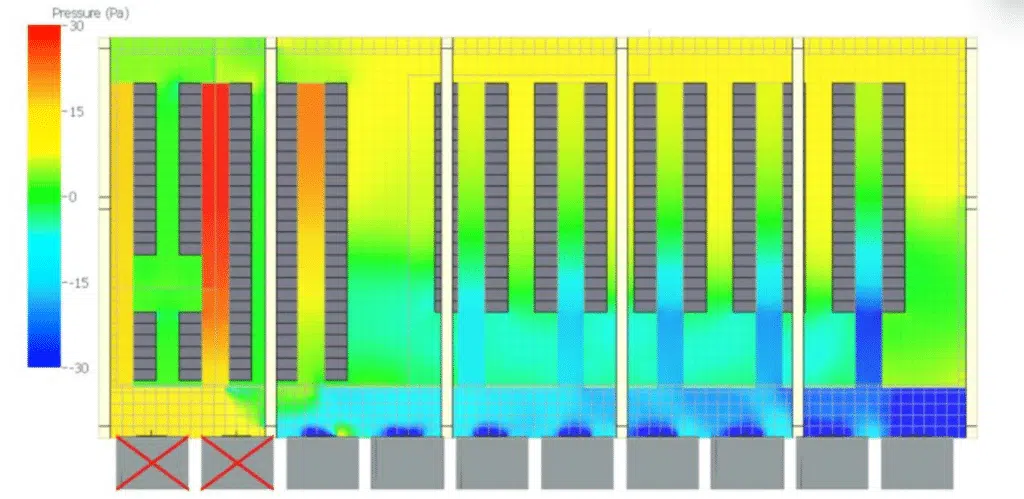
- Pressure under the raised floor;
- Temperature around the systems;
- Performance of the CRAC/CRAH units;
- Containment effectiveness;
- Impact of a cooling-unit failure;
- Consequence of a load variation;
- Comparison between different cooling configurations.
These analyses make it possible to make informed decisions on the design and operation, with a level of precision unattainable by thermal probes alone or empirical experience.
CFD software suited to data centers
The market offers many software packages capable of simulating flows and thermodynamic phenomena: ANSYS, Autodesk CFD, XFlow, OpenFOAM, Phoenics, FlowVision, STAR-CD, TileFlow, Sigma6Room, Gas Dynamics Tool, etc. Some tools (TileFlow, Sigma6) include data-center-specific libraries (fans, air-conditioning units, perforated tiles, IT equipment). Nevertheless, the quality of the analyses depends heavily on the expertise of the CFD specialist, able to adjust the models and rigorously interpret the results.
The process of carrying out a CFD study
1. Data collection
Initial and decisive phase: it conditions the reliability of the simulations. It relies on the analysis of the technical information (layout plans, equipment characteristics, airflow schematics, dissipated powers, nominal operating data) to characterise air velocities, pressures, temperatures and flow rates, and to identify obstacles, preferential paths and leak zones. It establishes a coherent modelling basis, defines the assumptions and sets the boundary conditions.
2. Creating the 3D model
Key step: faithfully representing the data center as a usable digital twin. Built in CAD, it incorporates all the geometric elements influencing the flows and the heat transfer: room size, layout of the racks and telecom cabinets, raised floor (height, position and perforation rate of the tiles), air-conditioning equipment (flow rates, velocities, directions, fan type, supply orientation) and obstacles (cable trays, ancillary structures). This detailed modelling avoids simplifying assumptions and oversizing.
3. Boundary conditions
Fundamental element: they mathematically translate the interaction between the computational domain and its environment, defining on the boundaries the imposed values or the functional relationships of the conserved quantities (velocity, pressure, temperature, flux). Depending on the problem: Dirichlet conditions (fixed value), Neumann (gradient/flux) or mixed; no-slip walls, isothermal or adiabatic; conditions specific to the turbulence models. Their rigorous implementation is essential for numerical stability, convergence and physical representativeness.
4. Mesh
The simulation involves the numerical solving of second-order non-linear partial differential equations. As the structure is made up of an infinite number of points, it is divided into a finite number of nodes and elements: this is the mesh. The software determines the size and distribution of the cells on each edge, surface and volume (according to curvature, gradients, geometric proximity); the mesh is then refined by the engineers in the high-gradient zones.
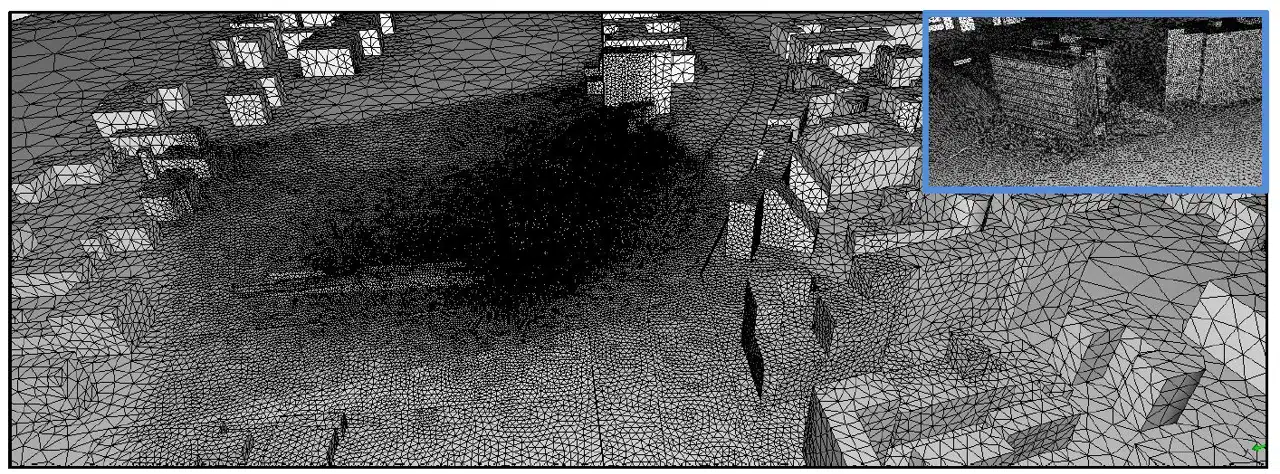
The mesh is of a hybrid type: elements generated without layout constraints, allowing complex geometries while keeping good quality. It combines tetrahedral, prismatic or pyramidal elements in 3D — bringing together the advantages of structured and unstructured meshes. In each finite volume, the conservation equations are expressed in algebraic form.
5. Analysis and optimisation
Final phase: turning the numerical data into concrete improvement levers. The results are used as thermal maps, velocity fields, slices and animations, making it easier to identify the critical zones (hot spots, recirculation, flow imbalances, efficiency losses). Corrective actions are proposed: reorganising the equipment, adjusting the flow rates and supply orientations, modifying the perforated tiles, positioning the air conditioners. The scenarios are iterated to converge towards an optimal thermal and airflow solution.
Summary
CFD simulation software makes it possible to precisely represent fluid flow (liquid or gaseous) and all the associated physical phenomena, in particular heat transfer. Drawing on thermodynamic modelling, it offers an in-depth analysis of the airflow and thermal behaviour — making it possible both to design high-performance systems and to finely optimise existing installations, particularly in complex environments such as data centers.
Without CFD, the reliable assessment of the temperature and airflow distribution would remain largely approximate: these quantities result from the interaction of many parameters — thermal load of the IT equipment, layout and performance of the air-conditioning units, temperatures of the heat-transfer fluids, raised-floor configuration, grille layout, fan characteristics.
By simultaneously integrating all these factors, CFD simulation establishes itself as an indispensable tool to understand, anticipate and control the thermal and airflow behaviour of a data facility, while securing the design choices and improving the overall energy efficiency.
Internal and external CFD studies, failure scenarios, PUE, fire safety: our engineers support you from design to operation.