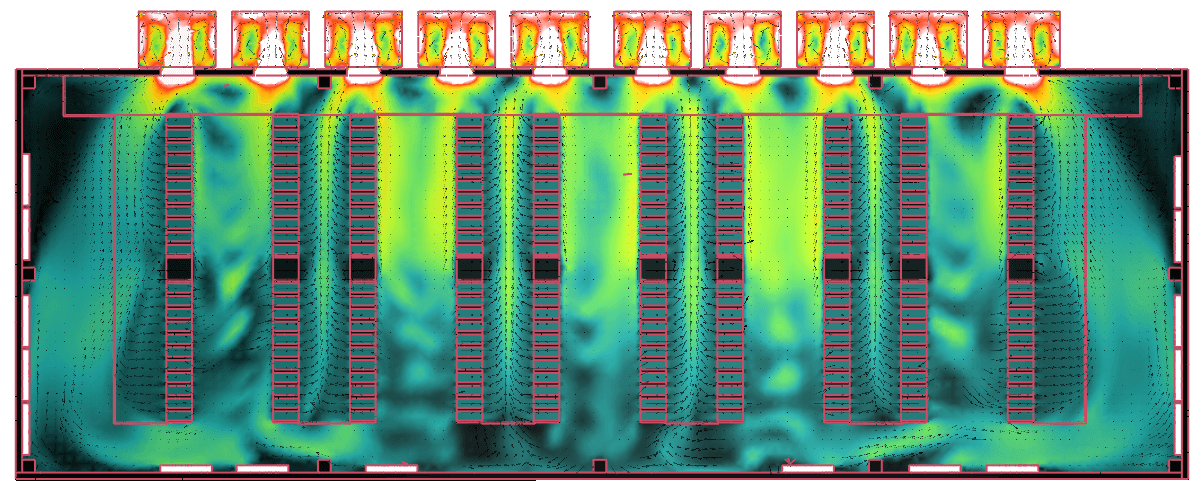

Design of a data center's climate installations: aisle containment, diffusing false ceiling and resilience in the event of a power-supply failure.
EOLIOS Engineering carried out the sizing of the climate installations of a data center, in partnership with IMOGIS. Several crisis scenarios were studied to test the resilience of the air-conditioning systems.
Key point. CFD design study of a data center in Paris (partner IMOGIS). The simulations demonstrate the efficiency of the containment of the hot and cold aisles: without containment, numerous recirculations cause a generalised overheating of up to +20 °C relative to the ASHRAE criteria used. The study validates the diffusing false ceiling and the addition of adjustable grilles, then tests the room in the event of an electrical power-supply failure.
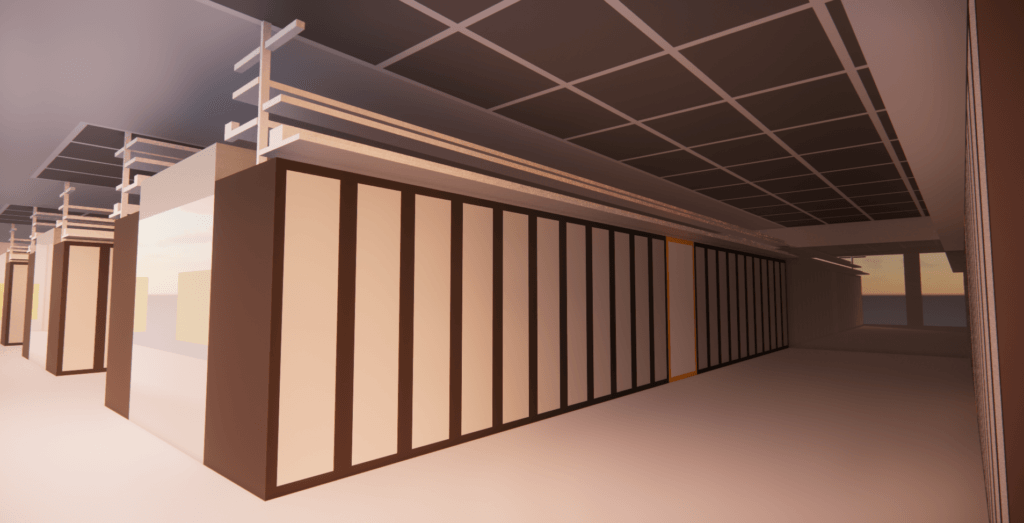
As part of the design of a data center in partnership with IMOGIS, EOLIOS carried out the sizing of the climate installations. The first studies focused on the design of the hot and cold aisles: although this type of design is now well known and mastered, the efficiency of this containment was once again demonstrated.
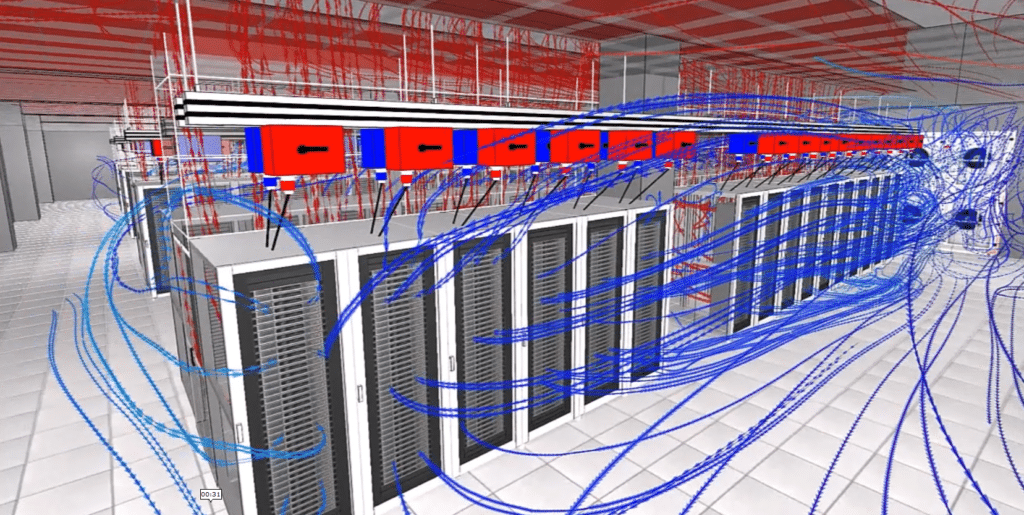
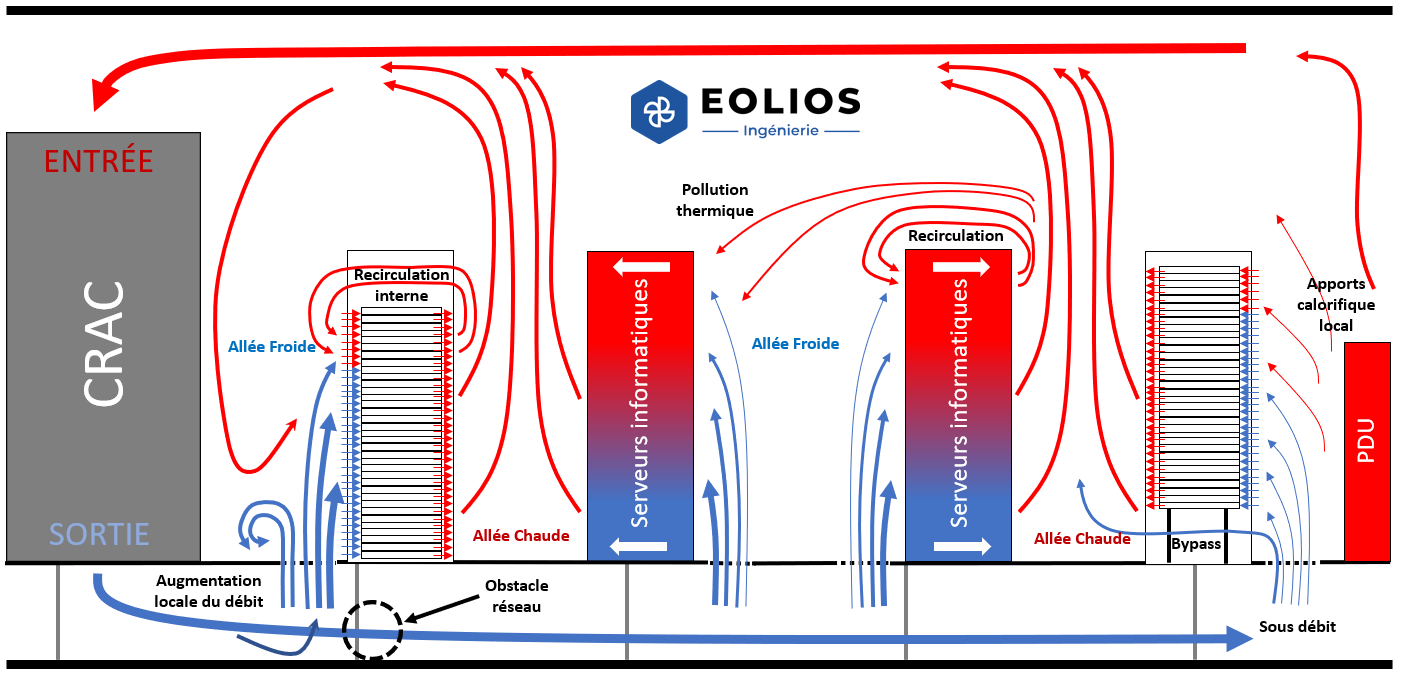
Without containment, numerous recirculations were highlighted, causing a generalised overheating (up to +20 °C relative to the ASHRAE design criteria used). In parallel, the principle of diffusion in the cold aisles was studied.
Physical enclosure of the hot or cold aisles that prevents the air rejected by the servers from mixing with the cold supply air. It removes recirculation, lowers the intake temperatures and improves the energy efficiency of the cooling.

The challenge was to study the risk of hot spots appearing under different critical layouts. The study highlighted the efficiency of the diffusing false ceiling regulation systems, which bring great flexibility in distributing the server powers across the room. Several scenarios made it possible to grasp various unfavourable operating modes.
Global airflow movements were observed, capable of concentrating the heat rejects of the systems, cabinets and lighting at a few unfavourable points. These phenomena were optimised by adding adjustable grilles in certain specific zones of the server hall.
A technical ceiling fitted with adjustable grilles through which the cold air is diffused into the room. Its zone-by-zone regulation offers great flexibility to adapt the cold distribution to the powers actually installed.
Key takeaway. Aisle containment and a diffusing false ceiling with adjustable grilles are often enough to remove recirculation and absorb very heterogeneous layouts, without oversizing the cold production.

The diffusing false ceiling turns the upper plenum into a controllable supply surface: instead of a uniform flow rate, each zone receives the cold air through adjustable grilles whose opening is tuned. This granularity is decisive in a room where the powers per rack are heterogeneous and change over the operating phases. Here CFD serves to link, zone by zone, the diffused flow rate to the thermal load actually dissipated under the grille.
Load mapping: transferring the server powers rack by rack onto the ceiling plan.
Opening adjustment: modulating the grille opening rate to align the flow rate with the local load.
Control of global movements: identifying the airflow loops that concentrate the rejects at a few points.
Controlled air return: verifying that the hot air reaches the return without short-circuiting the cold aisles.
A buffer volume, here in the upper part, kept at a slight overpressure and from which the cold air is distributed to the room through grilles. Its pressure and the grille opening rate set the flow rate delivered at each point.
The ability of an installation to reallocate the available cold towards the zones that need it, without oversizing the whole. A false ceiling with adjustable grilles achieves this through local adjustment rather than by adding power.
Key takeaway. The value of a diffusing false ceiling lies in its control: it is the fine adjustment of the grilles, validated by CFD, that absorbs the heterogeneous layouts without oversizing the cold production.
Designing the climate installations of a data center through simulation requires a rigorous computation chain, where every assumption is traced before the results are used. The numerical model only has value if it faithfully reproduces the physics of the room: forced convection of the recyclers, natural convection of the hot plumes, conduction in the partitions and radiation between surfaces. The strength of the approach is to make quantifiable, from the design stage, what would otherwise remain an engineer's intuition.
Geometric modelling: reproducing the room volume, the racks, the recyclers and the diffusing false ceiling at real scale.
Meshing: dividing the air volume into computation cells, refined at the grilles, the aisles and the rack inlets where the gradients are strongest.
Boundary conditions: supply flow rates and temperatures, powers dissipated per rack, wall properties and regulation setpoints.
Turbulence model: closure of the averaged Navier-Stokes equations to reproduce the real mixing of the air.
Convergence & exploitation: verifying the stability of the residuals, then temperature, velocity and pressure maps usable rack by rack.
Dividing the air volume into elementary cells where the flow and heat-transfer equations are solved. A fine mesh better reproduces the gradients near the grilles and the racks, at the cost of a higher computation time; the art lies in refining it where it is useful.
A set of additional equations that represent the effects of the eddies on the mean flow without solving them one by one. It conditions the accuracy of the simulated air mixing in the aisles and around the racks.
Key takeaway. The reliability of a design study depends as much on the quality of the mesh and the boundary conditions as on the computing power: a well-posed model turns the climate sizing into a measurable decision rather than an endured safety margin.

Once the design was optimised, studies of utility power-supply failure estimated the extreme maximum temperatures and the duration of threshold exceedance for the most unfavourable servers.
Recommendations concerned the installation of UPS units for certain regulation systems, in order to accelerate the restart of the backup systems and limit the temperature rise of the room.
An uninterruptible power supply that maintains electricity during the switchover to the backup generators. Powering the regulation systems via a UPS accelerates the recovery of the ventilation and limits the temperature rise during an outage.
Containment, diffusing false ceiling and power-supply failure: answers to the questions designers and operators ask before a CFD study.
Without containment, numerous recirculations appear and cause a generalised overheating, up to +20 °C relative to the ASHRAE criteria. Containment removes the mixing of the flows and makes the cooling reliable, as also shown by our internal study of the DC28 data center.
Its adjustable grilles offer great flexibility to distribute the cold according to the server powers actually installed, zone by zone, and to absorb heterogeneous layouts.
The study simulates different critical layouts to locate the concentrations of heat rejects, then adds adjustable grilles in the specific zones concerned to rebalance the diffusion.
Studies of a utility-grid outage estimate the extreme maximum temperatures and the duration of threshold exceedance for the most unfavourable servers, until the backup systems restart.
Powering certain regulation systems via a UPS accelerates the restart of the backup and limits the temperature rise of the room during the switchover.
Explore our expertise, projects and technical papers to go beyond the FAQ.
Visualisation of the recirculation in the data center and of the effect of the aisle containment.
Digital twinData center study – Data Hall and UPS rooms
Smoke controlSmoke-control engineering in a data center
HyperscaleExternal & internal CFD – Hyperscale Data Center
OptimisationCFD optimisation – Data Center
InternalData Center – DC28 – Internal
Technical roomsTechnical rooms – Data Center
CoolingCooling optimisation – Data Center
ExternalData Centers – DC15.1 & DC15.2 – External
ExternalData Center – PA 22 – External
GeneratorPressure-loss study – Generator – Data center
ExternalData Center – Paris
FireData Center – NOVEC gas
InternalData center – DC17 – Internal
ExternalData center – D14 – External
ExternalData center – DC25 & DC26 – External
InternalData Center – DC10 – Internal
ExternalData Center – DC25 & DC26 – External
CFD expertise, delivered projects and technical dossiers: the whole Data Center field in one place.