
Impact of wind on a high-rise building
Impact of wind on a high-rise building
Year
2026
Customer
LA CAENNAISE
Location
Caen, France
Typology
Air & wind
Our other projects :


Home » Air & Wind » Simulation of wind pressure on buildings – Eurocode 1 » Impact of wind on a high-rise building
Wind impacts on a high-rise building: CASCADES Tower in Caen
CFD: A tool for solving wind dimensioning problems
As part of the construction of a new high-rise building in Caen, EOLIOS carried out a comprehensive CFD study to analyze the effects of wind in a dense urban environment, in terms of both speeds and pressures. The approach combines Eurocode meteorological analysis, ASHRAE data and multi-directional numerical simulations to guarantee the safety and comfort of future users.
EOLIOS is a leader in external CFD simulation of wind issues. Our studies are based on feedback from measurement campaigns under real conditions and from a hundred or so simulated sites around the world.
Study of wind loads: framework and simulation tools
Context and objective of a numerical study of extreme winds
The CASCADES tower is a high-rise building located in Caen (Calvados department). As part of its construction, it was essential to precisely analyze the influence of wind on the structure and its immediate environment. The results of this study are a key step in guaranteeing the performance, safety and durability of the structure in the face of wind action.
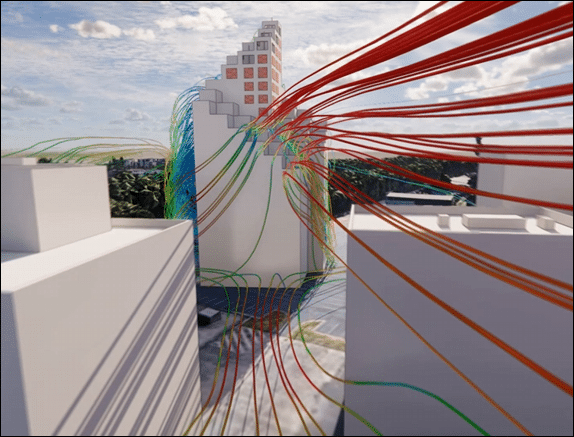
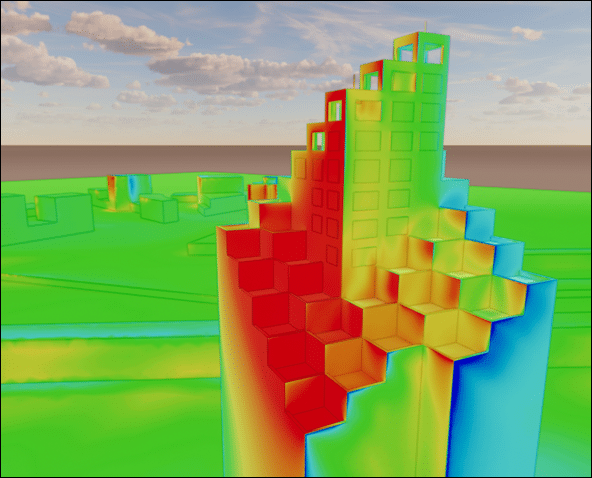
The main objectives of the mission were as follows:
- Identify the most unfavorable wind conditions to which the site may be subjected
- Characterize the site effects generated by the shape of the building and neighboring structures;
- Mapping air speeds around the tower for eight main directions
- Determine the pressures exerted on all tower walls (facades, windows, mosaics, masts)
- Identify risk zones and maximum pressures reached
- Assessing wind comfort on terraces in medium wind conditions
Why use CFD to study the impact of wind on a tower?
Computational Fluid Dynamics(CFD) numerically solves the partial differential equations governing fluid flows. Applied to buildings, it provides precise information on air velocities, pressures and aerodynamic phenomena occurring around and inside structures, even on complex structures and taking the environment into account.
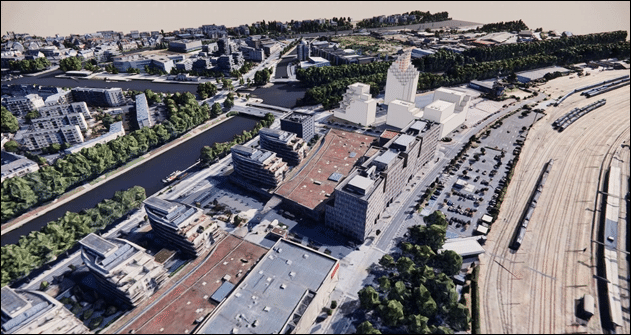
A 3D model specifically adapted to the digital resolution was created from plans supplied by the customer and satellite images. The geometry incorporates the CASCADES tower as well as all surrounding buildings likely to generate significant aeraulic masks. Details of geometry with low aerodynamic impact are deliberately simplified to concentrate computing power on areas of interest.
Origins and characterization of on-site winds
Wind profile used for simulations
The wind observed at ground level is strongly influenced by the vertical structure of the atmospheric boundary layer, which breaks down into three distinct sub-layers: the rough sub-layer (a few meters), the surface boundary layer (10 to 100 m), the seat of strong velocity gradients, and the outer layer or inertial sub-layer (up to ~1 km), little disturbed by topography. Wind speed increases with altitude according to a logarithmic profile – a phenomenon known as vertical shear – which is at the heart of all CFD modelling of urban sites.
Calculation of extreme wind speeds over a 50-year period using the EUROCODE standard
Extreme wind speeds over a 50-year return period were determined in accordance with Eurocode standard NF EN 1991-1-4, the regulatory reference for calculating wind actions on structures. This approach is based on the use of reference wind speeds defined on a national scale, corrected for local site characteristics: terrain roughness, topography, altitude and surrounding terrain category. The calculations provide design wind speeds associated with a rare but statistically representative meteorological event over the lifetime of the structure. These extreme speeds constitute the input data for CFD simulations, and are used to design exposed facades, roof elements and equipment to ensure the tower’s stability and safety in the face of the most severe aerodynamic stresses.
Results of numerical studies of extreme winds: Pressure and speeds
Wind speeds, gusts and site effects
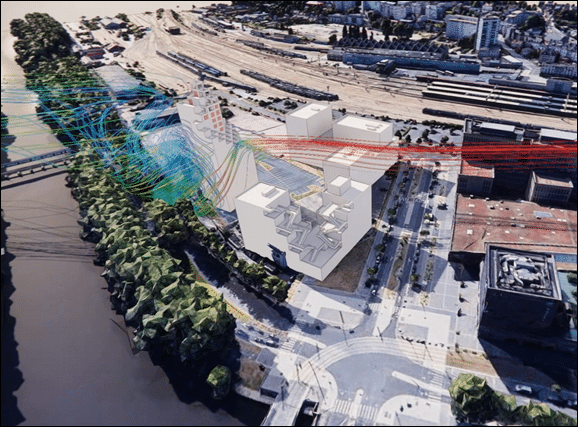
The multi-directional analysis revealed several significant aerodynamic phenomena around the tower:
- Edge accelerations:the tower’s vertical edges generate localized overspeeds and turbulent vortices for all wind orientations.
- Venturi effect:to the west, a corridor formed by upstream buildings channels the flow, significantly amplifying velocities and generating the maximum pressure observed on façade mosaics.
- Direct exposure:to the east, the absence of upstream buildings directly exposes the tower to the incident wind, leading to the highest pressures on the masts.
- Shelter zones: for certain orientations, the presence of surrounding buildings generates recirculation zones that partially protect the tower from maximum stress.
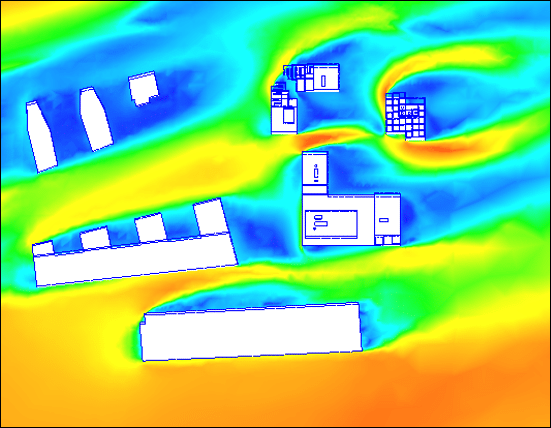
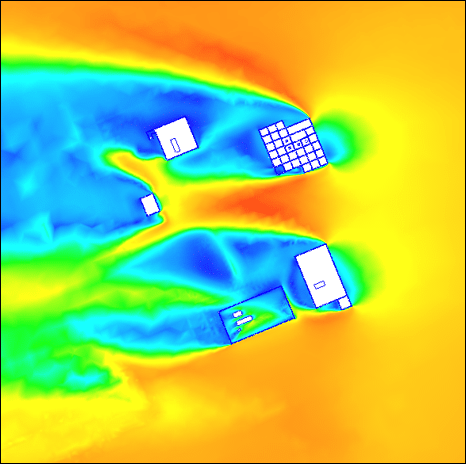
The lower part of the tower benefits from the shelter afforded by the surrounding buildings; conversely, the upper levels – extending beyond the urban fabric – are directly exposed to the incident wind, generating maximum stresses on facades and roof elements.
Study of pressures on walls and sensitive areas
CFD simulations were used to determine the pressure fields exerted by the wind on all of the tower’s surfaces for the various directions studied. For each facade element, minimum and maximum pressures were calculated in order to identify the extreme stresses likely to occur in the operational phase or during severe wind events. This approach provides a complete envelope of the aerodynamic loads applied to the structure and its add-on elements.
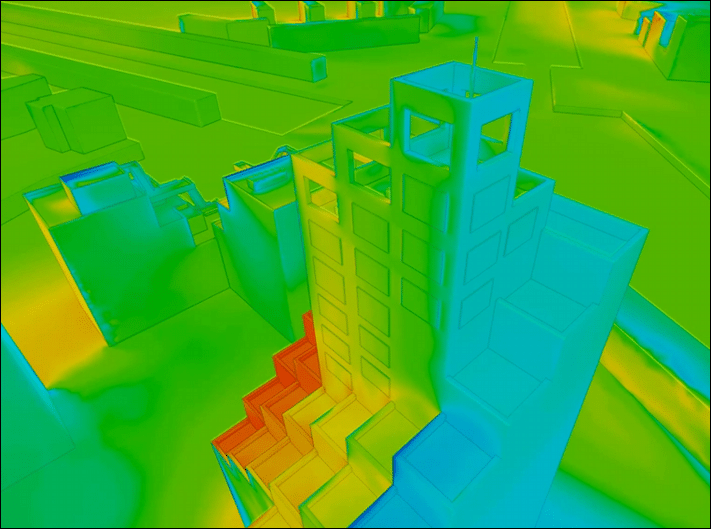
The results highlight the coexistence of positive and negative pressures, depending on façade orientation and local flow dynamics. Positive pressures correspond to areas of direct impact of the wind on the façade: the flow compresses the surfaces and applies a force directed towards the interior of the building. Negative pressures, on the other hand, reflect suction generated by flow separations and recirculation zones; forces are then directed towards the outside of the structure. This distinction is particularly important when dimensioning façade elements and fastening systems, as some components are more sensitive to pull-out phenomena than to compressive forces.
Local zooming was therefore carried out on areas considered to be sensitive in the project, in order to obtain a detailed reading of aerodynamic loads. Specific analyses were carried out on light masts, facade mosaics, windows and railings, in order to precisely characterize the pressure levels reached and guide the sizing of exposed elements.
Comparing numerical results with sourced values
Comparison of the CFD results with the analytical values of the Eurocode standard (NF EN 1991-1-4) in a simplified case (no surrounding buildings, headwind) confirms good consistency between the two approaches. The pressures obtained by numerical simulation are contained within the pressure range calculated according to the standard, the latter remaining more conservative – which validates the relevance of regulatory dimensioning for resistance to wind loads on facade elements.
CFD analysis of wind at height: summary of results and contributions
Ensuring occupant comfort at height
Comparison of the CFD results with the analytical values of the Eurocode standard (NF EN 1991-1-4) in a simplified case (no surrounding buildings, headwind) confirms good consistency between the two approaches. The pressures obtained by numerical simulation are contained within the pressure range calculated according to the standard, the latter remaining more conservative – which validates the relevance of regulatory dimensioning for resistance to wind loads on facade elements.
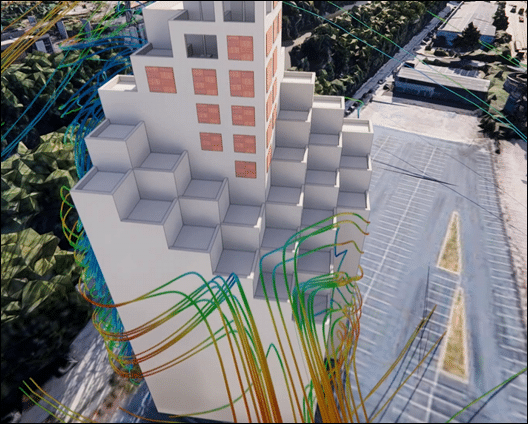
The comfort study is conducted for the prevailing annual mean wind speed – the scenario most representative of terrace use conditions (summer, mid-season). The velocity fields for each terrace level enable us to identify :
- Zones of optimal comfort, protected by architectural elements
- Local acceleration zones to be addressed in design (guardrails, windbreaks)
- Exposed terraces requiring specific recommendations
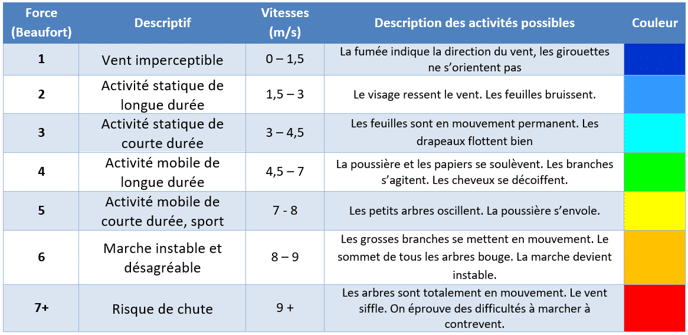
Interpretation of wind comfort according to the Beaufort scale (high-rise buildings and terraces)
The analysis of wind speeds on the various terraces is interpreted using the Beaufort scale, an international reference for relating flow speeds to the effects felt by users. This scale, which ranges from 0 to 12 levels, provides a qualitative and quantitative assessment of wind intensity, from totally calm conditions to strong winds that can limit or even prohibit certain outdoor activities.
In the context of a high-rise building, this reading is particularly relevant, as it enables CFD results to be translated into comfort criteria that can be used directly by the design and architecture teams. The zones identified as being below the discomfort thresholds generally correspond to spaces that are favorable to appropriation by users, while the upper levels of the scale (Beaufort 5 and above) reflect potentially uncomfortable conditions requiring protective devices or a reconfiguration of uses.
Optimizing aeraulic comfort and design recommendations for IGH terraces
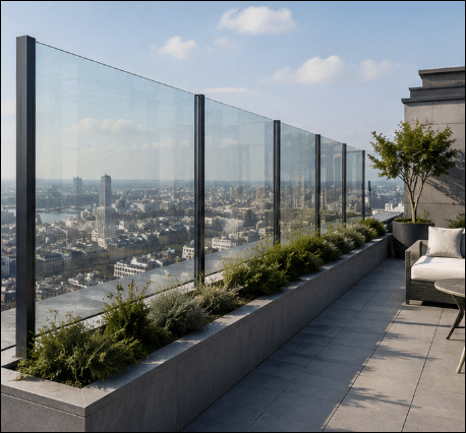
Over and above the simple identification of comfort zones, the CFD study enables us to orientate design and mitigation principles aimed at improving the aeraulic behaviour of the terraces. Analysis of the velocity fields highlights acceleration zones associated with roof overhangs, tower corners and geometric discontinuities.
To improve user comfort, several design levers can be considered: installing solid or semi-permeable railings, adding architectural windbreaks, creating buffer volumes or optimizing the layout of furniture and walkways. These devices reduce wind speeds locally and limit turbulence phenomena, thus significantly improving the comfort of use of terraces in average annual wind conditions. This integrated approach between numerical simulation and architectural recommendations ensures a balance between aeraulic performance, user safety and the quality of outdoor uses at height.
CFD analysis of wind at height: summary of results and contributions
Understanding the effects of wind on a high-rise building using CFD
The CFD study carried out on the CASCADES tower highlighted the main aerodynamic behaviours of the site, including local accelerations, channelling effects, recirculation zones and high exposures at the top of the structure. This numerical approach provides a detailed, spatialized and multi-directional analysis of velocities and pressures, far more refined than a purely analytical approach.
Unlike Eurocode methods, which are voluntarily enveloped and simplified, CFD integrates the real geometry of the project as well as its built environment, enabling better representation of site effects and local stress concentrations. It is thus an essential complementary tool, providing a more realistic and operational understanding of wind actions on high-rise buildings.
Reducing wind nuisance on buildings: CFD benefits and applications
CFD studies of this type are part of current practice applied to high-rise buildings and complex urban environments, where they are used for façade dimensioning, optimization of exposed elements and analysis of exterior comfort. They are particularly relevant when analytical approaches reach their limits due to geometric complexity and urban interactions, offering a more faithful three-dimensional representation of flows. In the future, these tools can be extended to other issues such as outdoor thermal comfort, pollutant dispersion or energy optimization on an urban scale, confirming their growing role in the integrated design of architectural and urban projects.
Video summary of the study
Summary of the study
As part of the construction of a new high-rise building in Caen, EOLIOS carried out a comprehensive CFD study to analyze the effects of wind in a dense urban environment, in terms of both speeds and pressures. The approach combines Eurocode meteorological analysis, ASHRAE data and multi-directional numerical simulations to guarantee the safety and comfort of future users.
Video summary of the mission
Discover other Air & Vent projects
Impact of wind on a high-rise building
CFD air quality control study – Issy underground RER station construction site
Controlling wind erosion on a solar power plant
Securing a commercial site – CFD study of wind risk
Fine particle capture in a metro station
Impact of wind on a solar power plant
Study of aeraulic comfort – Middle school
Wind comfort study – Rooftop
Wind impacts on high-rise buildings: Tours Olympiades in Paris
Comfort – Rooftop of a palace – Casablanca
Tour Liberté – La Défense
Cooling towers – ICPE
Pedestrian comfort study – La Défense
Confort au Vent – PSG training center
Wind study – La Défense
Sharaan by Jean Nouvel resort
Air coolers – Critical study – Heat wave
Fine dust measurements
Balenciaga – Wind potential