

Contamination study – Pharmaceutical production lines
Étude de contamination - Lignes de production pharmaceutique
Year
2025
Customer
NC
Location
France
Typology
Laboratoires
Home » Laboratories » Study of dust in clean rooms » Contamination study – Pharmaceutical production lines
Study of a pharmaceutical production building
EOLIOS expertise in aeraulic modelling and particle diffusion
EOLIOS Ingénierie was asked to analyze air flows and particle dispersion within a production laboratory. Thanks to an on-site audit, and several associated CFD simulations, our engineers characterized air movements, identified sensitive areas, understood the mechanisms that could lead to cross-contamination between production lines, and proposed concrete solutions to avoid such contamination.
This expertise enables us to provide tailored solutions to improve air quality, flow control and laboratory safety.
EOLIOS is a leading player in CFD simulation applied to complex indoor environments, drawing on extensive feedback from measurement campaigns and numerous studies carried out on real sites.
Controlling air flows in laboratories: minimizing the risk of cross-contamination
Air as a vector for particles
In a cleanroom,air is never neutral: it transports, dilutes or concentrates fine particles from processes, operators or equipment. The slightest fault in blowing, unexpected recirculation or localized turbulence can cause dust to be dispersed towards sensitive areas or adjacent workstations. Understanding how air actually circulates is therefore essential to controlling the risk of cross-contamination, particularly in pharmaceutical environments where product quality depends directly on aeraulic stability.
Case study: the risk of cross-contamination between production lines
In this laboratory, five production lines operate in parallel. During each cycle, the bagging machines release a small quantity of product into the air at the time of sealing: this is a normal phenomenon, inherent to the process, but it becomes problematic when the environment is not compartmentalized. In this work area, the lines are not physically isolated from each other. Air circulates freely over the workstations, allowing dust to disperse from one line to another. This particle transfer creates a risk of cross-contamination, with quality, cleanliness and compliance issues at stake, making it essential to control air flows.
Understanding air flows with an audit
Smoke test
An initial audit phaseidentified the air’s behavior through smoke tests. These tests revealed several noteworthy phenomena.
Firstly, the helical grilles used blow the air parallel to the ceiling, rather than vertically, creating recirculation zones which allow low-level particles to rise and be diffused.
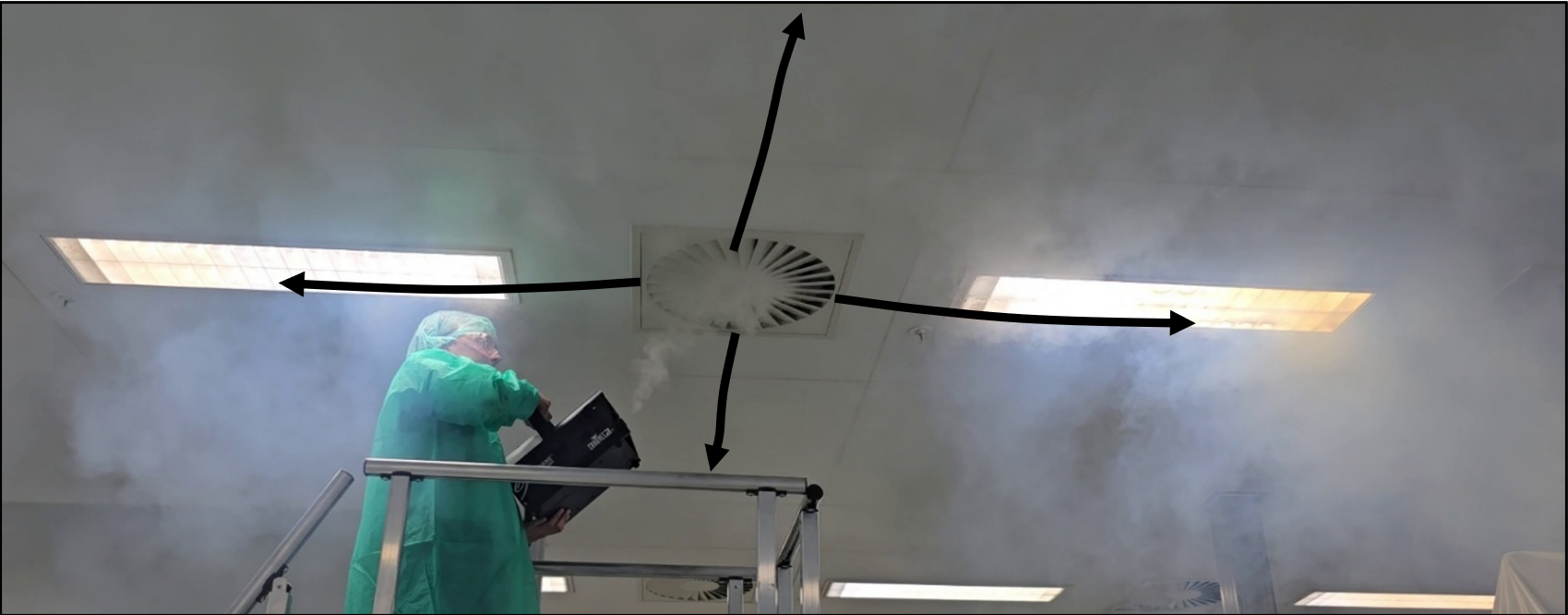
As a result of this parallel blowing, the air flow runs along the ceiling, and in particular manages to pass over the central partitions, which are open at the top. This reduces the risk of contamination in the area.
Finally, it was found that the particles propagate in the corridor allowing users to move from one line to another, creating a potential source of contamination.
These results confirm that the initial configuration does not guarantee effective containment, notably due to the horizontal blowing of the helical grilles.
Thermal camera
It is important to carry out a thermal study of the room to be studied, as hot spots, if they exist, are likely to significantly modify the local aeraulics.
The thermal camera study reveals the presence ofheating elements linked to the sealing of bags and other devices, rising in temperature up to 65°C, which can locally disrupt air flows and create rising zones.
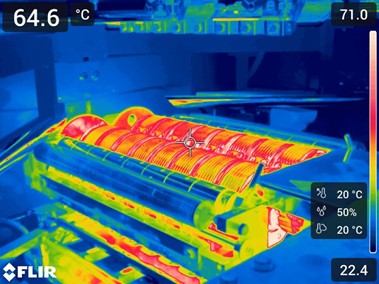
These measurements were used to complete our understanding of actual flow behavior and to provide input for CFD modeling.
Optimizing a configuration with CFD
3D modeling and simulation of various configurations
A complete 3D model of the production room was produced to guarantee the accuracy of the CFD results. To do this, EOLIOS engineers relied on audit measurements, site plans and technical documentation of the various elements likely to influence the room’s thermo-aerodynamic behavior.
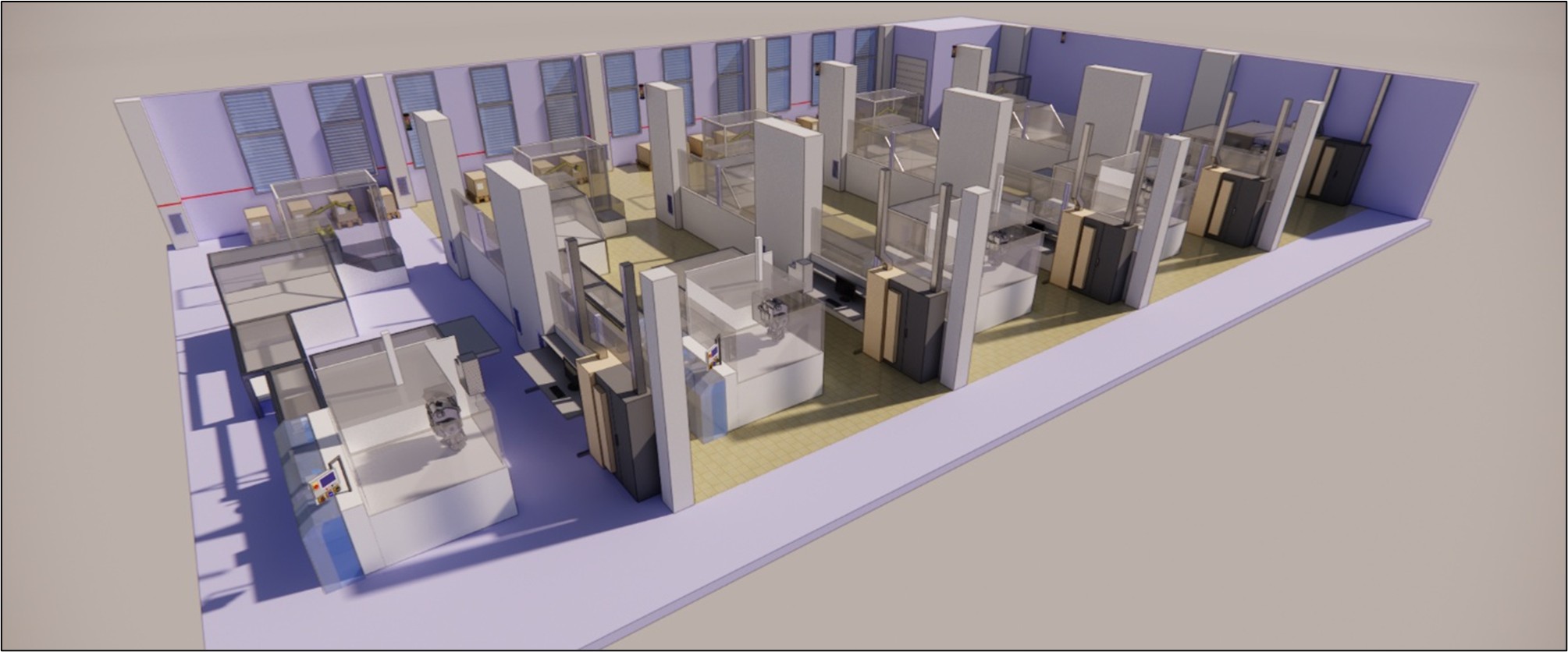
Three scenarios were studied: the existing configuration, theaddition of partitions, and an optimized configuration with modified diffusers.
Configuration 1 - Current situation
This simulation studies the original configuration, without any design modifications. It serves both as a reference simulation, and to check the model’s consistency with the measurements taken during the audit.
Initial results confirm the findings made during the audit: the horizontally-blowing swirl diffusers generate recirculation, allowing particles emitted at low altitude to rise to higher levels, where they are subsequently diffused, notably through the opening located above the central partitions. In addition, some of the particles pass through the corridor near the bagging machines, contaminating the adjacent line.
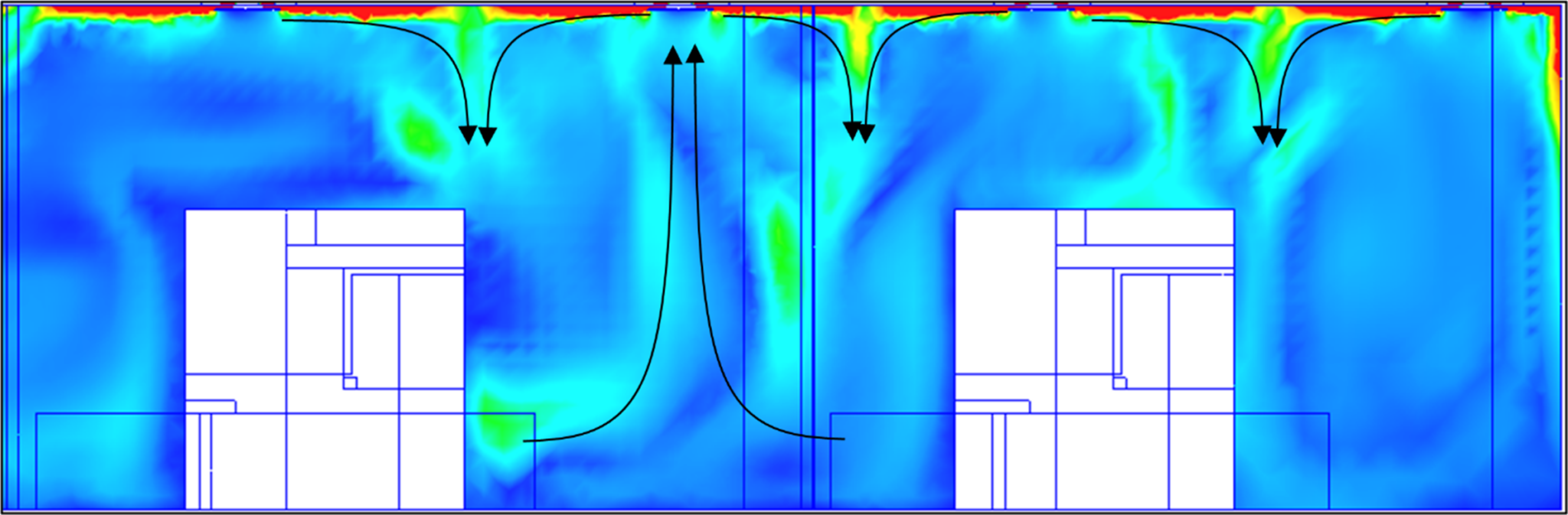
Configuration 1 - Current situation
Since it was found thata significant proportion of particle transmission took place above the central partitions and via the corridor, it was proposed to partition off these areas, in order to eliminate the flow at these points.
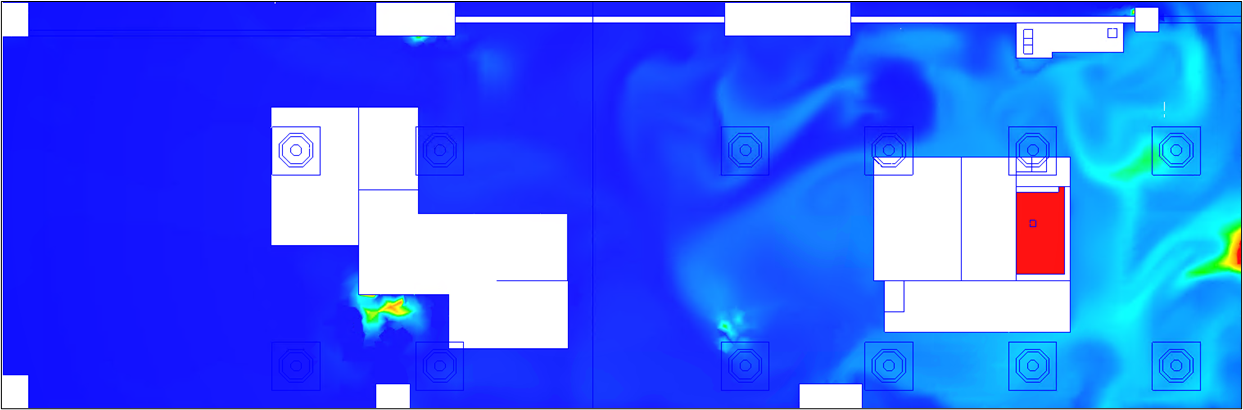
Closing the partitions significantly improves containment between the chains, but the recirculation created by the horizontal diffusers remains. As a result, the bagging zone is highly concentrated in particles, since low-level particles are redirected upwards, but are no longer diffused towards neighboring lines.
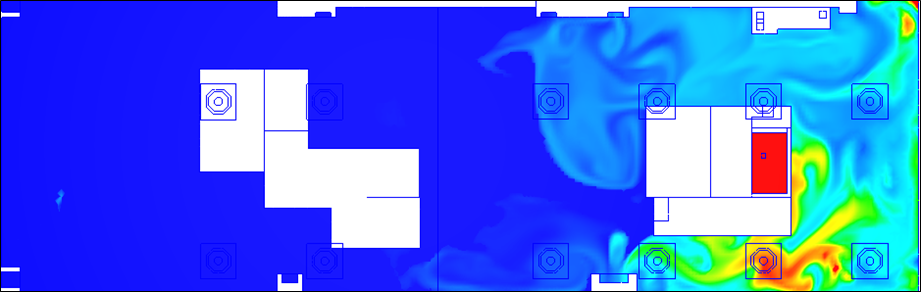
Partitioning the line has limited the spread of particles to other lines. However, the concentration of particles in the operators’ work areas is very high, which could pose a health risk.
Configuration 3 - Vertical diffusers & optimized partitioning
The final configuration combines :
- Closing the upstream corridor;
- Closing the central partitions;
- Replacement of swirl grilles with square, vertically-blown diffusers.
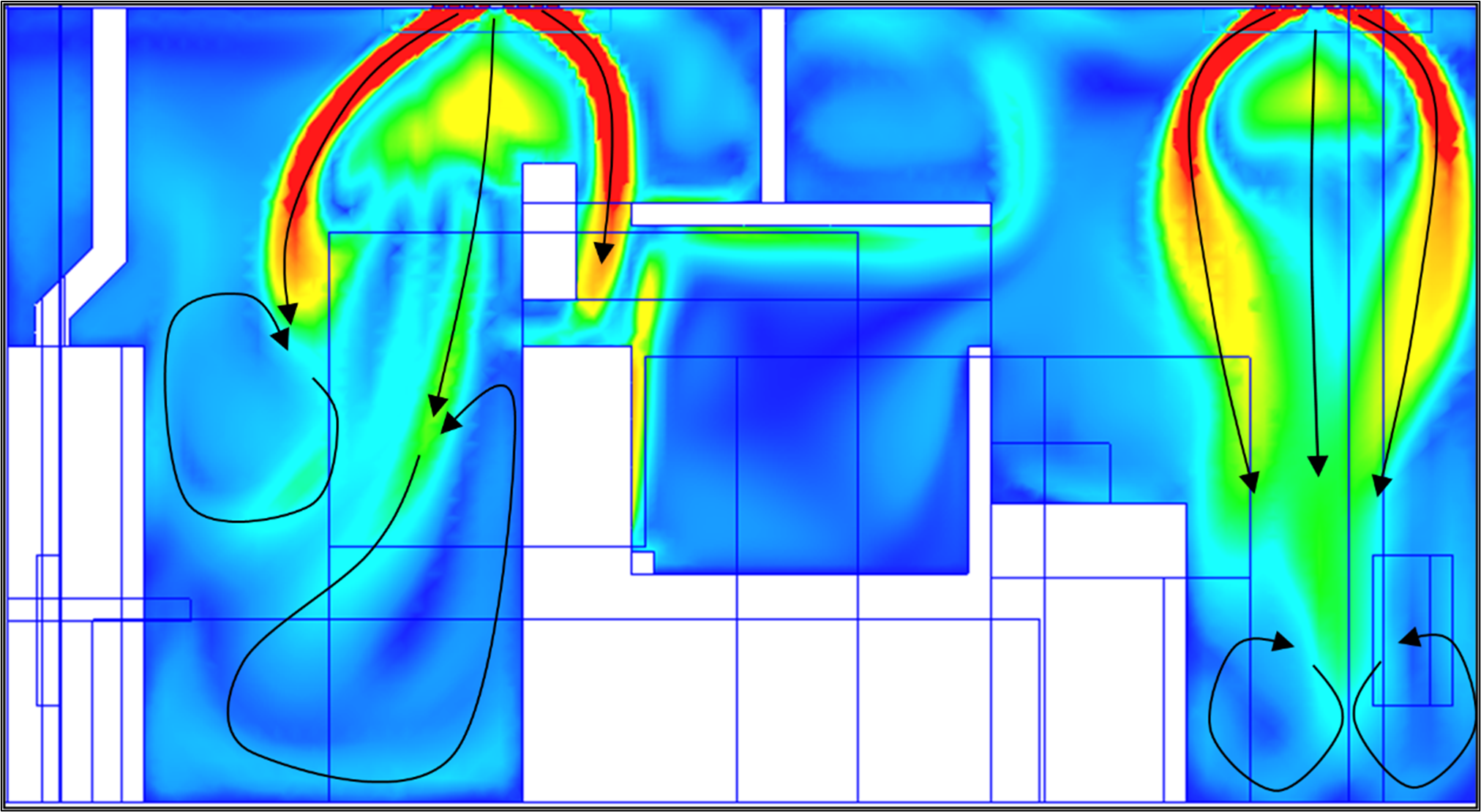
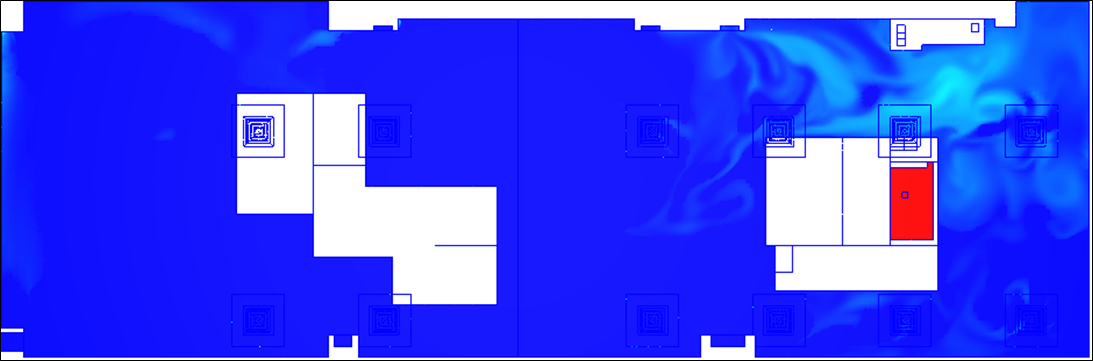
Changing the air discharge grilles has visibly reduced the recirculation zones present in previous configurations. As a result, the strong updrafts under the grilles have disappeared, severely limiting the opportunities for particles to rise to higher altitudes for subsequent diffusion. Instead, particles are redirected towards the recovery grids located on the walls at the bottom.
The study: validate, correct and secure long-term control of air flows and particle dispersion
CFD for cross-contamination control
The CFD study carried out by EOLIOS in this multi-line cleanroom provides a detailed and operational understanding of the particle dispersion phenomena generated during sealing operations. Each sealing cycle diffuses a very small quantity of product into the air, a normal but critical phenomenon when several lines share the same volume.
Thanks to realistic modeling of the laboratory, equipment, blowers and physical barriers, the analysis enables us toidentify precisely how air flows transport these particles from one line to another. The study highlights sensitive areas, validates or invalidates existing configurations, and proposes concrete adjustments to limit recirculation and reduce the risk of cross-contamination.
The added value of digital simulation: making the invisible visible
CFD makes it possible to visualize phenomena that are impossible to measure directly:
- Complex air movements ;
- Recirculations above partitions ;
- Stagnant zones ;
- Probable particle trajectories ;
- Real efficiency of blowers and compartments.
This rigorous approach makes it possible to take targetedaction, identifying weak points in the system and virtually testing different modifications (partitions, types of grilles, compartmentalization of the upstream corridor, etc.).
A real decision-making tool
Simulation is a strategic tool here: not only can it objectively evaluate existing devices, it can also anticipate faults linked to geometry, layout or blowing mode. By visualizing flows and quantifying the impact of each change, CFD transforms prevention into informed decision-making.
An approach to quality and performance
Beyond immediate analysis, this study is part of a continuous improvement process:
- Reduce dust at source ;
- Reinforce the separation between lines;
- Optimizing blowers;
- Design more robust and controlled environments.
For sensitive industrial environments (pharmaceuticals, cosmetics, food, electronics, etc.), CFD becomes an essential management tool: controlling air flows, limiting cross-contamination and guaranteeing the conformity of production areas to tomorrow’s requirements.
EOLIOS Ingénierie's expertise in cleanroom air quality and flow control
The study carried out by EOLIOS at this pharmaceutical laboratory demonstrates the value of an approach combining on-site audit and digital simulation. By visualizing air flows, recirculation zones and particle trajectories invisible to the naked eye, the team was able to identify the real mechanisms of cross-contamination between production lines, and assess the impact of the proposed layouts.
This approach, halfway between advanced aeraulic engineering and a detailed understanding of industrial processes, illustrates EOLIOS’ ability to help laboratories find reliable, practical solutions tailored to their production constraints. Thanks to an objective analysis and comparative scenarios, the study was able to steer the technical choice towards a more stable, more homogeneous blowing configuration that significantly limits the resuspension of dust.
Through this expertise, EOLIOS contributes to securing sensitive environments, reducing the risk of contamination, and guaranteeing more controlled and sustainable operation of pharmaceutical production facilities.
Find out more:
Video summary of the study
Summary of the study
The study carried out by EOLIOS in this pharmaceutical production building highlights the importance of a global approach combining field audit and advanced digital simulation to sustainably control the risks of cross-contamination. By finely analyzing air flows, recirculation zones and particle trajectories generated by bagging operations, the engineers were able to understand the actual dispersion mechanisms between production lines and identify the limits of the existing configuration.
Several scenarios were objectively compared using realistic CFD modeling, integrating equipment, heat sources and blowing devices. This approach enabled us to assess the effectiveness of partitioning, measure the impact of horizontal diffusers and demonstrate the benefits of an optimized configuration combining compartmentalization and vertical air discharge. The solutions adopted limit recirculation, significantly reduce the resuspension of dust and promote the evacuation of particles towards the exhaust, while at the same time improving working conditions for operators.
At the crossroads of aeraulic engineering, understanding of industrial processes and pharmaceutical regulatory requirements, this study illustrates EOLIOS’ ability to transform invisible phenomena into concrete decision-making levers. By providing reliable recommendations, adapted to site constraints and validated by simulation, EOLIOS contributes to securing sensitive environments, boosting production quality and guaranteeing more controlled, sustainable operation of pharmaceutical facilities.
Video summary of the mission
Discover other laboratory projects
Contamination study – Pharmaceutical production lines
Dust dispersion study – Geology laboratory
HVAC – Medical equipment warehouse
VOC treatment process improvement
Cleanroom aeraulics
Pharmaceutical Laboratory – Dust
Qualification of fume cupboards – Laboratory
Study of a clean room